
American companies waste over $150 billion annually on underutilized office space—that’s 40% of all commercial real estate sitting empty while businesses struggle with rising costs. For commercial real estate leaders navigating today’s challenging economic landscape, this statistic represents more than just inefficiency; it’s a massive opportunity to reclaim resources and drive meaningful impact to the bottom line.
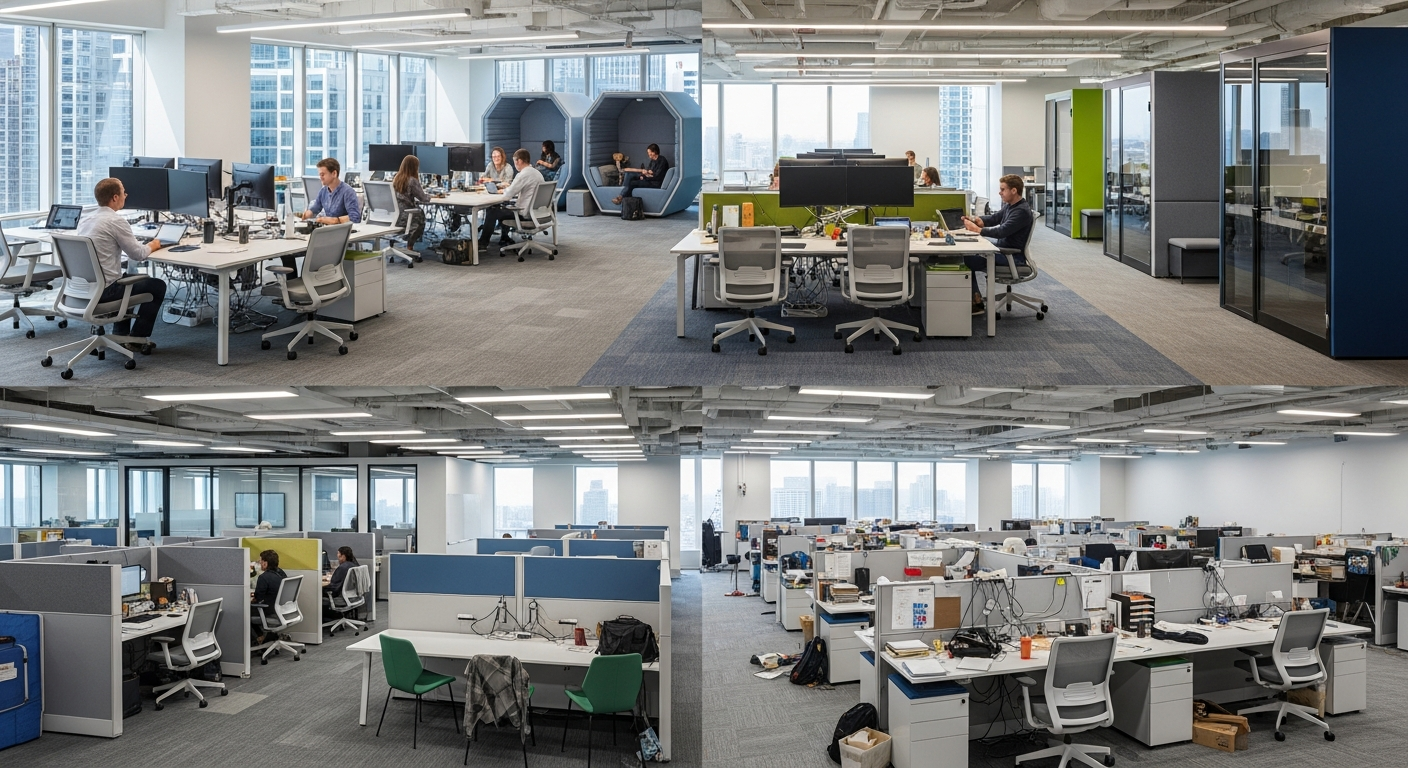
These aren’t simply design preferences or aesthetic choices. Every square foot decision, every layout configuration, and every space allocation strategy has measurable financial implications that ripple through operational budgets, employee productivity, and long-term business performance. The difference between a well-planned office and a poorly designed one can mean the difference between competitive advantage and costly inefficiency.
As hybrid work models reshape how we think about workspace utilization, the stakes have never been higher. Companies that fail to optimize their office layouts are essentially throwing money away—not just on rent and utilities, but on lost productivity, employee dissatisfaction, and missed opportunities for innovation. Meanwhile, forward-thinking organizations are discovering that strategic office design isn’t just about creating beautiful spaces; it’s about creating financial value.
This guide reveals six critical office layout mistakes that are costing companies millions in wasted resources, reduced productivity, and missed opportunities. More importantly, it shows CRE professionals exactly how to identify these expensive errors and transform them into competitive advantages. These aren’t theoretical concepts—they’re actionable insights backed by real data and proven solutions that can immediately impact your organization’s performance.
From space utilization failures that drain operational budgets to acoustic design oversights that devastate productivity, each mistake we’ll explore comes with a clear financial cost and an equally clear path to improvement. The question isn’t whether your organization can afford to address these issues—it’s whether you can afford not to.
Mistake #1: Underutilizing Space and Poor Space Planning
Space utilization represents the single largest financial drain in commercial real estate, yet most companies remain completely unaware of how much money they’re hemorrhaging through poor planning decisions. The numbers are staggering: companies waste an average of $300,000+ annually on underutilized space, according to comprehensive research by VergeSense. At current market rates of $35+ per square foot annually, every unused area becomes a massive expense that generates zero business value.
The mathematics of space waste are ruthlessly simple. Consider a typical 50,000 square foot corporate headquarters where optimal utilization should reach 60-70%. Instead, most organizations achieve utilization rates of just 30-40%, meaning they’re paying full price for nearly half their space while receiving no return on investment. That’s not just inefficiency—that’s a fundamental misallocation of capital that could be deployed for growth, technology, or talent acquisition.
Poor space planning manifests in predictable patterns that CRE leaders can learn to identify and eliminate. Oversized conference rooms that remain empty 80% of the time represent some of the most expensive real estate in any building. These spaces, often designed based on theoretical maximum capacity rather than actual usage patterns, consume premium square footage while generating minimal value. A single 500-square-foot boardroom used twice per week costs approximately $17,500 annually in a major metropolitan market—enough to fund a junior employee’s salary.
Dead zones present another costly challenge that stems from inadequate traffic flow analysis. These are spaces that employees naturally avoid due to poor location, inadequate lighting, or uncomfortable environmental conditions. Unlike conference rooms that serve a specific function, dead zones provide no value whatsoever while consuming valuable real estate. They represent pure waste, often located in prime areas that could be repurposed for high-impact activities like collaboration, focused work, or employee amenities.
The hidden costs extend far beyond rent. Underutilized spaces still require full maintenance, utilities, cleaning, and security coverage. HVAC systems must heat, cool, and ventilate empty areas. Lighting systems operate regardless of occupancy. Janitorial services clean unused conference rooms and vacant workstations. These operational expenses compound the waste, turning space utilization problems into ongoing financial drains that persist month after month.
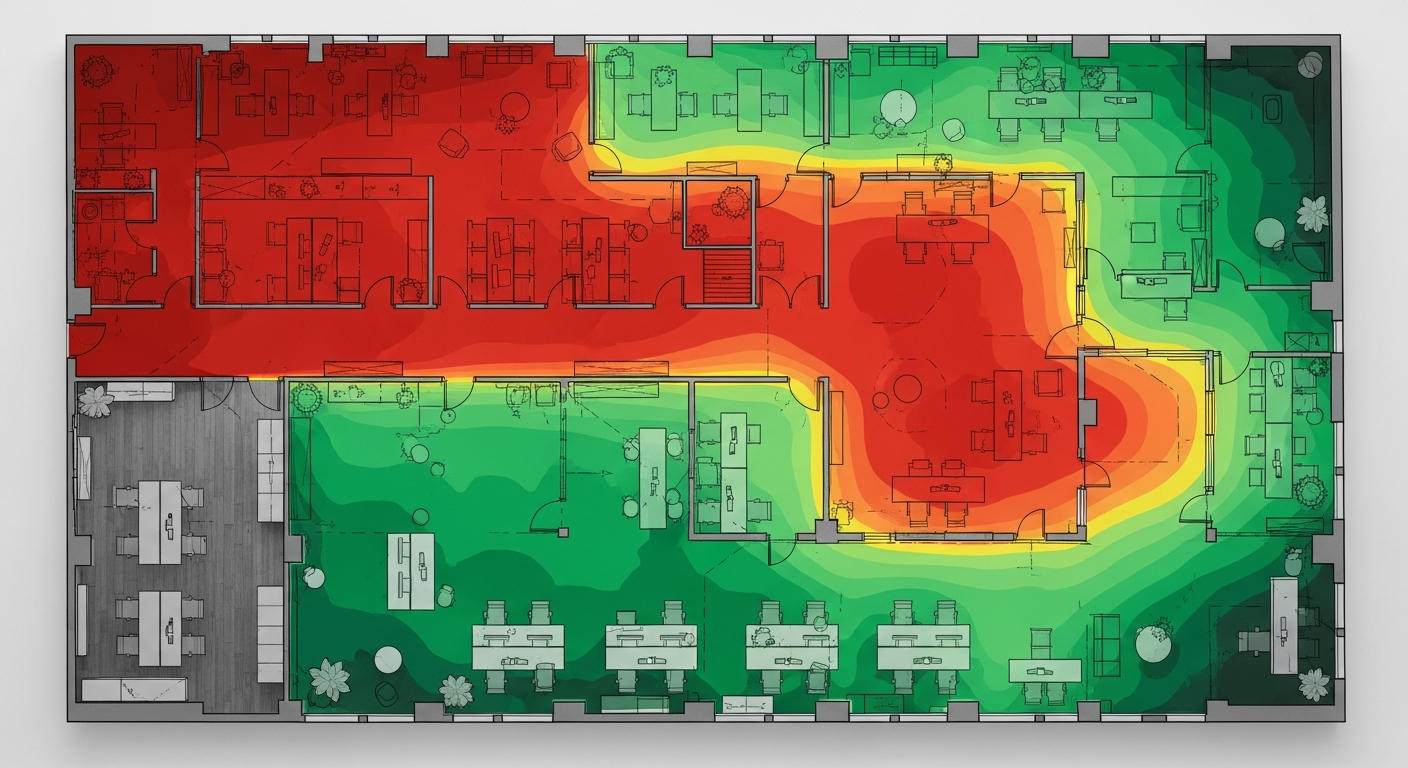
Modern space planning requires a fundamental shift from intuition-based design to data-driven optimization. Traditional approaches rely on assumptions about how employees work, collaborate, and move through spaces. These assumptions, formed during different eras of work culture, often prove wildly inaccurate in today’s dynamic workplace environment. The result is spaces that look impressive on architectural renderings but fail to support actual business needs.
Density’s research on space utilization benchmarks reveals that the $150 billion in industry waste stems largely from this disconnect between planned usage and actual behavior. Companies continue to allocate space based on traditional ratios and historical precedents rather than current data about how their teams actually work. This backward-looking approach ensures that space planning decisions remain suboptimal.
Effective space planning begins with understanding true utilization patterns through comprehensive data collection. This means tracking not just occupancy levels, but usage intensity, duration, and purpose. A conference room that’s technically “booked” for eight hours daily but actually used for only four hours represents a different optimization opportunity than one that’s fully utilized during peak hours but empty during off-peak times.
The financial impact of improved space planning is immediate and measurable. Organizations that implement AI-powered optimization solutions typically see 15-30% improvements in space efficiency within the first quarter. This translates to hundreds of thousands of dollars in annual savings for medium-sized organizations and millions for large enterprises.
Space utilization optimization also enables better decision-making about expansion, contraction, and reconfiguration. Instead of defaulting to expensive lease renewals or costly relocations, companies can make informed choices based on actual usage data. Matterport’s space utilization metrics guide provides frameworks for measuring and improving utilization that many leading organizations now consider essential for strategic real estate management.
The transformation from wasteful to optimized space utilization requires commitment to measurement, analysis, and continuous improvement. However, the financial returns justify the investment many times over, while the operational benefits create lasting competitive advantages that compound over time.
While poor space planning wastes money on unused areas, our next mistake shows how the wrong acoustic environment in used spaces can be equally costly to productivity.
Mistake #2: Ignoring Acoustic Design and Noise Control
Acoustic design failures create a hidden productivity tax that costs companies billions annually while being completely preventable through proper planning and investment. The World Economic Forum reports that background noise can reduce productivity by up to 66%, making acoustic design one of the most critical yet overlooked elements in office planning. This isn’t just about employee comfort—it’s about protecting one of your organization’s most valuable assets: focused thinking time.
The economics of noise distraction are devastating for knowledge workers whose value comes from cognitive output rather than physical production. Information workers lose 2.1 hours daily to noise interruptions and distractions, according to comprehensive workplace studies. At an average fully-loaded cost of $75 per hour for professional employees, this represents $157.50 in lost productivity per person per day. For a 200-person organization, daily noise-related productivity losses exceed $31,500, or approximately $8 million annually.
These numbers become even more alarming when we consider the compounding effect of interruptions. Research shows that it takes an average of 23 minutes to fully refocus after each noise-related interruption. This means that a single 30-second conversation can eliminate nearly half an hour of productive work time. In environments where such interruptions occur multiple times per hour, employees may never achieve deep focus states necessary for complex problem-solving, strategic thinking, or creative work.
The Institute for Facility Management’s research reveals that workplace distractions cost businesses an estimated $650 billion annually in lost productivity across the United States. This staggering figure encompasses not just noise disruptions, but all forms of workplace distraction. However, acoustic issues represent the largest single category of disruption, particularly in open office environments that prioritize visual openness over acoustic privacy.
Open offices, designed to promote collaboration and reduce real estate costs, paradoxically create some of the most expensive productivity challenges in modern workplaces. BambooHR’s analysis of workplace distractions shows that 69% of employees report decreased productivity specifically due to noise in open office settings. The irony is profound: spaces designed to save money on real estate costs actually waste far more money through productivity losses than they save on rent.
Speech represents the most disruptive form of workplace noise because human brains are hardwired to process language, making conversations impossible to ignore even when they’re not directed at us. Employees waste an average of 21.5 minutes daily on conversational interruptions—not participating in conversations, but being distracted by nearby discussions. This involuntary attention capture disrupts concentration and forces mental resets that drain cognitive energy throughout the day.

The compounding effects of acoustic stress extend beyond immediate productivity losses. Chronic noise exposure elevates cortisol levels, increases fatigue, and reduces job satisfaction. Employees in noisy environments report higher stress levels, more frequent headaches, and greater difficulty maintaining focus throughout the day. These stress-related impacts contribute to higher absenteeism, increased healthcare costs, and elevated turnover rates.
Acoustic design solutions exist at multiple price points and intervention levels, making noise control accessible for organizations with varying budgets and constraints. Sound masking systems, which generate subtle background noise to obscure speech patterns, typically cost $2-4 per square foot to install but can improve concentration by 50% or more. Acoustic panels and sound-absorbing materials offer permanent solutions that reduce reverberation and control noise transmission between areas.
Strategic zoning represents one of the most cost-effective acoustic interventions. By separating high-conversation areas from focused work zones, organizations can preserve quiet spaces without eliminating collaboration opportunities. This requires careful planning during the design phase but costs virtually nothing compared to post-occupancy acoustic treatments.
Advanced acoustic solutions include directional sound systems, noise-canceling technology, and adaptive audio environments that adjust background noise levels based on occupancy and activity patterns. While these technologies require higher initial investments, they offer sophisticated control over acoustic conditions that can optimize productivity across different work modes and times of day.
The return on investment for acoustic improvements is measurable and immediate. Organizations that invest in comprehensive acoustic design typically see productivity improvements of 10-20% within weeks of implementation. For knowledge work organizations, these productivity gains translate directly to revenue increases that far exceed the cost of acoustic interventions.
qbiq’s analysis of open office challenges demonstrates that acoustic planning must be integrated into the initial design process rather than addressed as an afterthought. Retrofitting acoustic solutions costs 3-5 times more than incorporating them during initial construction or renovation, making early planning essential for cost-effective noise control.
Beyond daily noise disruptions, companies also lose money when their spaces can’t adapt to changing business needs and future growth.
Mistake #3: Lack of Workspace Flexibility and Future-Proofing
Inflexible office designs become expensive liabilities when businesses need to adapt, forcing costly renovations or relocations instead of simple reconfigurations. The modern business environment demands agility, yet most office spaces lock organizations into rigid layouts that can’t evolve with changing operational requirements. This inflexibility carries enormous hidden costs that accumulate over time, making workspace adaptability one of the most critical yet overlooked factors in strategic real estate planning.
The financial impact of inflexibility becomes apparent when companies need to accommodate growth, restructuring, or changing work patterns. Major space reconfigurations can cost $50-150 per square foot when permanent walls need to be moved, electrical systems require modification, and fixed furniture must be replaced. Compare this to the marginal cost of reconfiguring flexible spaces, which typically runs $5-15 per square foot for furniture rearrangement and minor modifications. The difference represents a 10-30x cost multiplier that can quickly consume annual real estate budgets.
Traditional office design prioritizes permanent solutions that create impressive visual impact during initial construction but prove catastrophically expensive to modify. Private offices with fixed walls, built-in conference rooms with permanent AV installations, and custom millwork create beautiful spaces that become financial prisons when business needs change. These permanent fixtures represent sunk costs that provide no value when they can’t adapt to new requirements.
The cost of inflexibility extends beyond direct renovation expenses. Companies often delay necessary organizational changes because the physical environment can’t support new structures. Sales teams that need to expand can’t access appropriate space configurations. Collaborative projects requiring temporary team rooms must work around inadequate facilities. Product development cycles slow down when physical spaces can’t adapt to changing project requirements. These operational constraints impose opportunity costs that dwarf direct facility expenses.
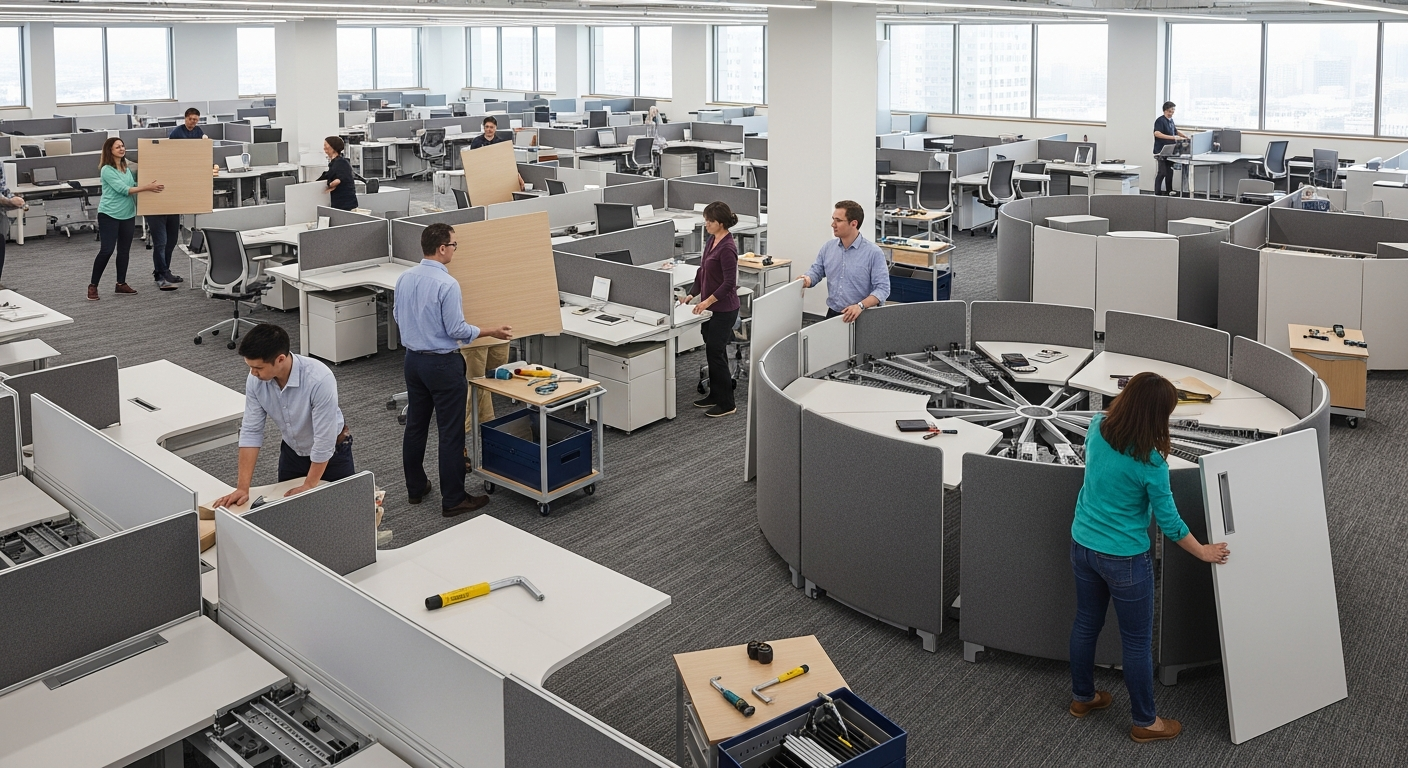
EY’s research on corporate real estate strategies reveals that hybrid workforce models require unprecedented flexibility in space allocation and configuration. Organizations can no longer predict which areas will need to support individual work versus collaboration on any given day. Static space allocations that worked in traditional office environments become expensive inefficiencies in hybrid models.
Future-proofing requires anticipating change rather than reacting to it. This means designing spaces with inherent adaptability that can accommodate multiple scenarios without major reconstruction. Modular furniture systems, moveable wall solutions, and flexible infrastructure enable rapid reconfiguration without construction timelines or contractor involvement. These solutions cost 20-30% more initially but save 200-300% on future modification costs.
Technology infrastructure represents a critical but often overlooked component of workspace flexibility. Fixed power and data installations force furniture layouts into predetermined configurations, eliminating the ability to optimize spaces for different functions. Flexible power delivery through overhead systems, raised floors, or mobile solutions enables unlimited furniture arrangements without electrical contractor involvement. The initial investment in flexible infrastructure pays dividends every time spaces need reconfiguration.
Agile workspace design principles emphasize multi-purpose functionality that maximizes space value across different usage scenarios. Areas that function as individual workstations during focused work periods can transform into collaborative zones during team activities. Conference rooms with moveable furniture can accommodate both formal presentations and informal brainstorming sessions. This multi-purpose approach increases space utilization while reducing total square footage requirements.
360 Workplace’s research on future flexibility identifies key design principles that support long-term adaptability. These include standardized furniture systems that enable easy reconfiguration, neutral color palettes that work across different functions, and infrastructure planning that supports various technology requirements. Organizations that embrace these principles create valuable assets that appreciate rather than depreciate over time.
The business case for flexibility becomes stronger as change accelerates. Companies that once reconfigured spaces every 5-7 years now face pressure to adapt annually or even quarterly. Market conditions, competitive pressures, and evolving work patterns demand organizational agility that inflexible spaces cannot support. The organizations that thrive are those that view physical space as a dynamic tool for enabling business strategy rather than a static constraint that limits possibilities.
qbiq’s guide to modern office design emphasizes that AI-powered planning tools can model multiple scenarios during the design phase, identifying optimal flexible solutions that support various future configurations. This predictive approach prevents expensive mistakes while ensuring that initial investments in flexibility address actual business needs rather than theoretical scenarios.
Even flexible spaces fail when they don’t properly balance collaboration needs with focused work requirements—a mistake that impacts both productivity and employee satisfaction.
Mistake #4: Imbalanced Collaboration vs Focus Spaces
The modern workplace suffers from a fundamental misunderstanding of how different types of work require different spatial environments. Organizations consistently over-prioritize collaboration spaces while neglecting the focused work areas that enable individual productivity, creating expensive imbalances that reduce overall performance. This mistake carries enormous hidden costs through decreased work quality, extended project timelines, and employee frustration that manifests as reduced engagement and increased turnover.
37% of employees report that open-plan offices decrease their productivity due to lack of adequate focus areas, according to comprehensive workplace studies. This statistic represents millions of knowledge workers struggling to perform deep work in environments designed primarily for interaction and collaboration. The financial impact is staggering: if more than one-third of your workforce operates at reduced capacity due to environmental constraints, your organization is essentially paying full salaries for diminished output.
The collaboration paradox reveals the counterintuitive reality that too much open space actually reduces face-to-face interaction. Harvard Business School research demonstrates that open offices can decrease face-to-face collaboration by up to 70% as employees retreat to digital communication to avoid disrupting colleagues or being overheard. This means organizations invest heavily in collaboration-oriented design only to achieve the opposite of their intended goals.
The optimal balance typically requires approximately 60% individual focus space, 30% collaboration areas, and 10% social/amenity spaces. However, most modern offices invert this ratio, allocating 60-70% of space to collaboration while cramming individual work into whatever areas remain. This misallocation forces employees to compete for quiet spaces, reduces work quality, and creates stress that impacts both performance and retention.
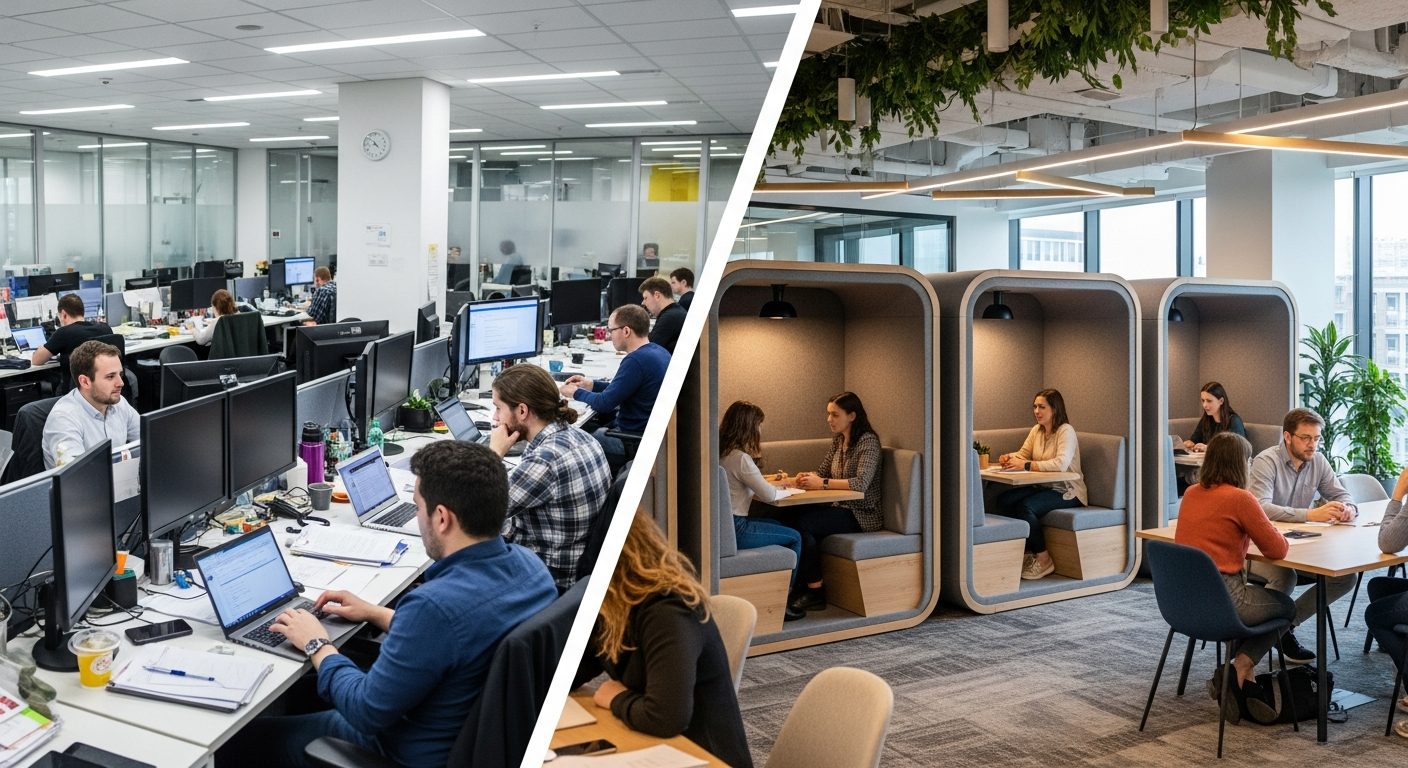
Missing elements in space planning include phone booths for private conversations, quiet zones for deep work, small team rooms for focused collaboration, and heads-down work areas that shield employees from visual and auditory distractions. These spaces don’t require expensive construction or premium finishes—they simply need thoughtful planning that recognizes different work modes require different environmental conditions.
M Moser Associates’ research on office design impact reveals that employee satisfaction correlates directly with access to appropriate work settings for their tasks. Employees who can easily find suitable spaces for their current work mode report 40% higher job satisfaction and demonstrate measurably better performance outcomes. Conversely, employees forced to work in inappropriate environments experience stress that compounds throughout the day and impacts overall well-being.
The retention costs of imbalanced spaces are enormous but often overlooked. Replacing employees who leave due to poor work environments averages $15,000-75,000 per person, depending on role complexity and seniority level. For organizations experiencing turnover rates of 15-20% annually, workspace dissatisfaction can contribute to hundreds of thousands of dollars in unnecessary recruitment and training costs. Many companies invest heavily in retention programs while ignoring the physical environment factors that drive employee dissatisfaction.
Activity-based working represents an evolved approach that recognizes different tasks require different spatial supports. Rather than assigning permanent workstations, employees choose from various work settings based on their current activities. This model requires diverse space types that support the full spectrum of work modes: individual focus, small group collaboration, large team meetings, informal interactions, and private conversations.
The business case for balanced space allocation extends beyond productivity and retention. Organizations with well-designed workspace variety attract better talent because prospective employees can envision themselves working effectively in the environment. This recruitment advantage enables companies to access higher-quality candidates while often paying lower compensation premiums than organizations competing primarily on salary and benefits.
Space allocation decisions should be driven by actual work patterns rather than assumptions about collaboration needs. Many organizations discover that their teams spend 70-80% of their time on individual work that requires concentration, yet only 20-30% of their space supports these activities. This fundamental mismatch ensures that most employees operate in suboptimal conditions most of the time.
qbiq’s analysis of balanced workspace design provides frameworks for optimizing space allocation based on actual usage data rather than theoretical collaboration goals. AI-powered planning tools can model different allocation scenarios and predict their impact on productivity, satisfaction, and space utilization before construction begins.
The NIH’s systematic review of office design impact on performance confirms that workspace variety directly influences cognitive performance, with employees demonstrating measurably better outcomes when they can access appropriate environments for their current tasks. This research provides scientific validation for investing in balanced space design rather than defaulting to collaboration-heavy layouts.
Implementation requires careful planning that considers not just space types but their location, accessibility, and booking systems. Focus areas located next to high-traffic zones provide little value, while collaboration spaces tucked away in building corners remain underutilized. The spatial relationships between different work settings often matter more than the individual quality of each space type.
While balancing physical spaces is crucial, the most expensive mistake is making these critical decisions without proper data and testing—an approach that amplifies every other error.
Mistake #5: Skipping Data-Driven Planning and Test Fits
Traditional space planning relies on assumptions, intuition, and historical precedents rather than empirical data about how spaces will actually be used. This approach virtually guarantees expensive trial-and-error cycles as organizations discover that their beautifully designed offices fail to support actual work patterns. The cost of getting spatial planning wrong extends far beyond initial construction expenses, creating ongoing productivity drains and expensive post-occupancy modifications that could be entirely avoided through proper upfront analysis.
The financial mathematics are stark: post-occupancy changes average $75-200 per square foot compared to just $5-15 per square foot for comprehensive upfront planning and testing. This 10-20x cost differential means that organizations spending $50,000 on thorough planning can avoid $500,000-1,000,000 in future modification costs. Yet most companies skip data-driven planning to save time and money upfront, only to spend far more fixing preventable problems later.
Data-driven planning begins with understanding actual usage patterns rather than theoretical requirements. How do employees actually move through spaces? Which areas experience peak demand at different times of day? What types of activities require which environmental conditions? How do collaboration patterns change seasonally or based on project cycles? These questions can only be answered through systematic observation and measurement, not through assumptions or executive preferences.
AI-powered space planning provides optimized layouts based on comprehensive analysis of business requirements, usage patterns, and spatial relationships. These tools can process thousands of layout variations in minutes, identifying optimal configurations that balance competing priorities while maximizing space efficiency. The optimization capabilities far exceed what human planners can achieve through manual analysis, while dramatically reducing the time required to explore multiple scenarios.
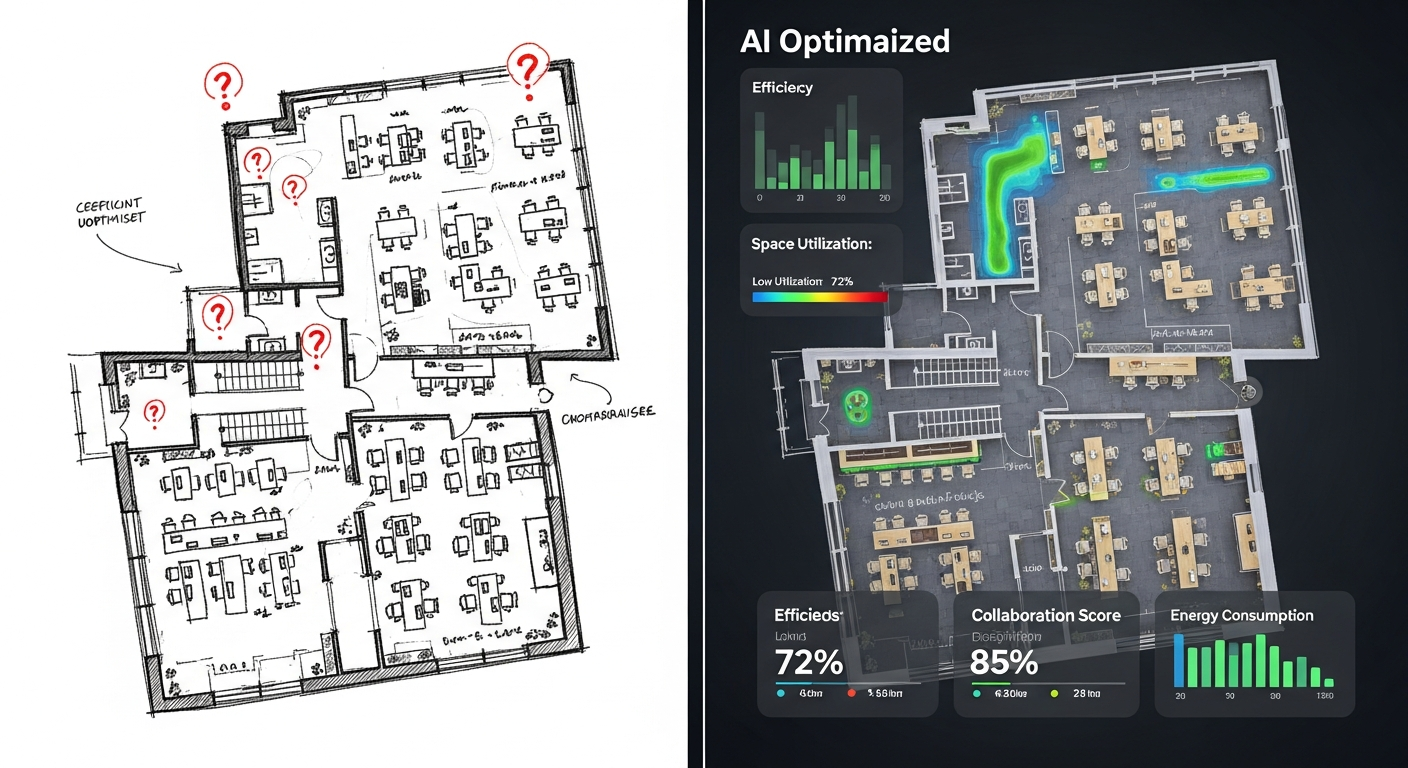
Test fits and scenario planning enable organizations to validate design decisions before committing to expensive construction. Virtual reality walkthroughs allow stakeholders to experience spaces before they’re built, identifying potential problems while changes are still easy and inexpensive to implement. Digital modeling can simulate different usage scenarios, revealing how spaces will perform under various conditions and helping planners optimize for actual rather than theoretical requirements.
The cost of inadequate planning manifests in predictable ways that data-driven approaches can prevent. Circulation bottlenecks that force expensive wall relocations. Conference rooms that are too small for their intended purposes. Technology infrastructure that can’t support actual usage patterns. Storage areas located in inconvenient locations that reduce efficiency. Each of these problems costs tens of thousands of dollars to fix but could be avoided through proper upfront analysis.
Advanced planning tools enable multiple scenario testing without physical mockups or construction. Organizations can model different growth scenarios, test various team configurations, and optimize for changing work patterns without any physical commitment. This scenario planning capability proves invaluable for organizations operating in dynamic environments where future requirements are difficult to predict with certainty.
The ROI of proper planning typically ranges from 15-30% improvement in space efficiency and employee satisfaction. For a typical corporate headquarters, this translates to hundreds of thousands of dollars in annual value through reduced space requirements, improved productivity, and enhanced employee experience. The payback period for comprehensive planning investments usually measures in months rather than years.
Traditional versus AI-powered planning approaches differ fundamentally in their ability to process complex requirements and optimize across multiple variables simultaneously. Human planners, no matter how experienced, cannot consider all the spatial relationships, usage patterns, and constraint factors that influence optimal design. AI tools excel at this type of multi-variable optimization, producing solutions that human planners would never discover through manual processes.
Data-driven insights encompass occupancy patterns, collaboration frequency, space utilization rates, environmental preferences, and workflow requirements. This information enables planners to make informed decisions about space allocation, furniture selection, technology infrastructure, and environmental controls. Without this data, planners resort to generic solutions that may or may not align with actual organizational needs.
The planning process should include continuous feedback loops that validate assumptions and refine solutions based on actual performance data. Post-occupancy evaluations reveal how well spaces meet their intended purposes, providing insights that inform future planning decisions. Organizations that embrace this learning approach continuously improve their space planning capabilities while avoiding repeated mistakes.
CBRE’s research on corporate real estate best practices identifies data-driven planning as a key differentiator between high-performing and average organizations. Leading companies invest in comprehensive planning that prevents problems rather than reacting to issues after they emerge. This proactive approach reduces total cost of ownership while improving space performance across all key metrics.
Rapid planning capabilities enable organizations to test multiple scenarios quickly and inexpensively, identifying optimal solutions before committing to expensive implementation. This speed and flexibility prove essential in dynamic business environments where requirements change frequently and traditional planning timelines are too slow to support business needs.
The transformation from assumption-based to data-driven planning requires cultural change as well as tool adoption. Organizations must embrace measurement, analysis, and evidence-based decision making rather than relying on precedent and intuition. However, the financial returns justify this investment many times over, while the improved outcomes create competitive advantages that compound over time.
Even with perfect space planning, companies lose money when they overlook the human element—designing spaces that technically function but fail to support employee well-being and satisfaction.
Mistake #6: Neglecting Employee Experience and Well-Being
Employee well-being represents the ultimate measure of office design success, yet it’s often treated as a secondary consideration after functional requirements and aesthetic preferences. This approach proves catastrophically expensive because poor workplace design drives turnover, reduces productivity, and damages company reputation in ways that directly impact financial performance. The costs are enormous: poor workplace design contributes to $200-300 billion annually in stress-related productivity losses across the United States economy.
The recruitment and retention implications are particularly significant in today’s competitive talent market. 88% of employees consider workplace design when evaluating job offers, according to comprehensive employment surveys. This means that organizations with substandard work environments automatically handicap themselves in talent competition, forcing them to offer higher compensation to attract quality candidates or accept lower-quality hires who are willing to work in inferior conditions.
Forbes research on workplace well-being demonstrates that well-designed offices improve employee satisfaction by 16% and productivity by 20%. These improvements translate directly to bottom-line impact through reduced turnover, decreased absenteeism, and enhanced performance. For a 200-person organization, a 20% productivity improvement represents millions of dollars in additional value creation annually.
Ergonomic failures alone cost companies $21.6 billion annually in workplace injuries and health issues, according to workplace design research. These costs include direct medical expenses, workers’ compensation claims, reduced productivity during recovery periods, and replacement worker training. Most ergonomic problems are entirely preventable through proper furniture selection, workspace configuration, and environmental design.

The retention impact of workplace design often goes unrecognized until expensive turnover patterns emerge. Improving workplace design can reduce turnover by 25-40%, which translates to enormous cost savings given that replacing professional employees typically costs $15,000-75,000 per person. For organizations experiencing high turnover rates, workspace improvements often provide faster ROI than expensive retention programs focused on compensation and benefits.
Well-being factors that organizations frequently overlook include natural light access, air quality management, biophilic design elements that connect employees with nature, comfortable breakout spaces for informal interaction, and ergonomic furniture that supports healthy posture and movement. These elements don’t require expensive construction or premium finishes, but they do require intentional planning that prioritizes employee experience alongside functional requirements.
Natural light access represents one of the most cost-effective well-being investments. Employees with access to natural light report 15% higher well-being scores and demonstrate measurably better sleep quality, which directly impacts daily performance and long-term health outcomes. Optimizing natural light distribution through strategic space planning costs nothing but provides enormous value for employee satisfaction and productivity.
Air quality management affects cognitive performance in ways that most organizations never consider. Poor ventilation, inadequate filtration, and excessive CO2 levels reduce cognitive function by 15-50%, according to environmental health research. Upgrading HVAC systems and monitoring air quality provides measurable returns through improved decision-making, reduced fatigue, and fewer health-related absences.
Biophilic design elements—plants, natural materials, water features, and nature-inspired patterns—reduce stress hormones, improve concentration, and enhance creativity. These interventions cost relatively little to implement but provide significant psychological benefits that improve both individual well-being and team dynamics. Organizations with extensive biophilic design report higher employee engagement and lower stress-related health claims.
The recruitment advantage of exceptional workplace design enables organizations to attract better talent while often paying lower compensation premiums. Prospective employees who tour impressive, well-designed offices form positive impressions about company culture, values, and employee treatment that influence their willingness to accept job offers. This recruitment edge proves particularly valuable for competitive positions where multiple companies may offer similar compensation packages.
Strategic workplace design approaches recognize that employee experience drives business outcomes rather than being merely a cost center. Leading organizations invest in workplace design as a strategic tool for talent attraction, retention, and performance rather than viewing it as a facilities management expense.
Space planning that prioritizes employee experience requires understanding how different individuals prefer to work and providing variety that accommodates diverse needs. Some employees thrive in bustling, energetic environments while others perform best in quiet, controlled settings. Some prefer visual openness while others need enclosed, private spaces. Workplace design that acknowledges and accommodates this diversity enables all employees to perform at their best.
Modern workspace design principles emphasize human-centered design that puts employee needs at the center of planning decisions. This approach requires understanding actual work patterns, collaboration styles, and individual preferences rather than imposing generic solutions that may not align with organizational culture or employee expectations.
The measurement of workplace well-being requires ongoing assessment through surveys, usage analytics, and performance metrics. Organizations should track employee satisfaction, engagement levels, turnover rates, and productivity measures to understand how workplace design impacts actual outcomes. This data enables continuous improvement and demonstrates the ROI of well-being investments.
Implementation often requires balancing individual preferences with collective needs while maintaining operational efficiency and cost control. The most successful approaches provide variety and choice rather than trying to create one-size-fits-all solutions. Employees who can select appropriate environments for their current tasks and personal preferences report higher satisfaction and demonstrate better performance than those forced to work in inappropriate settings.
These six mistakes cost companies millions annually, but the solution isn’t just avoiding errors—it’s embracing a smarter approach to office planning that prevents problems before they start.
6 Mistakes to Avoid
The cumulative cost of these six office layout mistakes reaches staggering proportions when we examine their combined impact on organizational performance. Space waste alone drains $150 billion annually from the U.S. economy. Noise disruption destroys $650 billion in productive capacity. Inflexible designs force expensive renovations that multiply initial investments by 10-30x. Imbalanced spaces drive turnover costs that can reach $75,000 per employee. Poor planning amplifies every other mistake through expensive post-occupancy corrections. And neglected employee well-being contributes another $200-300 billion in stress-related productivity losses.
These aren’t unavoidable business expenses—they’re preventable mistakes that forward-thinking CRE leaders can eliminate through strategic planning and intelligent design. Every dollar wasted on underutilized space, every hour lost to noise distractions, every expensive renovation required by inflexible design represents money that could have been invested in growth, innovation, or competitive advantage. The organizations that recognize this opportunity are transforming their approach to office planning from reactive problem-solving to proactive value creation.
The shift from traditional to data-driven planning represents more than just a tool upgrade—it’s a fundamental change in how organizations think about physical space as a business asset. Leading companies no longer view office design as a facilities management task but as a strategic business tool that directly impacts productivity, retention, recruitment, and competitive positioning. They understand that every spatial decision carries financial implications and that optimal design requires the same analytical rigor applied to other major business investments.
The competitive advantage flows to organizations that embrace this strategic perspective. While their competitors struggle with the hidden costs of poor design decisions, these companies benefit from optimized space utilization, enhanced productivity, superior talent attraction, and reduced operational expenses. The financial benefits compound over time as better workplace design enables better business performance across multiple dimensions.
The transformation begins with recognizing that excellence in office design isn’t about creating impressive spaces that photograph well—it’s about creating environments that enable human performance and business success. This requires understanding how spaces actually get used, what types of work require what types of environmental support, and how design decisions impact measurable business outcomes.
The technology now exists to eliminate guesswork from space planning through AI-powered optimization, comprehensive data analysis, and predictive modeling that prevents expensive mistakes before they occur. Organizations that embrace these tools gain immediate advantages while building capabilities that will serve them well as workspace requirements continue to evolve in response to changing business needs and work patterns.
How to Avoid These Mistakes
Ready to eliminate these costly office layout mistakes? qbiq’s AI-powered architectural planning platform helps CRE professionals create optimized, data-driven office layouts in minutes instead of weeks. Our automated space planning technology prevents expensive design errors before construction begins, ensuring your office investment delivers maximum ROI from day one.
Don’t let your organization become another casualty of poor space planning. See how leading companies are transforming their space planning approach and discovering the future of office design with qbiq’s intelligent architectural solutions. Contact us today to learn how AI-powered planning can eliminate waste, boost productivity, and turn your office space into a competitive advantage.






.png)


