
The traditional office planning process is broken. What once took weeks of back-and-forth between stakeholders, architects, and designers can now be accomplished in minutes. In today’s rapidly evolving workplace landscape (where hybrid work models have reduced office space per employee by 22% while increasing collaborative spaces by 44%) the need for agile, intelligent space planning has never been greater.
This guide will take you through the complete workflow of transforming office layout concepts into executable plans using modern AI-powered tools, enabling commercial real estate developers, facility managers, and corporate space planners to streamline their processes and unlock the full potential of any space.
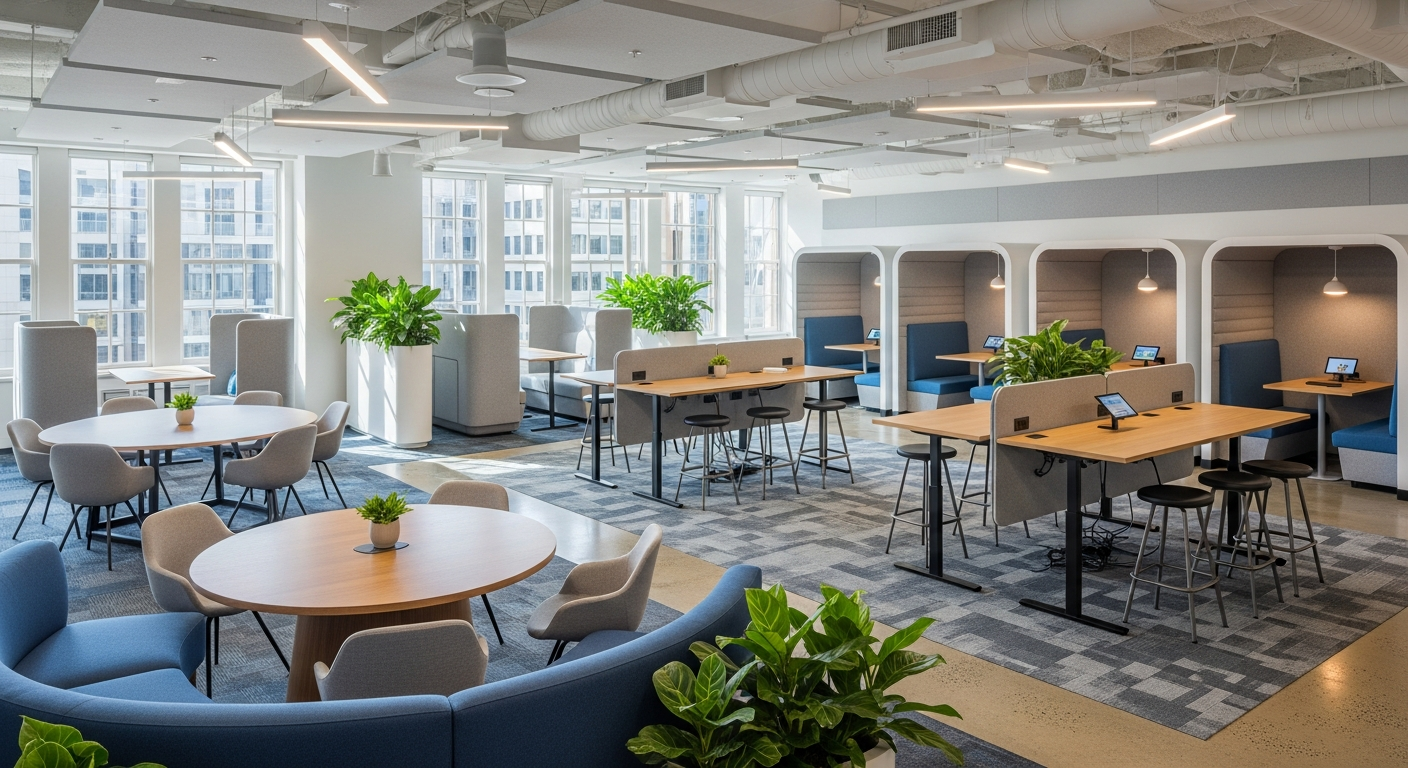
Gone are the days when facility managers had to wait weeks for architects to produce initial floor plans, only to discover that the proposed layouts didn’t align with actual workflow requirements or budget constraints. The modern workplace demands agility. It’s not just in how we work, but in how we design and optimize the spaces where work happens. As organizations continue to navigate the complexities of hybrid work models, remote collaboration, and evolving employee expectations, the ability to rapidly prototype, test, and implement office layouts has become a competitive advantage.
Consider the typical scenario faced by a growing tech company that has outgrown its current space. Traditional planning would involve multiple consultations with architects, lengthy stakeholder meetings, manual drafting iterations, and weeks of uncertainty about whether the final design would actually work. Meanwhile, the company is paying for underutilized space or cramped conditions that impact productivity. This outdated approach not only wastes time and money but also creates missed opportunities for creating spaces that truly support modern work styles.
The transformation we’re witnessing in office layout planning is about fundamentally rethinking how we approach space as a strategic business asset. Forward-thinking organizations are discovering that the right combination of AI-powered tools, data-driven insights, and agile planning methodologies can compress months of traditional planning into hours of productive iteration, all while achieving better outcomes for employees, visitors, and the bottom line.
The Modern Office Layout Challenge
The commercial real estate industry faces an unprecedented convergence of challenges that make traditional office planning methods not just inefficient, but potentially catastrophic for business operations. The shift to hybrid work models has fundamentally altered how organizations think about space, creating a complex puzzle that manual planning processes simply cannot solve effectively.
The Time Crunch Reality
Traditional office planning relies on manual processes that can take 3-6 weeks for initial layouts, causing delays that ripple through entire project timelines. During this extended period, organizations face mounting pressure from multiple directions: employees working in suboptimal conditions, landlords requiring space decisions for lease negotiations, and executive leadership demanding concrete plans for budget allocation. The organizations that are planning to cut and optimize space to accommodate hybrid work are finding that traditional planning timelines no longer align with business realities.
Every day of delay in the planning process represents lost productivity, increased temporary space costs, and potential talent retention issues. A mid-sized financial services firm recently shared that their six-week planning process for a new branch office resulted in $200,000 in extended lease costs for temporary space, plus the immeasurable impact of reduced team collaboration during the transition period.
The Hybrid Work Complexity
Hybrid work models have fundamentally changed space requirements, with companies needing to optimize for both in-person collaboration and flexible usage patterns that traditional planning methods weren’t designed to handle. The average commercial office space per employee decreased by 22% in 2023, but this statistic only tells part of the story. Organizations are simultaneously increasing collaborative spaces by 44% while reducing dedicated desk assignments by 35%.
This creates a sophisticated balancing act that requires understanding peak occupancy patterns, team collaboration cycles, and individual work preferences. Manual planning approaches lack the analytical capability to optimize for these variable factors simultaneously. A manufacturing company with 1,200 employees discovered that their pre-pandemic space allocation model was completely obsolete when 60% of their workforce adopted hybrid schedules, requiring a complete reimagining of everything from meeting room ratios to parking allocation.
The Stakeholder Alignment Nightmare
Stakeholder alignment becomes exponentially more complex when dealing with multiple departments, landlords, tenants, and design professionals, each with their own priorities, timelines, and success metrics. IT departments focus on technology infrastructure and data security. HR teams prioritize employee experience and wellness features. Finance demands cost optimization and rapid ROI. Operations requires minimal disruption to ongoing business activities.
Traditional planning processes often involve sequential stakeholder input, where each group provides feedback in isolation, leading to conflicting requirements and multiple redesign cycles. A healthcare organization recently described their planning process as “herding cats,” where each department’s input invalidated previous decisions, creating a cycle of revisions that extended their planning timeline from six weeks to four months.
The Data Deficit Problem
Manual planning processes lack the data-driven insights needed for optimal space allocation and ROI maximization in an environment where real estate costs continue to rise and efficiency demands increase. Without real-time utilization data, heat mapping, and predictive analytics, planners are essentially designing blindfolded, making educated guesses about how space will actually be used.
The implications extend beyond mere inefficiency. AI implementation in commercial real estate has revealed that organizations using data-driven planning approaches achieve 15-25% better space utilization rates and 30% faster adaptation to changing business needs. Companies stuck with manual processes often discover after implementation that their carefully planned spaces don’t align with actual usage patterns, leading to expensive retrofits and ongoing operational inefficiencies.
The Cost of Getting It Wrong
Rising real estate costs demand precision in space planning to avoid costly mistakes and redesigns that can consume entire project budgets. The average commercial real estate cost per square foot has increased by 18% over the past two years, making every square foot of space a significant investment that must deliver measurable returns.
When traditional planning approaches result in suboptimal layouts, the financial impact compounds over time. Underutilized meeting rooms, poorly positioned collaborative areas, and inadequate technology infrastructure don’t just waste money—they actively hinder productivity and employee satisfaction. A consulting firm recently calculated that their poorly planned office layout was costing them $150,000 annually in lost productivity due to inefficient traffic patterns and inadequate meeting spaces.
The traditional approach to office planning has become a liability in today’s fast-moving business environment. Organizations that continue to rely on manual, sequential planning processes are not just losing time and money—they’re missing opportunities to create spaces that actively contribute to business success, employee satisfaction, and competitive advantage. The solution lies in establishing a clear vision and requirements framework that can guide more intelligent, efficient planning processes.
Defining Your Vision: Requirements & Constraints
Successful office layout transformation begins long before the first line is drawn on a floor plan. The foundation of any exceptional workspace lies in the systematic identification and articulation of stakeholder needs, spatial requirements, and business constraints that will guide every subsequent design decision. This critical phase determines whether the final space will be a strategic asset that drives business success or an expensive compromise that satisfies no one completely.
Stakeholder Mapping and Alignment
Stakeholder alignment starts with identifying all decision-makers and influencers who will impact or be impacted by the office layout transformation. This goes far beyond the obvious players like facility managers and department heads to include IT teams responsible for technology infrastructure, security personnel concerned with access control and emergency protocols, and executive leadership focused on cultural transformation and business outcomes.
Each stakeholder group brings unique perspectives and requirements that must be understood and balanced. IT teams focus on power distribution, network infrastructure, and technology refresh cycles that may not be visible in traditional floor plans but are critical for operational success. HR teams prioritize employee wellness features, accessibility compliance, and spaces that support cultural values and recruitment efforts. Finance teams demand clear ROI projections and cost optimization strategies that demonstrate the business value of space investments.
The key to effective stakeholder alignment lies in creating structured input sessions that capture both explicit requirements and underlying concerns that may not be immediately obvious. A global consulting firm discovered that their initial planning sessions focused entirely on functional requirements while missing critical cultural factors that ultimately determined whether employees would actually use the planned collaborative spaces effectively.
Quantifying Space Requirements
Quantifying current and projected headcount requires sophisticated analysis that accounts for hybrid work schedules, peak occupancy periods, and growth projections that may vary significantly across different teams and business units. The traditional approach of simply calculating desks per employee has become obsolete in an environment where 40% of employees work hybrid schedules and space usage patterns fluctuate dramatically based on project cycles, seasonal business patterns, and team collaboration requirements.
Modern space planning requires understanding not just how many people need space, but when they need it, what types of activities they’ll be performing, and how their work patterns interact with other teams. A technology company with 800 employees discovered that their peak occupancy occurred on Tuesdays and Wednesdays, reaching 85% capacity, while Mondays and Fridays averaged only 45% occupancy. This insight completely changed their space allocation strategy, allowing them to reduce their total footprint by 30% while actually improving the employee experience during peak periods.
Functional Requirements and Space Programming
Establishing functional requirements involves analyzing the specific types of work activities that occur within the organization and determining the spatial characteristics that best support those activities. This analysis must consider current work patterns while anticipating how those patterns may evolve as the business grows and changes.
Meeting room ratios, for example, require analysis of actual usage data rather than relying on industry averages that may not reflect the organization’s specific collaboration patterns. Research on evolving workplace priorities shows that organizations are increasingly prioritizing experience quality over space quantity, leading to sophisticated programming that includes focused work zones, collaborative areas, learning spaces, and social interaction areas that serve different purposes throughout the day.
Quiet work zones must be acoustically isolated and positioned to minimize distractions, while collaborative spaces need flexible technology infrastructure and easy reconfiguration capabilities. Specialized equipment needs, from high-powered workstations for design teams to secure areas for confidential discussions, require careful integration into the overall layout without disrupting general workflow patterns.
Budget Parameters and Timeline Constraints
Defining budget parameters extends beyond simple construction costs to include furniture and equipment, technology infrastructure, temporary space during construction, and ongoing operational expenses that will impact the total cost of ownership. Effective budget planning also considers the cost of business disruption during implementation and the potential revenue impact of improved employee productivity and space efficiency.
Timeline constraints often drive critical design decisions, particularly when lease expiration dates or business growth pressures create non-negotiable deadlines. However, rushed implementations without proper planning often result in higher costs and suboptimal outcomes. A financial services firm learned this lesson when their accelerated timeline forced them to accept a layout that required expensive modifications within 18 months of completion.
Regulatory Compliance and Infrastructure Assessment
Regulatory compliance requirements, including ADA accessibility standards, building codes, and safety regulations, must be integrated into the planning process from the beginning rather than addressed as an afterthought during design development. These requirements often drive fundamental layout decisions about circulation patterns, door locations, and emergency egress routes that significantly impact space efficiency and user experience.
Assessing existing infrastructure limitations requires technical analysis of HVAC capacity, electrical systems, and structural considerations that may not be immediately obvious but can derail otherwise excellent design concepts. A law firm’s open office conversion was nearly abandoned when they discovered that their existing HVAC system couldn’t support the planned density without major mechanical upgrades that doubled their budget.
Success Metrics Beyond Aesthetics
Creating success metrics requires moving beyond subjective aesthetic preferences to establish measurable outcomes that align with business objectives. Employee productivity metrics might include survey data about space satisfaction, collaboration effectiveness measures, and quantitative analysis of space utilization patterns over time.
Space utilization rates provide concrete data about whether the planned layout actually supports intended activities, while operational efficiency metrics can demonstrate the financial impact of improved space planning. Organizations that establish clear success metrics from the beginning create accountability frameworks that ensure the final space delivers measurable value rather than just visual appeal.
The vision definition phase requires patience and systematic analysis, but it creates the foundation for all subsequent planning decisions. When stakeholder requirements are clearly understood and documented, the space planning methodology can be applied with confidence and precision, ensuring that the final layout reflects genuine organizational needs rather than generic design trends.
Space Planning Methodology & Optimization
Modern space planning has evolved from simple square footage calculations to sophisticated optimization frameworks that consider human behavior, organizational culture, and business performance as primary design drivers. The most effective approaches integrate proven methodologies with data-driven insights to create environments that actively support productivity, collaboration, and employee satisfaction while maximizing the strategic value of real estate investments.
Activity-Based Working Principles
Activity-based working (ABW) represents a fundamental shift from traditional assigned seating models to flexible environments that provide different zones optimized for specific types of work activities. This methodology recognizes that modern knowledge work involves multiple types of activities throughout the day (focused concentration, collaborative brainstorming, formal presentations, informal interactions, and learning opportunities) each requiring different spatial characteristics to be performed effectively.
The implementation of ABW principles requires careful analysis of actual work patterns within the organization rather than relying on generic assumptions about knowledge work. A professional services firm discovered through detailed activity mapping that their employees spent 40% of their time in focused work activities, 35% in collaborative activities, 15% in learning and development activities, and 10% in social interaction. This data enabled them to allocate space proportionally to actual usage patterns rather than defaulting to traditional office layouts that prioritized individual assigned desks.
Successful ABW environments provide focused work zones that offer acoustic privacy and minimal distractions, often positioned away from high-traffic areas and equipped with adjustable lighting and ergonomic furniture that supports extended concentration periods. Collaborative zones require flexible furniture arrangements, integrated technology for both in-person and remote participants, and acoustic design that contains conversation without requiring complete isolation.
Learning zones support both formal training activities and informal knowledge sharing, requiring flexible technology infrastructure and furniture that can be easily reconfigured for different group sizes and learning styles. Social interaction zones, often overlooked in traditional planning, play a crucial role in organizational culture and innovation by providing comfortable spaces for spontaneous interactions that often lead to breakthrough ideas and cross-departmental collaboration.
Data-Driven Space Utilization Optimization
Space utilization optimization using data-driven approaches enables organizations to make evidence-based decisions about space allocation rather than relying on intuition or outdated industry standards. Companies implementing systematic utilization analysis achieve 15-25% efficiency gains through strategic layout decisions that align space allocation with actual usage patterns.
Modern utilization analysis employs multiple data sources including badge access logs, meeting room booking systems, environmental sensors, and direct observation studies to create comprehensive pictures of how space is actually used throughout different time periods and business cycles. This analysis often reveals significant disconnects between intended space usage and actual patterns.
A technology company discovered that their large conference rooms, designed for 20-person meetings, averaged only 6 participants per meeting while small huddle rooms designed for 4 people were consistently overbooked with 6-8 participants. This insight led to a complete reconfiguration that converted large conference rooms into multiple medium-sized meeting spaces, resulting in 40% better meeting space utilization and significantly improved employee satisfaction.
Utilization optimization also considers temporal patterns that vary by department, project cycles, and business seasonality. Sales teams may require more collaborative space during quarter-end periods, while development teams may need extended focus time during product launch phases. Understanding these patterns enables dynamic space programming that adapts to changing business needs without requiring major physical modifications.
Biophilic Design Integration
Biophilic design integration acknowledges the fundamental human connection to natural elements and incorporates these elements strategically to reduce stress, enhance creativity, and improve overall workplace satisfaction. Research consistently demonstrates that biophilic design elements can enhance productivity by up to 22% while reducing stress levels and improving air quality.
The implementation of biophilic principles extends beyond simply adding plants to include natural lighting optimization, water features, natural material selections, and views of outdoor environments. Natural lighting optimization requires careful analysis of building orientation, seasonal sun patterns, and the integration of artificial lighting systems that mimic natural circadian rhythms throughout the day.
Living walls and plant installations provide air purification benefits while creating visual interest and acoustic benefits that reduce noise levels in open office environments. However, successful plant integration requires consideration of maintenance requirements, irrigation systems, and plant selections that thrive in commercial office environments with varying light conditions.
Natural material selections, including wood finishes, stone elements, and organic textures, create tactile connections to natural environments while contributing to acoustic performance and visual warmth that contrasts with the typically sterile character of commercial office buildings. These material choices must be balanced with durability requirements and maintenance considerations that impact long-term operational costs.
Flexible and Modular Design Strategies
Flexible and modular design strategies using movable walls, multi-purpose rooms, and adaptable furniture systems enable organizations to accommodate changing team sizes, project requirements, and business growth without requiring major renovations. Current trends in commercial office design emphasize adaptability as a core design principle that supports organizational agility.
Movable wall systems provide the ability to quickly reconfigure spaces for different activities or team sizes, but successful implementation requires careful coordination with HVAC systems, electrical infrastructure, and acoustic performance requirements. The most effective systems integrate seamlessly with ceiling and floor systems to provide genuine room reconfiguration capabilities rather than simple space division.
Multi-purpose rooms require sophisticated technology infrastructure that supports various activities from video conferencing to training sessions to informal collaboration. This includes integrated audiovisual systems, flexible lighting controls, and furniture that can be easily reconfigured without requiring technical expertise from users.
Adaptable furniture systems enable individual workstations and collaborative areas to be modified based on changing needs without requiring permanent modifications to the space. Height-adjustable desks, mobile storage solutions, and modular seating systems provide users with control over their immediate work environment while maintaining consistency with the overall design concept.
Traffic Flow and Acoustic Optimization
Traffic flow optimization ensures smooth movement patterns throughout the office while minimizing noise disruption between different activity zones. Effective circulation design considers both planned movement patterns for daily activities and emergency egress requirements that must comply with safety regulations.
Primary circulation routes should connect high-traffic areas like entrances, elevators, restrooms, and break areas while avoiding disruption to focused work zones and sensitive activities like video conferencing or client meetings. Secondary circulation patterns provide access to individual workstations and specialized areas without creating bottlenecks during peak movement periods.
Acoustic optimization requires understanding how sound travels through open office environments and implementing strategic interventions that maintain communication flexibility while providing appropriate acoustic separation for different activities. This includes ceiling treatments that absorb reflected sound, strategic placement of sound-masking elements, and furniture selections that contribute to acoustic performance without sacrificing visual openness.
The integration of these space planning methodologies creates environments that actively support business objectives while providing employees with spaces that enhance their ability to perform their best work. However, the manual application of these principles across multiple layout options would require weeks of iterative design work. This creates the perfect opportunity to leverage AI-powered tools that can rapidly test multiple scenarios and optimize complex trade-offs that would be impossible to evaluate manually.
The AI-Powered Transformation
The integration of artificial intelligence into office layout planning represents the most significant advancement in space design since the introduction of computer-aided drafting. Modern AI systems combine machine learning algorithms, spatial analysis capabilities, and optimization engines to solve complex space planning challenges that would require weeks of manual iteration in minutes of computational analysis. This transformation enables organizations to explore hundreds of layout possibilities, optimize for multiple competing factors simultaneously, and achieve outcomes that consistently exceed what traditional planning methods can deliver.
Automated Layout Generation at Scale
Automated layout generation can produce dozens of optimized floor plan options in minutes rather than weeks, each tailored to specific requirements and constraints while exploring design possibilities that human planners might never consider. These systems employ sophisticated algorithms that understand spatial relationships, circulation patterns, adjacency requirements, and building code constraints to generate layouts that are not only functionally effective but also code-compliant and constructible.
The power of automated generation lies in its ability to rapidly explore the vast solution space of possible arrangements. A typical 50,000 square foot office space has millions of possible layout combinations when considering different room sizes, orientations, and spatial relationships. Manual exploration of this solution space would be impossible within practical project timelines, but AI systems can evaluate thousands of combinations in minutes, identifying optimal solutions that balance competing requirements.
Recent implementations demonstrate the dramatic impact of this capability. A financial services firm needed to consolidate three office locations into a single 40,000 square foot space while maintaining operational efficiency and employee satisfaction. Traditional planning approaches suggested this consolidation would require compromises in either space quality or operational effectiveness. However, AI-generated layouts identified configuration options that not only accommodated all three teams effectively but actually improved collaboration patterns by optimizing adjacencies between frequently interacting departments.
The automated generation process considers factors that manual planning often overlooks or inadequately addresses. These include optimal desk orientations for natural light exposure, traffic flow patterns that minimize disruption to focused work activities, and equipment placement that balances accessibility with operational efficiency. The result is layouts that feel intuitively well-designed while delivering measurable performance improvements.
Predictive Analytics for Space Utilization
Predictive analytics for space utilization helps organizations right-size their offices and avoid over or under-provisioning expensive commercial real estate by analyzing historical usage patterns, business growth projections, and evolving work style trends. These systems employ machine learning models trained on utilization data from similar organizations to predict how different layout configurations will perform under various scenarios.
The accuracy of these predictions has improved dramatically as AI systems analyze larger datasets and incorporate more sophisticated variables. Modern systems consider not just headcount projections but also work pattern evolution, collaboration frequency changes, and seasonal business fluctuations that significantly impact space requirements. A technology company discovered that their traditional growth planning model, which projected space needs based solely on headcount growth, would have resulted in 40% over-provisioning because it failed to account for increasing hybrid work adoption and evolving collaboration patterns.
Predictive models also identify potential utilization problems before they impact operations. By analyzing planned layouts against behavioral models, AI systems can predict areas that will be underutilized, spaces that will experience overcrowding, and circulation bottlenecks that will develop as the organization grows. This foresight enables proactive design modifications that prevent problems rather than reacting to them after occupancy.
The financial impact of accurate space utilization prediction is substantial. Organizations that leverage predictive analytics achieve 25-30% better space efficiency compared to traditional planning approaches, translating to millions of dollars in avoided real estate costs for large organizations. More importantly, these predictions enable organizations to plan confidently for growth without the risk of costly space shortages or expensive underutilized areas.
Real-Time Optimization Algorithms
Real-time optimization algorithms balance competing factors such as natural light exposure, traffic flow efficiency, noise level management, and departmental proximity requirements to identify layout solutions that optimize across multiple objectives simultaneously. These algorithms employ sophisticated mathematical optimization techniques originally developed for complex engineering applications, adapted specifically for spatial design challenges.
The optimization process considers factors that human designers struggle to balance simultaneously. Natural light exposure optimization ensures that workstations receive optimal daylight while minimizing glare and heat gain that can impact comfort and energy costs. Traffic flow optimization minimizes travel distances for frequently connected activities while ensuring adequate circulation capacity during peak usage periods. Noise level management optimizes acoustic separation between incompatible activities while maintaining visual connections that support collaboration.
Advanced AI implementation in building systems demonstrates that organizations achieve 25-40% energy cost reductions and 30-35% maintenance savings through intelligent optimization of building systems integration with space layouts. These algorithms consider HVAC efficiency, lighting system performance, and equipment placement to minimize ongoing operational costs while maximizing occupant comfort.
The optimization process also adapts to changing requirements without starting from scratch. When business needs evolve or space requirements change, AI systems can quickly evaluate modification options and identify optimal adjustment strategies that minimize disruption and cost while maintaining layout effectiveness. This adaptive capability is particularly valuable for growing organizations that need to accommodate changing teams and business functions without major renovations.
Enhanced Decision-Making Through Visualization
Enhanced decision-making through data visualization and scenario modeling allows stakeholders to see the impact of different layout choices before implementation, enabling more informed decisions and reducing the risk of costly modifications after construction. Modern visualization systems create photorealistic renderings, virtual reality experiences, and interactive 3D models that help stakeholders understand spatial relationships and design implications that are difficult to grasp from traditional 2D floor plans.
These visualization tools integrate real-time data to show how spaces will perform under different scenarios. Stakeholders can explore peak occupancy periods, seasonal usage variations, and alternative work pattern scenarios to understand how layout decisions will impact actual operations. A healthcare organization used scenario modeling to evaluate how their planned layout would accommodate pandemic-related social distancing requirements, identifying modifications that maintained operational effectiveness while ensuring employee safety.
Interactive visualization enables collaborative design review sessions where multiple stakeholders can explore design options together and provide immediate feedback on proposed layouts. This collaborative approach significantly reduces the revision cycles that typically extend traditional planning timelines while ensuring that final designs reflect the input and requirements of all key stakeholders.
The visualization tools also support change management by helping employees understand and embrace new workplace concepts before implementation. When people can experience proposed layouts virtually and understand how new spaces will support their work activities, adoption rates increase significantly and resistance to change decreases measurably.
Rapid Prototyping and Iterative Refinement
Rapid prototyping capabilities enable quick iterations based on stakeholder feedback, reducing the typical planning timeline from weeks to hours while improving design quality through increased iteration cycles. This approach mirrors software development methodologies where rapid iteration and user feedback create better final products than traditional linear development processes.
AI-powered prototyping can generate layout variations that explore specific feedback themes in minutes, enabling design sessions where stakeholders can see immediate responses to their input and refine their requirements through direct interaction with design alternatives. A consulting firm reduced their planning timeline from eight weeks to three days using iterative prototyping sessions that generated 50+ layout variations based on evolving stakeholder feedback.
The rapid iteration capability enables exploration of innovative design concepts that might be dismissed as too risky under traditional planning approaches. When the cost of exploring new ideas is minimal, organizations can test creative solutions and discover breakthrough approaches that deliver exceptional results. This experimental approach often leads to layouts that exceed initial expectations while maintaining practical functionality.
The iterative process also improves stakeholder alignment by ensuring that all parties understand the implications of their requirements and can see how different priorities interact with each other. When stakeholders can immediately see how their requests impact space efficiency, cost, and other departments’ needs, they make more informed decisions and develop greater ownership of the final solution.
This AI-powered transformation creates unprecedented opportunities for organizations to optimize their workspace investments while reducing planning timelines and improving outcomes. However, understanding these capabilities is only the first step. The practical application of these tools requires a systematic workflow that guides organizations from initial concept through final implementation while ensuring that the full potential of AI-powered planning is realized.
From Concept to Reality: The Implementation Workflow
The transformation from digital layout concepts to physical workplace reality requires a systematic workflow that leverages AI capabilities while addressing the practical complexities of construction, technology integration, and change management. Modern implementation approaches compress traditional timelines while improving outcomes through intelligent sequencing, proactive problem-solving, and continuous optimization that extends throughout the entire project lifecycle.
Phase 1: Rapid Space Analysis and Requirement Input
The implementation workflow begins with rapid space analysis and requirement input, where basic parameters generate initial layout concepts within minutes of data entry. This phase leverages AI-powered analysis tools that process building constraints, occupancy requirements, functional needs, and regulatory compliance factors simultaneously to establish the foundational parameters that will guide all subsequent design development.
Modern space analysis tools import building information models (BIM), architectural drawings, and site survey data to create accurate spatial databases that serve as the foundation for layout generation. These systems automatically identify structural constraints, MEP infrastructure limitations, and regulatory compliance requirements that must be accommodated in any viable layout solution. The automated analysis eliminates weeks of manual constraint identification that traditionally occurs during the design development phase.
Requirement input interfaces guide stakeholders through structured data collection that captures both explicit needs and implicit preferences that significantly impact layout success. Machine learning algorithms analyze input patterns to identify potential conflicts or missing requirements before they become design problems. A pharmaceutical company discovered that their initial requirements failed to account for secure storage needs that would have required major design modifications during construction; the AI system identified this gap during initial input analysis and prompted for clarification that prevented costly changes.
The rapid analysis phase produces multiple concept layouts within 15-20 minutes of requirement input, providing immediate visual feedback that enables stakeholders to refine their requirements and priorities before investing in detailed design development. This immediate feedback loop dramatically improves requirement quality by helping stakeholders understand the spatial implications of their decisions.
Phase 2: Collaborative Review and Iterative Refinement
Stakeholder review and iterative refinement using collaborative digital platforms allow real-time feedback and adjustments that maintain momentum while ensuring comprehensive input from all relevant parties. Modern collaboration platforms integrate visualization tools, commenting systems, and version control capabilities that enable distributed teams to participate effectively in design review regardless of their physical location or technical expertise.
The collaborative review process employs structured feedback frameworks that guide stakeholders to provide specific, actionable input rather than subjective preferences that are difficult to implement effectively. Interactive tools allow stakeholders to explore layout alternatives, test different scenarios, and understand the trade-offs associated with different design decisions. This hands-on exploration generates more informed feedback and reduces the revision cycles that typically extend traditional planning timelines.
Real-time collaboration capabilities enable design charrettes where multiple stakeholders can simultaneously review layouts, propose modifications, and see immediate results from suggested changes. A multinational corporation completed their entire stakeholder review process in two half-day collaborative sessions that would have required six weeks of sequential reviews using traditional approaches. The collaborative format also improved stakeholder alignment by enabling all parties to understand how their requirements interact with other priorities and constraints.
Digital collaboration platforms maintain comprehensive audit trails that document all feedback, decisions, and rationale that inform design development. This documentation proves invaluable during construction when questions arise about design intent or when post-occupancy modifications are needed to address evolving business requirements.
Phase 3: Technical Validation and Systems Integration
Technical validation including code compliance checks, MEP (mechanical, electrical, plumbing) coordination, and constructability analysis ensures that design concepts can be successfully implemented within budget and timeline constraints. AI-powered validation tools automatically check layouts against building codes, accessibility requirements, and local regulations to identify compliance issues before they delay construction or require costly design modifications.
MEP coordination employs sophisticated modeling tools that simulate mechanical, electrical, and plumbing systems integration with proposed layouts to identify conflicts, optimize infrastructure efficiency, and ensure adequate capacity for planned operations. AI implementation in smart building systems enables predictive analysis of energy consumption, HVAC performance, and electrical load distribution that optimizes both initial construction costs and ongoing operational expenses.
Constructability analysis evaluates proposed layouts for construction efficiency, material optimization, and project phasing opportunities that can reduce costs and accelerate implementation timelines. AI algorithms analyze construction sequences to identify potential conflicts, optimize material deliveries, and coordinate trades scheduling to minimize delays and cost overruns.
The technical validation phase also includes technology infrastructure planning that ensures adequate data, power, and audiovisual systems capacity for both current needs and future expansion requirements. Modern offices require significantly more technology infrastructure than traditional spaces, and inadequate planning during design development often results in expensive retrofits and operational limitations that impact long-term space effectiveness.
Phase 4: Detailed Design Development and Documentation
Detailed design development with material specifications, furniture selections, and construction documentation transforms validated concepts into implementable construction projects. This phase leverages AI-assisted design tools that maintain consistency with established design concepts while optimizing material selections, furniture specifications, and construction detailing for cost, performance, and maintainability.
Material specification systems analyze performance requirements, budget constraints, and maintenance considerations to recommend optimal selections that meet functional needs while supporting long-term operational efficiency. AI algorithms consider factors like durability, acoustic performance, environmental impact, and lifecycle costs to identify material combinations that optimize across multiple criteria simultaneously.
Furniture specification tools integrate with space planning algorithms to ensure that selected furniture supports planned activities while meeting ergonomic, aesthetic, and budget requirements. Modern specification systems can automatically generate furniture layouts, coordinate delivery scheduling, and optimize storage requirements during construction to minimize project disruption.
Construction documentation employs automated drafting tools that generate accurate, code-compliant drawings directly from validated 3D models, eliminating the manual drafting errors that often cause construction delays and change orders. Automated documentation systems maintain consistency across all project drawings while enabling rapid modifications when design changes are necessary.
Phase 5: Implementation Planning and Change Management
Implementation planning with phased move-in strategies minimizes business disruption during construction or renovation while ensuring smooth transitions that maintain operational effectiveness throughout the project timeline. Modern implementation approaches employ sophisticated project management algorithms that optimize construction sequencing, temporary space planning, and move coordination to minimize downtime and maintain productivity.
Phased implementation strategies enable organizations to maintain operations while spaces are renovated or constructed by carefully sequencing work to minimize disruption to critical business functions. AI-powered project management tools analyze workflow requirements, construction schedules, and temporary space options to develop implementation plans that minimize operational impact while maintaining project momentum.
Change management integration addresses the human factors that determine whether new spaces achieve their intended benefits by providing employees with the information, training, and support needed to effectively utilize new work environments. Successful change management begins during the design phase and continues through post-occupancy evaluation to ensure that space investments deliver measurable improvements in productivity, satisfaction, and business performance.
Move coordination employs specialized logistics planning that optimizes furniture installation, technology deployment, and employee transition scheduling to minimize confusion and downtime during the critical transition period. Modern move management systems integrate with building security, vendor coordination, and employee communication platforms to ensure seamless transitions that maintain business continuity.
Quality Assurance Through Digital Twin Technology
Quality assurance through digital twin modeling allows virtual walk-throughs and final adjustments before physical construction begins, reducing the risk of costly modifications and ensuring that completed spaces meet stakeholder expectations. Digital twin technology creates precise virtual replicas of planned spaces that enable immersive experiences using virtual reality, augmented reality, and interactive 3D modeling platforms.
Virtual walk-throughs enable stakeholders to experience proposed spaces at full scale and identify potential issues that are difficult to detect from traditional drawings or renderings. These immersive experiences often reveal sightline problems, circulation inefficiencies, or acoustic concerns that require design modifications before construction begins.
The digital twin platform serves as a living project database that maintains accurate records of all design decisions, material specifications, and construction details that inform ongoing facility management after project completion. This digital documentation significantly improves long-term space management by providing facility teams with complete, accurate information about building systems, furniture specifications, and design intent that supports effective maintenance and future modifications.
This systematic implementation workflow transforms AI-powered design concepts into functional workplace environments that deliver measurable business value while minimizing the risks and delays associated with traditional construction projects. The effectiveness of this approach is demonstrated through numerous real-world applications that showcase the dramatic improvements possible when modern tools and methodologies are applied systematically.
Real-World Applications & Success Stories
The theoretical benefits of modern office layout planning approaches become tangible through real-world implementations that demonstrate measurable improvements in space efficiency, employee satisfaction, and business performance. These success stories illustrate how organizations across different industries have leveraged AI-powered tools and systematic planning methodologies to overcome complex space challenges while achieving outcomes that exceeded initial expectations and delivered substantial return on investment.
Corporate Office Consolidation Excellence
The Bridgespan Group’s transformation from multi-floor operations to an efficient single-floor suite represents a masterclass in strategic space consolidation that enhanced collaboration and productivity while significantly reducing real estate costs. The nonprofit consulting organization faced the challenge of maintaining their collaborative culture while dramatically reducing their physical footprint in response to hybrid work adoption and changing space utilization patterns.
The traditional approach to this consolidation would have involved painful compromises between space efficiency and operational effectiveness, potentially forcing the organization to choose between maintaining their collaborative culture or achieving necessary cost reductions. Instead, the implementation of systematic space analysis revealed optimization opportunities that enabled both objectives simultaneously.
The consolidated layout employed activity-based working principles that created distinct zones for different types of work activities while maintaining the visual and acoustic connectivity that supported the organization’s collaborative culture. Focus work areas were positioned to minimize distractions while remaining visually connected to collaborative spaces, enabling seamless transitions between individual and team activities throughout the day.
The space optimization achieved 35% reduction in total square footage while actually improving space functionality and employee satisfaction scores. Meeting room utilization increased by 40% through strategic sizing and scheduling optimization, while informal collaboration spaces experienced 60% higher usage rates compared to the previous multi-floor layout. The consolidation also eliminated the communication barriers and inefficiencies associated with teams being distributed across multiple floors.
Dramatic Space Optimization Success
Fox Rothschild’s dramatic efficiency improvement, reducing their Minneapolis office from 100,000 to 40,000 square feet while maintaining full functionality, demonstrates the transformative potential of data-driven space optimization combined with strategic workplace design. This 60% reduction in space utilization represents one of the most aggressive space optimization projects in the legal industry, achieved without compromising operational effectiveness or employee satisfaction.
The optimization process began with comprehensive analysis of actual space utilization patterns that revealed significant inefficiencies in the traditional layout. Large corner offices were occupied less than 30% of the time, while small conference rooms were consistently overbooked and meeting requests were frequently denied due to inadequate availability. The data analysis also revealed that most client meetings involved 2-4 participants rather than the 8-12 participants that the existing conference rooms were designed to accommodate.
The optimized layout replaced large private offices with flexible work areas that could accommodate both focused work and small group collaboration, while reconfiguring meeting spaces to align with actual usage patterns. Glass-front offices were repositioned to maximize natural light distribution throughout the space while maintaining privacy for confidential client discussions when needed.
Technology infrastructure optimization enabled the space reduction by implementing cloud-based systems that eliminated the need for large server rooms and extensive file storage areas. Document management systems digitized client files that previously required substantial physical storage space, while unified communication platforms reduced the number of specialized conference rooms needed for different types of meetings.
Rapid Prototyping Innovation
SVR Commercial’s use of advanced layout tools to quickly generate multiple options and 3D virtual tours demonstrates how rapid prototyping capabilities can compress traditional planning timelines while improving stakeholder engagement and decision quality. The commercial real estate firm leveraged AI-powered design tools to transform their client consultation process from weeks of iterative design development to interactive design sessions that generated final layouts within hours.
The rapid prototyping approach enabled SVR Commercial to explore creative design solutions that might have been dismissed as too risky under traditional planning approaches. When the cost of testing new ideas is minimal, both designers and clients become more willing to experiment with innovative concepts that can deliver exceptional results. This experimental mindset led to breakthrough layouts that consistently exceeded client expectations while maintaining practical functionality.
The 3D virtual tour capability transformed client presentations from static floor plan reviews to immersive experiences that enabled clients to understand spatial relationships and design implications that are difficult to grasp from traditional drawings. Clients could virtually walk through proposed layouts, experience sightlines and circulation patterns, and provide immediate feedback that could be incorporated into design refinements within the same meeting.
The business impact extended beyond improved client satisfaction to measurable productivity improvements for SVR Commercial’s design team. Designers could focus on creative problem-solving rather than repetitive drafting tasks, while clients made faster decisions based on more comprehensive understanding of proposed solutions. The firm reported 50% reduction in design revision cycles and 40% improvement in client satisfaction scores related to the design process.
Hybrid Work Adaptation Leadership
Fox Rothschild’s Philadelphia headquarters spanning 90,000 square feet demonstrates sophisticated adaptation to hybrid work patterns through strategic space programming that maximizes natural light distribution and supports flexible collaboration models. The law firm’s headquarters renovation project addressed the fundamental challenge facing professional services organizations: how to maintain operational effectiveness and professional image while adapting to dramatically different space utilization patterns.
The hybrid work adaptation strategy employed predictive modeling to understand how changing work patterns would impact different areas of the office over time. Rather than simply reducing space proportionally, the analysis identified specific functions that would increase in importance (small group collaboration, video conferencing capabilities, flexible meeting spaces) while others would decrease (assigned seating, large conference rooms, filing storage).
Glass-front offices were strategically repositioned to create natural light wells that distribute daylight throughout the interior space while maintaining the visual hierarchy and professional atmosphere that clients expect from a major law firm. Workstations were designed with maximum flexibility to accommodate both permanent and temporary occupancy patterns while maintaining consistent technology and ergonomic standards.
The space programming integrated advanced audiovisual systems throughout collaborative areas to support seamless hybrid meetings where both in-person and remote participants can collaborate effectively. This technology infrastructure investment proved critical for maintaining client service quality while enabling greater workplace flexibility for attorneys and staff.
Municipal Innovation and Efficiency
New York City’s comprehensive real estate optimization strategy using data collection and analysis has improved space utilization across multiple departments while demonstrating how large-scale organizations can apply modern space planning principles systematically. The municipal implementation represents one of the largest-scale applications of data-driven space optimization, involving hundreds of facilities and thousands of employees across diverse functional requirements.
The city’s optimization program began with comprehensive space utilization studies that revealed significant inefficiencies across different departments and facility types. Administrative offices averaged 45% space utilization during normal business hours, while specialized facilities like laboratories and emergency operations centers maintained much higher utilization rates that required different optimization strategies.
Data collection systems employed badge access logs, environmental sensors, and scheduling system analysis to create detailed pictures of how different spaces were actually used throughout various time periods and seasonal cycles. This analysis revealed that many facilities experienced dramatic utilization variations based on seasonal business cycles, special events, and emergency response requirements that were not reflected in traditional space allocation models.
The optimization implementation employed phased approaches that allowed departments to test new space configurations without committing to permanent changes until effectiveness was validated through actual usage data. This iterative approach reduced resistance to change while ensuring that final configurations delivered measurable improvements in operational efficiency.
Financial Impact and ROI Validation
Typical 50,000 square foot buildings achieve $125,000-$200,000 in annual savings with implementation costs recovered within 18-24 months through the combination of reduced space requirements, improved operational efficiency, and enhanced productivity outcomes. These financial benefits compound over time as organizations continue to optimize their space utilization and adapt to changing business requirements without major renovation investments.
The savings sources extend beyond simple rent reductions to include energy cost optimization through improved space utilization, reduced furniture and equipment requirements through space sharing strategies, and maintenance cost reductions through more efficient space configurations. Organizations also report productivity improvements that contribute to revenue growth, though these benefits are more difficult to quantify precisely.
Implementation cost recovery timelines vary based on project scope and optimization opportunities, but most organizations achieve full cost recovery within two years while continuing to realize ongoing savings throughout the lease term. The financial benefits become more significant over time as organizations avoid the costs associated with traditional space expansion or relocation projects that would have been necessary without optimization improvements.
These success stories demonstrate that the transformation from traditional office planning to AI-powered optimization approaches represents more than just technological advancement—it enables fundamental improvements in how organizations approach space as a strategic asset that actively supports business success while optimizing operational costs and employee satisfaction.
Where to Next
The transformation from traditional office layout planning to AI-powered, rapid implementation represents more than just a technological upgrade—it’s a fundamental shift toward more agile, efficient, and responsive workspace design. As we’ve explored throughout this guide, the combination of clear vision setting, proven space planning methodologies, and intelligent automation tools enables organizations to move from concept to reality in minutes rather than months.
The statistics speak for themselves: companies implementing these modern approaches are achieving 15-25% efficiency gains in space utilization, 25-40% reductions in energy costs, and significant improvements in employee productivity that directly impact business performance and competitive advantage. The case studies from organizations like The Bridgespan Group, Fox Rothschild, and SVR Commercial demonstrate that these improvements are not theoretical benefits but measurable outcomes achieved by forward-thinking organizations across different industries and scales.
Perhaps most significantly, the shift to AI-powered planning approaches democratizes access to sophisticated space optimization capabilities that were previously available only to organizations with substantial resources and specialized expertise. Small and medium-sized businesses can now access the same analytical tools and optimization algorithms that large corporations use to maximize their space investments, leveling the playing field for workplace excellence.
The workflow transformation from weeks of manual iteration to minutes of automated analysis fundamentally changes how organizations can respond to evolving business needs, growth opportunities, and market changes. When space planning becomes a rapid, iterative process rather than a major undertaking, organizations gain strategic agility that enables them to adapt quickly to changing circumstances while maintaining operational effectiveness.
The integration of stakeholder collaboration tools, predictive analytics, and virtual reality visualization creates new possibilities for inclusive design processes that ensure all voices are heard and all requirements are understood before implementation begins. This collaborative approach not only improves design quality but also increases organizational buy-in and adoption rates that determine whether space investments deliver their intended benefits.
Looking ahead, the continued evolution of AI capabilities promises even more sophisticated optimization algorithms, enhanced predictive modeling, and seamless integration with building systems that will further compress implementation timelines while improving outcomes. Organizations that embrace these capabilities now position themselves to take advantage of future innovations while building internal competencies that support ongoing space optimization and adaptation.
Whether you’re a commercial real estate developer looking to optimize property value, a facility manager tasked with right-sizing office space for hybrid work models, or a corporate space planner preparing for organizational growth and change, the tools and methodologies outlined in this guide provide a clear pathway to success. The key lies in starting with systematic vision definition, leveraging proven space planning principles, and applying AI-powered tools to rapidly explore and optimize layout options that deliver measurable business value.
The future belongs to organizations that can adapt quickly to changing workplace demands while maintaining the human-centered design principles that foster collaboration, productivity, and well-being. By embracing AI-powered planning tools and data-driven optimization strategies, you’re not just improving your current space—you’re future-proofing your organization for the dynamic workplace landscape ahead.
The transformation is accessible, the benefits are proven, and the time to begin is now. Organizations that continue to rely on traditional planning approaches risk falling behind competitors who leverage modern tools to create spaces that actively contribute to business success, employee satisfaction, and operational efficiency. The question is not whether this transformation will happen, but whether your organization will lead the change or struggle to catch up.
Ready to transform your office space in minutes instead of months?
Experience the power of AI-driven architectural planning with qbiq. Our automated spatial intelligence platform enables you to quickly generate, visualize, and optimize office layouts that maximize both efficiency and employee satisfaction. Whether you’re planning a complete renovation or optimizing existing space, qbiq’s intuitive tools put professional-grade architectural capabilities at your fingertips.
Join forward-thinking organizations already using qbiq to unlock the full potential of their spaces. No architectural experience required.
.png)





.png)


