
The traditional office is dead… and it’s about time. For decades, we’ve watched employees squeeze their diverse work styles into identical cubicles, forcing creative brainstorming into sterile conference rooms and attempting deep focus work in bustling open offices. This fundamental mismatch between how we work and where we work isn’t just inefficient; it’s actively undermining productivity, creativity, and employee satisfaction across industries.
Modern work is inherently diverse. In a single day, a marketing manager might need to analyze data in complete silence, collaborate on campaign strategies with her team, take client calls, and engage in casual conversations that spark innovation. Yet most offices provide a one-size-fits-all environment that serves none of these activities particularly well. The result? Studies show that 70% of employees feel their workplace doesn’t support their productivity needs, leading to frustration, inefficiency, and ultimately, competitive disadvantage for organizations.
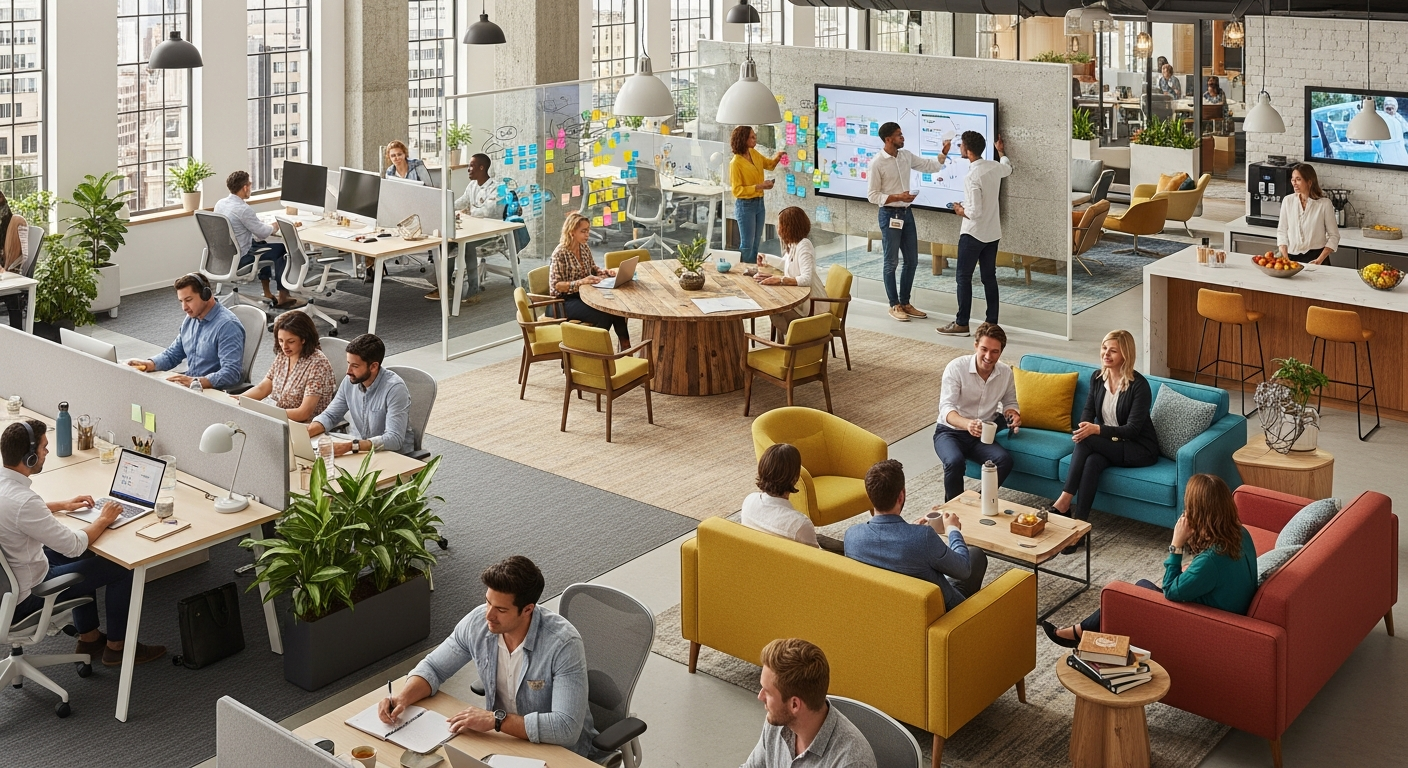
Enter activity-based working (ABW) (an approach that aligns space design with task diversity). Rather than assigning employees to fixed desks based on organizational hierarchy, ABW provides a variety of environments tailored to specific work activities. Need to focus? Head to a quiet focus pod. Brainstorming with your team? Use a collaboration hub equipped with digital whiteboards. Want to take a casual call? Grab a spot in the phone booth area.
The business case for ABW is compelling and data-driven. Organizations implementing activity-based working report 16% increases in productivity, 40% better space utilization, and up to 30% reduction in real estate costs. These aren’t marginal improvements—they represent transformational changes that directly impact the bottom line.
For commercial real estate professionals, landlords, and tenants, understanding ABW isn’t just about staying current with workplace trends. It’s about remaining competitive in a market where the most successful organizations are rethinking everything about how space supports work. The question isn’t whether activity-based working will become the standard - it’s whether you’ll lead or follow this transformation.
What is Activity-Based Working?
Activity-based working represents a fundamental shift in workplace philosophy—from designing spaces around job titles to creating environments that support the full spectrum of work activities. At its core, ABW is a workplace strategy that provides diverse environments tailored to specific work activities rather than traditional job roles or organizational hierarchy.
To understand why ABW matters, we need to trace the evolution of workplace design. The journey began with traditional assigned seating, where employees claimed permanent desks regardless of their daily tasks. This approach made sense when work was more routine and predictable, but it ignored the reality that even similar roles require different spatial supports throughout the day.
The open office movement promised to fix this by removing barriers and encouraging collaboration. However, the open office created new problems: increased distractions, lack of privacy, and one environment trying to serve all purposes. The pendulum had swung too far in one direction.
Hybrid and flexible working arrangements emerged next, allowing employees to work from various locations. While this addressed some limitations, it still didn’t solve the fundamental issue: when people were in the office, they often found themselves in spaces poorly suited to their immediate tasks.
Activity-based working represents the next step. It is recognizing that work exists on a spectrum of activities, each requiring different spatial supports. Whether you’re a software developer debugging code, a sales manager preparing for a client presentation, or a designer sketching concepts, your space needs change throughout the day. ABW acknowledges this reality by providing the right space for the right task at the right time.
The core principle underlying ABW is simple yet revolutionary: match space design to task requirements rather than job titles. This means moving beyond the assumption that all accountants need identical workstations or that all managers require corner offices. Instead, ABW asks: what does this specific activity need to be successful?
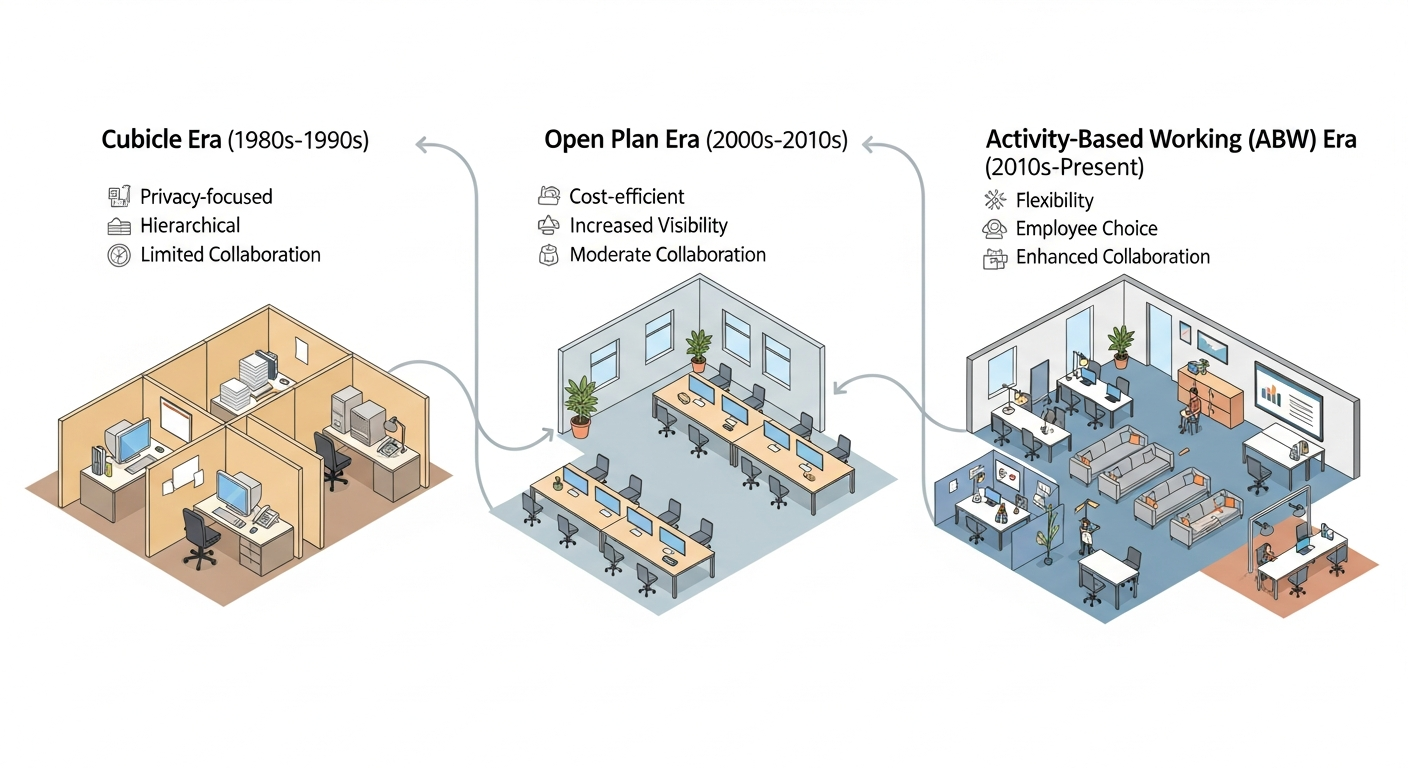
A focus task requires quiet, minimal visual distractions, and comfortable seating for extended periods. A collaborative session needs flexible furniture, technology integration, and acoustic separation from concentration areas. An informal conversation benefits from comfortable lounge seating and a relaxed atmosphere. ABW provides dedicated environments optimized for each of these activities.
This approach recognizes that modern knowledge work is inherently varied. Research from The Work Project shows that most employees engage in 6-8 different types of activities during a typical workday, from individual deep work to group problem-solving to informal networking. Traditional offices force all these activities into generic spaces, while ABW creates specialized environments for each.
The shift is more than just interior design. It’s a strategic response to changing work patterns, evolving employee expectations, and the need for greater space efficiency. Organizations implementing ABW report that employees naturally gravitate toward spaces that support their immediate needs, leading to higher satisfaction and productivity.
ABW also addresses the reality of modern workforce diversity. Younger employees might prefer open, collaborative environments, while experienced team members often value quiet, enclosed spaces. Introverts need places to recharge, while extroverts thrive in social settings. Rather than forcing everyone into identical environments, ABW provides options that respect different work styles and preferences.
The transition to activity-based working requires a fundamental shift in mindset—from “this is my desk” to “this is the space I need for this task.” It’s a move from ownership to access, from assignment to choice, from one-size-fits-all to right-fit solutions.
This foundational understanding of ABW sets the stage for examining why organizations across industries are making this strategic shift toward activity-based environments.
The Business Case for Activity-Based Working
The decision to implement activity-based working isn’t driven by design trends or employee perks—it’s motivated by measurable business outcomes that directly impact organizational success. The data supporting ABW adoption is both compelling and consistent across industries, making it a strategic investment rather than an operational expense.
Productivity improvements represent the most significant benefit of ABW implementation, with organizations reporting an average 16% increase in output after transitioning to activity-based environments. This improvement stems from better task-environment alignment: when employees can choose spaces optimized for their immediate work needs, they complete tasks more efficiently and with higher quality outcomes.
Consider the difference between trying to conduct a confidential phone call in an open office versus a dedicated phone booth, or attempting deep analytical work in a noisy collaboration area versus a quiet focus room. These mismatches between task and environment create friction that compounds throughout the day, leading to decreased productivity, increased stress, and longer project timelines.
Space utilization improvements offer equally impressive returns on investment. Traditional offices typically achieve 40-60% utilization rates, meaning expensive real estate sits empty for significant portions of the day. ABW implementations consistently achieve 40% better space utilization by eliminating permanently assigned but temporarily empty desks.
This improvement translates directly to real estate cost optimization. Organizations can accommodate the same number of employees in smaller footprints, or house more employees in existing spaces. For companies paying $50-100 per square foot annually in major markets, even modest space reductions generate significant savings. Some organizations report up to 30% reduction in real estate costs while maintaining or improving employee satisfaction.
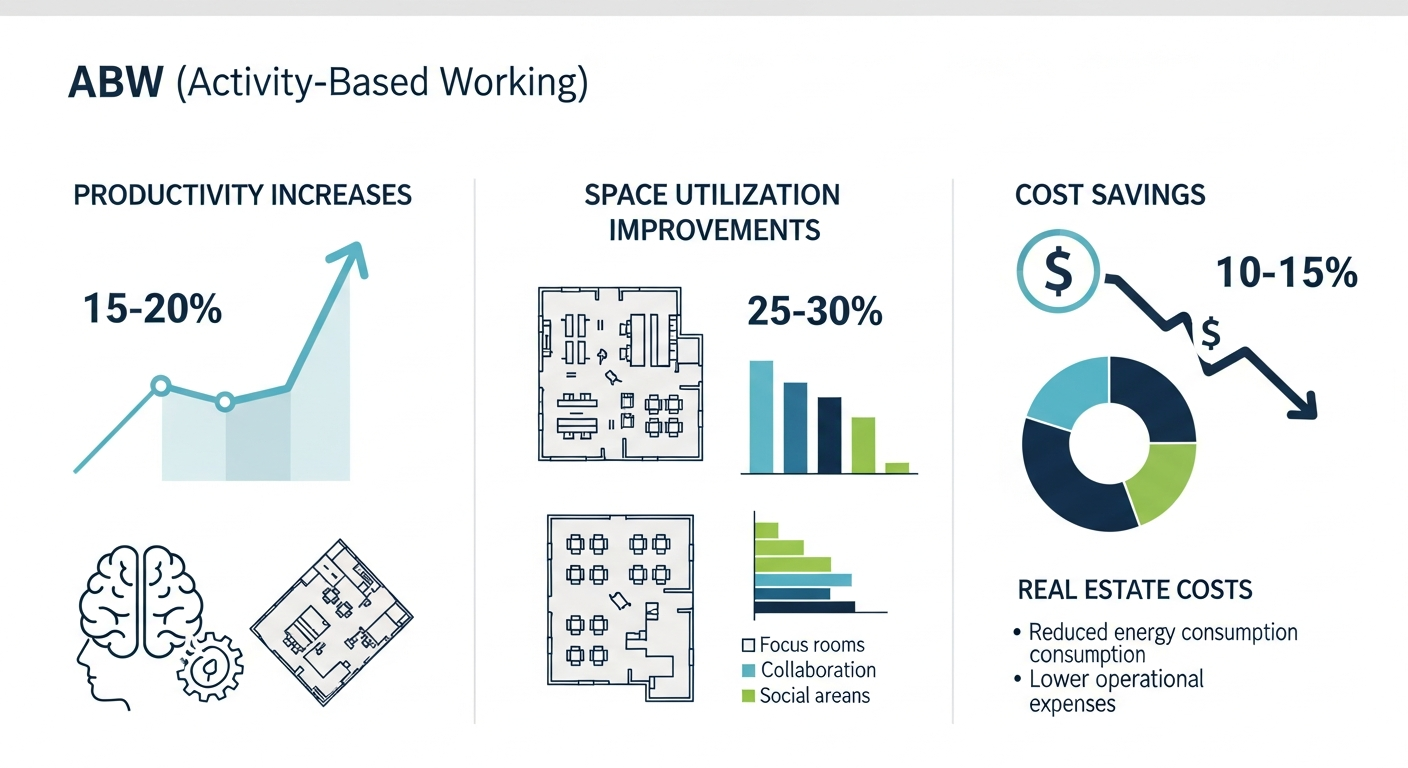
Employee satisfaction metrics provide additional validation for ABW investments. Organizations implementing activity-based working report 32% higher employee satisfaction scores, driven by increased autonomy, better work-environment fit, and reduced frustration with space limitations.
This satisfaction improvement directly supports talent retention and recruitment efforts. In competitive job markets, workplace quality has become a key differentiator for attracting and retaining top talent. Employees increasingly view flexible, well-designed workspaces as evidence of an organization’s commitment to their success and wellbeing.
The recruitment benefits extend beyond employee preferences. Organizations with ABW environments can demonstrate their commitment to innovation, efficiency, and employee experience during the hiring process. This positioning helps attract candidates who value progressive work environments and modern operational approaches.
ABW implementations also support sustainability goals that are increasingly important to employees, customers, and stakeholders. Better space utilization means lower environmental impact per employee, reduced energy consumption, and more efficient resource use. Many organizations find that ABW helps them achieve corporate sustainability targets while improving operational efficiency.
Risk mitigation represents another significant benefit of activity-based working. The COVID-19 pandemic demonstrated the vulnerability of organizations with inflexible space strategies. ABW environments proved more adaptable to changing health requirements, varying occupancy levels, and evolving work patterns. Organizations with ABW infrastructures could more easily accommodate hybrid work models, social distancing requirements, and fluctuating space needs.
The financial benefits extend beyond direct cost savings to include improved lease negotiation positions. Organizations with clear understanding of their actual space utilization patterns can make more informed decisions about lease renewals, expansions, or relocations. This data-driven approach to real estate decisions reduces the risk of over-committing to expensive space that doesn’t align with actual usage patterns.
Implementation costs for ABW environments are often offset by space efficiency gains and productivity improvements within the first year. Unlike traditional office renovations that primarily affect aesthetics, ABW investments generate measurable returns through improved operational efficiency and employee performance.
The cumulative effect of these benefits creates a competitive advantage that extends far beyond the physical workspace. Organizations with well-implemented ABW environments often report improved innovation, faster decision-making, and better cross-functional collaboration—outcomes that directly contribute to business success.
With such compelling evidence supporting ABW adoption, the critical question becomes: what specific space types does an effective activity-based environment actually require?
Essential Space Types in ABW Environments
Creating a successful activity-based working environment requires understanding the full spectrum of work activities and designing dedicated spaces to support each one. Rather than hoping that generic areas will somehow accommodate diverse needs, ABW implementations provide specialized environments optimized for specific tasks and work styles.
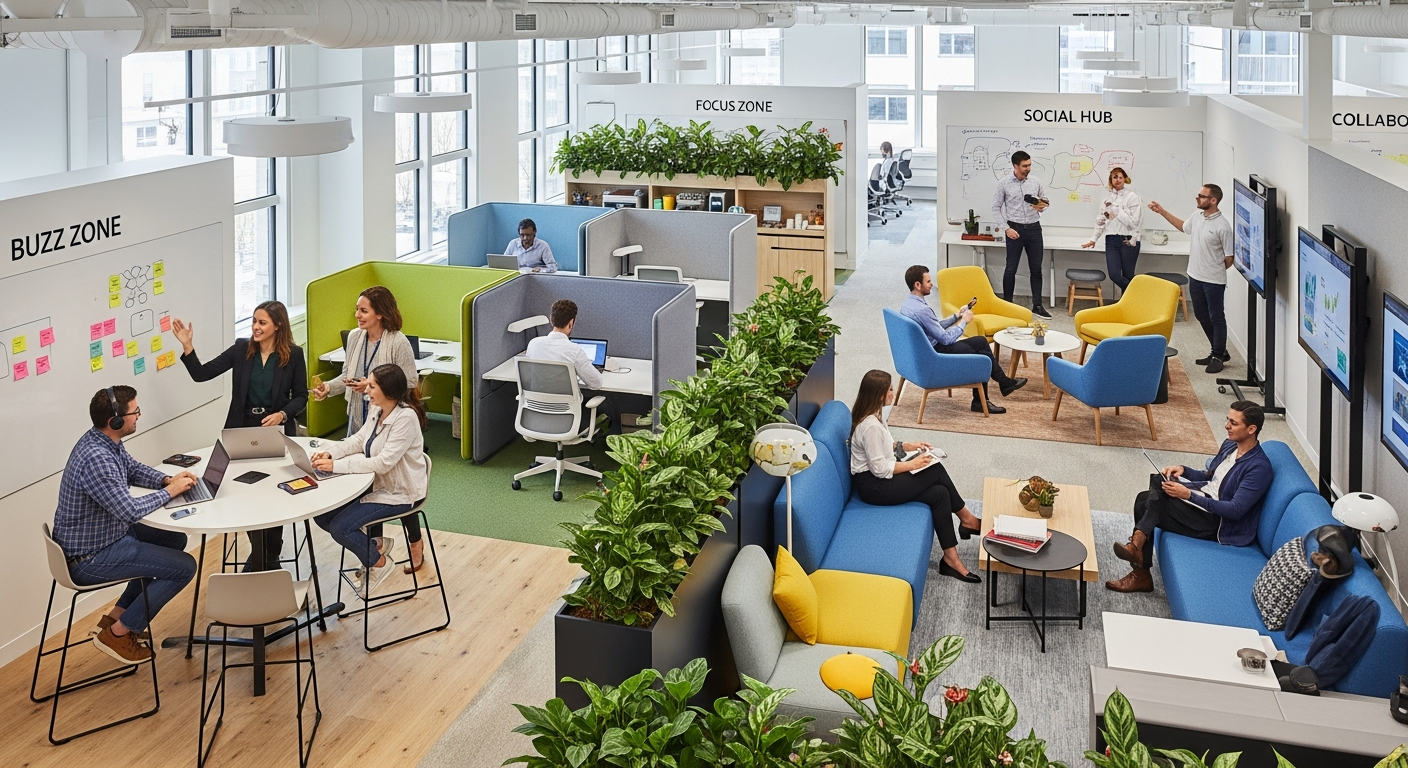
Focus zones form the foundation of any ABW environment, addressing the critical need for concentrated, interruption-free work. These spaces range from individual phone booths and focus pods to larger focus rooms that can accommodate 2-3 people working independently. The key characteristics include acoustic separation, minimal visual distractions, comfortable seating for extended periods, and appropriate lighting for detailed tasks.
Phone booths have become essential in open office environments, providing private spaces for confidential calls, video conferences, and sensitive conversations. These enclosed spaces typically accommodate one person and include ventilation, power outlets, and often integrated technology for seamless connectivity. Focus rooms expand this concept to accommodate multiple individuals who need quiet environments for independent work.
Library-style areas provide another focus option, offering quiet environments with flexible seating arrangements. These spaces typically include a mix of individual carrels, comfortable lounge seating, and standing work surfaces. The emphasis is on creating a scholarly atmosphere that encourages deep thinking and sustained concentration.
Collaboration hubs represent the energetic heart of ABW environments, designed to facilitate teamwork, creativity, and shared problem-solving. These spaces must be technology-enabled, acoustically separated from focus areas, and flexible enough to accommodate different group sizes and working styles.
Traditional meeting rooms remain important, but ABW collaboration hubs go beyond basic conference tables. Project rooms provide dedicated spaces for teams working on extended initiatives, equipped with writable surfaces, digital displays, and flexible furniture configurations. These spaces can be reserved for days or weeks, allowing teams to leave work in progress and maintain momentum between sessions.
Brainstorming areas prioritize creativity and idea generation, featuring writable walls, moveable furniture, and informal atmospheres that encourage free thinking. These spaces often include comfortable lounge seating, standing work surfaces, and abundant natural light to support creative energy.
Technology integration is crucial across all collaboration spaces. Digital whiteboards, wireless presentation capabilities, and high-quality video conferencing equipment enable seamless collaboration between in-person and remote team members. The rise of hybrid work has made technology-enabled collaboration spaces essential for organizational success.
INSERT IMAGE HERE: Detailed floor plan diagram showing different ABW space types labeled and color-coded, with employee avatars demonstrating typical activities in each zone
Social spaces serve the often-underestimated need for informal interaction, relationship building, and community formation. These areas support the spontaneous conversations that drive innovation, the casual check-ins that build trust, and the informal learning that happens between colleagues.
Café areas provide natural gathering spaces where employees can grab coffee, eat meals, and engage in casual conversations. These spaces often feature high communal tables, comfortable lounge seating, and kitchen facilities. The key is creating an atmosphere that encourages lingering and interaction rather than quick transaction and departure.
Game areas and recreational spaces acknowledge that play and relaxation support productivity and creativity. These might include ping-pong tables, board games, or simply comfortable seating arranged to encourage conversation. While some organizations worry about productivity implications, research consistently shows that informal social interaction supports team cohesion and innovation.
Learning environments support the continuous skill development and knowledge sharing that modern organizations require. These spaces accommodate training sessions, presentations, all-hands meetings, and other educational activities.
Classroom-style areas provide formal learning environments with appropriate acoustics, sightlines, and technology integration. Amphitheaters or stadium-style seating work well for larger presentations and company-wide meetings. Demo areas allow for hands-on training and product demonstrations.
Individual work areas bridge the gap between dedicated focus spaces and collaborative environments, providing flexible options for laptop work, casual calls, and independent tasks that don’t require complete isolation.
Hot-desking areas offer traditional desk configurations without assigned ownership, allowing employees to claim workspace as needed. These areas typically include ergonomic office chairs, adjustable-height work surfaces, and easy access to power and connectivity.
Soft seating areas provide alternatives to traditional desk work, acknowledging that many modern tasks can be accomplished comfortably from lounge chairs, standing tables, or casual seating arrangements. Counter-height surfaces along windows or in circulation areas offer quick touchdown options for brief tasks.
Specialized functions address unique organizational needs that don’t fit into standard categories. Maker spaces support prototyping and hands-on work with appropriate tools, ventilation, and storage. Wellness rooms provide private spaces for meditation, prayer, or personal calls. Storage areas ensure that the shared environment doesn’t become cluttered with personal belongings.
Transition zones often receive less attention but play crucial roles in ABW success. Circulation areas, elevator lobbies, and corridor spaces provide opportunities for chance encounters and informal conversations. Well-designed transition zones include casual seating, writable surfaces, and comfortable environments that encourage spontaneous collaboration.
The success of ABW environments depends on thoughtful integration of these space types rather than simply providing one of each. The relative proportions, adjacencies, and design details matter as much as the basic typology selection.
Understanding what spaces are needed represents just the first step in ABW planning—the real challenge lies in determining how much of each space type to include and how to arrange them for optimal functionality.
Space Allocation Strategies: The Planning Challenge
Determining the optimal mix of space types in an ABW environment represents one of the most complex challenges in workplace planning. Unlike traditional office design, where square footage calculations are based on headcount and job roles, activity-based working requires understanding work patterns, task frequency, and organizational culture to create environments that truly support productivity.
Most ABW implementations follow general allocation guidelines as starting points: approximately 60-70% collaborative spaces, 20-25% focus work areas, and 10-15% social and amenity spaces. However, these ratios represent broad frameworks rather than universal solutions. Successful ABW environments require customization based on numerous variables specific to each organization.
Organization size significantly impacts optimal space allocation. Smaller teams (under 50 people) often require higher percentages of collaborative space because informal communication happens more naturally and dedicated focus areas can be smaller and less numerous. Larger organizations typically need more focus spaces to accommodate the greater variety of individual tasks and to provide adequate quiet options when collaborative areas are in high demand.
Industry type creates another critical variable in space planning decisions. Technology companies with significant development work might require 35-40% focus spaces to accommodate programming, design, and analysis tasks that demand sustained concentration. Marketing agencies might prioritize collaborative spaces for campaign development, client presentations, and creative brainstorming sessions. Consulting firms often need more formal meeting spaces and professional client-facing areas.
Work patterns within organizations add another layer of complexity to allocation decisions. Some teams work in predictable cycles—busy periods requiring intensive collaboration followed by quieter phases focused on individual execution. Others maintain consistent patterns throughout the year. Understanding these rhythms helps inform decisions about space flexibility and multi-use capabilities.
Employee demographics influence space preferences and usage patterns. Organizations with predominantly younger workforces often see higher utilization of social spaces and collaborative areas. Teams with more experienced employees typically require greater quantities of quiet, enclosed spaces for focused work. Remote work adoption rates also affect in-office space needs and utilization patterns.
Technology adoption and workflow digitization create additional considerations for space allocation. Organizations with highly digitized processes might need fewer physical collaboration spaces because much of their teamwork happens virtually. Companies still relying on physical documents and analog processes require more storage, printing areas, and spaces for handling physical materials.
Activity mapping and observational studies provide the most reliable data for allocation decisions, but these approaches require significant time and expertise to execute properly. Many organizations attempt to shortcut this process by surveying employees about their preferences, but research shows significant gaps between stated preferences and actual behavior patterns.
The challenge of balancing competing needs adds complexity to every allocation decision. Providing insufficient focus spaces leads to employee frustration, reduced productivity, and complaints about noise and distractions. However, over-providing quiet areas can result in underutilized expensive real estate and missed opportunities for collaboration and innovation.
Social and amenity spaces present similar balancing challenges. Too little social space can undermine company culture and limit the informal interactions that drive innovation. Too much social space may be seen as frivolous expense that could have been better allocated to productive work areas.
Scenario planning becomes essential for testing different allocation strategies before committing to expensive construction and furniture investments. This approach involves modeling various configurations and testing them against different usage scenarios, peak demand periods, and organizational growth projections.
The risks of poor allocation decisions extend beyond employee satisfaction to include significant financial implications. Under-providing collaborative spaces can limit teamwork effectiveness and slow project completion. Over-providing expensive space types can inflate real estate costs without corresponding productivity benefits.
Successful space allocation also requires understanding adjacency relationships and circulation patterns. Focus areas must be acoustically separated from collaborative spaces but easily accessible when employees need to transition between individual and group work. Social spaces should be positioned to encourage natural traffic flow without disrupting concentration areas.
Future flexibility represents another critical consideration in allocation planning. Organizations change, teams grow and shrink, and work patterns evolve. The most successful ABW environments include built-in flexibility that allows for reconfiguration as needs change without major construction projects.
Peak usage patterns add temporal complexity to spatial allocation decisions. Many collaborative spaces experience heavy demand during certain hours or days, while remaining underutilized at other times. Understanding these patterns helps inform decisions about space sharing, booking systems, and flexible furniture solutions.
These allocation decisions represent exactly the kind of complex, multi-variable planning challenge that separates successful ABW implementations from expensive failures that neither support productivity nor justify their costs.
Planning ABW Environments: Transforming Complexity into Clarity
The complexity of ABW space allocation represents a perfect storm of variables that traditional planning methods simply cannot handle effectively. For decades, office planning relied on manual CAD drawings, rules of thumb, and the designer’s experience to create workspaces. This approach worked adequately when offices were simpler and more standardized, but it fails dramatically when applied to the nuanced, multi-variable optimization challenges that ABW environments demand.
Traditional planning processes typically produce one or two design options after weeks of iteration. Architects and designers spend countless hours manually arranging furniture, testing layouts, and producing static 2D drawings that require significant imagination to envision as actual working environments. The result is often a design that looks reasonable on paper but fails to address the complex realities of how people actually work.
The “what if” questions that are critical to ABW success remain largely unanswered in traditional planning approaches. What if we need more focus rooms and fewer large collaboration areas? What if we centralize amenities instead of distributing them throughout the floor? What if we accommodate growth by making certain areas more flexible? These scenarios require completely new drawings and additional weeks of design work.
Traditional planning also struggles with the speed requirements of modern business decisions. Lease negotiations, site evaluations, and project approvals often require space planning insights within days or weeks, not the months that manual design processes typically require. This timing mismatch forces decision-makers to commit to expensive real estate without fully understanding how well the space will support their actual needs.
The visualization limitations of traditional planning create additional challenges for decision-making. Static 2D floor plans require significant expertise to interpret and imagination to envision as functioning workspaces. Stakeholders struggle to understand how proposed layouts will actually feel and function, leading to expensive changes during construction or, worse, environments that don’t work as intended.
Enter the transformation that automated architectural capabilities bring to ABW planning. Modern planning tools can generate multiple scenario options in minutes rather than weeks, enabling rapid exploration of different allocation strategies, layout configurations, and design approaches. Instead of choosing between two options, decision-makers can evaluate five, ten, or more configurations to find the optimal solution for their specific needs.
This automated approach handles the complexity of ABW planning by testing multiple variables simultaneously. Space allocation ratios, adjacency requirements, circulation patterns, and growth scenarios can all be optimized together rather than addressed sequentially. The result is solutions that consider the full range of planning variables rather than simplifying assumptions that lead to suboptimal outcomes.
Rapid iteration capabilities enable the kind of scenario testing that ABW planning demands. Questions about focus space quantities, collaboration area sizes, and amenity placement can be answered through multiple design alternatives rather than theoretical discussions. This evidence-based approach to planning reduces risk and increases confidence in final design decisions.
Immersive 3D visualization transforms the decision-making process by allowing stakeholders to experience proposed environments before construction begins. Rather than imagining how a floor plan might feel, decision-makers can virtually walk through different options, understanding sightlines, spatial relationships, and overall functionality. This capability is particularly crucial for ABW environments where the success depends heavily on how spaces feel and function rather than just how efficiently they use square footage.
The speed advantages of automated planning extend beyond initial design to include ongoing optimization and change management. As organizations learn how their ABW environments are actually used, they can rapidly test alternative configurations and make informed decisions about modifications. This iterative approach to space planning supports the continuous improvement that successful ABW environments require.
Automated planning also democratizes sophisticated design capabilities, enabling non-designers to create professional-grade ABW layouts. Facility managers, real estate professionals, and business leaders can explore space planning options without requiring extensive architectural training. This accessibility speeds decision-making and reduces dependence on external consultants for routine space planning tasks.
The data integration capabilities of modern planning tools provide additional advantages for ABW environments. Occupancy sensors, badge access data, and booking system information can inform space planning decisions with actual usage patterns rather than assumptions about how spaces will be used. This evidence-based approach to planning and optimization represents a fundamental improvement over traditional methods.
Cost optimization becomes more sophisticated when planning tools can rapidly test multiple scenarios. Rather than committing to expensive space configurations based on limited options, organizations can explore numerous alternatives to find solutions that balance cost, functionality, and employee experience. The ability to quickly test different space allocation strategies enables more informed financial decisions about real estate investments.
These automated planning capabilities represent more than technological advancement—they enable a fundamentally different approach to ABW implementation that addresses the complexity and speed requirements of modern business environments.
With the right planning tools in place, success depends on thoughtful implementation strategies that bring ABW concepts to life in ways that actually support organizational goals and employee productivity.
Implementation Best Practices: Making ABW Work
Successfully implementing activity-based working extends far beyond space planning and design to encompass change management, technology integration, and continuous optimization. The most beautifully designed ABW environments fail when organizations underestimate the cultural and operational changes required to make new work patterns successful.
Pilot programs represent the most effective approach to ABW implementation, allowing organizations to test concepts, refine approaches, and build employee confidence before committing to full-scale transformations. A typical pilot might involve converting one floor or department to ABW principles while maintaining traditional spaces elsewhere. This approach provides valuable data about usage patterns, employee adaptation, and operational requirements while minimizing risk and investment.
Pilot programs should run for sufficient time to capture true usage patterns—typically 3-6 months to account for initial adjustment periods and seasonal variations. During this time, organizations can gather quantitative data through occupancy sensors and booking systems alongside qualitative feedback through surveys and focus groups. This dual approach provides comprehensive insights into what works, what doesn’t, and what requires modification.
Change management represents perhaps the most critical factor in ABW success. Employees accustomed to assigned desks and traditional work patterns often experience anxiety about the transition to activity-based environments. Clear communication about the reasons for change, expected benefits, and support during the transition helps address these concerns and builds buy-in for new work patterns.
Training programs should address both the practical aspects of using ABW environments and the cultural shifts required for success. Employees need to understand how to choose appropriate spaces for different tasks, how to use booking systems and shared resources, and how to be respectful of others in shared environments. This training is particularly important for employees who have worked in traditional offices for many years.
Leadership modeling plays a crucial role in successful ABW adoption. When senior executives embrace activity-based working by using different spaces for different tasks and demonstrating respect for shared space etiquette, it signals organizational commitment to the new approach. Conversely, when leaders continue to claim permanent offices while expecting staff to adopt ABW practices, it undermines the cultural change required for success.
Technology integration must be sophisticated yet seamless to support ABW functionality. Desk booking systems allow employees to reserve specific spaces when needed while preventing conflicts over popular areas. These systems should be mobile-friendly and intuitive to encourage adoption and reduce friction in daily use.
Occupancy sensors provide valuable data about actual space utilization patterns, helping organizations understand which areas are in high demand, which are underutilized, and how usage patterns change throughout the day and week. This data informs ongoing optimization efforts and supports evidence-based decisions about space modifications.
Acoustic design becomes critical in ABW environments where different activities happen in proximity to each other. Sound masking systems, appropriate materials selection, and careful space adjacencies help ensure that collaborative activities don’t disrupt focus work. Poor acoustic design is one of the most common reasons ABW implementations fail to deliver promised productivity benefits.
Technology infrastructure must support mobile work patterns and flexible space usage. Robust WiFi coverage, abundant power outlets, and wireless presentation capabilities enable employees to work productively from any space. Video conferencing capabilities in multiple spaces support hybrid work patterns and remote collaboration.
Etiquette guidelines help establish behavioral norms that make shared spaces work effectively for everyone. These might include guidelines about phone call volumes, how long someone can claim a space, and how to clean up after using shared resources. Clear, positive communication about these expectations helps prevent conflicts and maintains a productive environment.
The iterative nature of ABW success requires ongoing monitoring and adjustment. Monthly reviews of usage data, employee feedback, and space functionality help identify areas for improvement. Small modifications—adjusting furniture arrangements, changing booking policies, or adding acoustic treatments—can significantly improve environment effectiveness.
Common pitfalls in ABW implementation include under-providing quiet spaces, inadequate acoustic design, and insufficient technology infrastructure. Organizations often underestimate the demand for focus areas, leading to frustration and complaints about noise and distractions. Acoustic problems can make collaborative areas too disruptive and focus areas inadequately quiet.
Change fatigue represents another common challenge, particularly when organizations implement ABW alongside other major changes. Careful timing and clear communication help minimize this risk, while celebrating early wins and sharing success stories builds momentum for continued adoption.
Feedback loops must be established and maintained throughout the implementation process. Regular pulse surveys, focus groups, and usage data analysis help identify emerging issues before they become major problems. This proactive approach to issue resolution maintains employee confidence and supports continuous improvement.
Long-term success requires viewing ABW as an ongoing operational approach rather than a one-time design project. Work patterns evolve, organizations grow and change, and employee expectations shift over time. The most successful ABW environments include built-in flexibility and established processes for ongoing optimization.
These implementation strategies ensure that ABW investments deliver their promised returns in productivity, satisfaction, and space efficiency while avoiding the common pitfalls that cause expensive implementations to fail.
ABW
The transformation from traditional offices to activity-based working environments represents more than an evolution in workplace design—it’s a strategic response to fundamental changes in how knowledge work happens in the modern economy. The compelling statistics we’ve explored that show 16% productivity increases, 40% space utilization improvements, and up to 30% cost reductions, demonstrate that ABW delivers measurable business value when implemented thoughtfully.
Yet the journey from recognizing ABW’s potential to realizing its benefits requires navigating significant complexity in planning, design, and implementation. The traditional approaches to office planning simply cannot handle the multi-variable optimization challenges that successful ABW environments demand. Manual CAD processes, limited scenario exploration, and static visualization methods leave too many critical questions unanswered and too many expensive decisions made without sufficient information.
The organizations that will thrive in tomorrow’s competitive landscape are those that embrace both the strategic importance of activity-based working and the technological capabilities that make sophisticated ABW planning accessible and efficient. This isn’t about following workplace trends—it’s about investing in organizational agility, employee satisfaction, and competitive advantage through environments that truly support how modern work gets done.
Activity-based working acknowledges that productivity isn’t just about having the right people and processes—it’s about providing environments that amplify human capabilities rather than constrain them. When employees can choose spaces optimized for their immediate tasks, when collaboration flows naturally in purpose-built environments, and when individual focus work happens in truly supportive spaces, the entire organization benefits through improved outcomes, faster innovation, and higher satisfaction.
The evidence is clear: organizations implementing thoughtful ABW strategies gain significant competitive advantages through improved productivity, enhanced talent attraction and retention, and more efficient use of expensive real estate resources. The question isn’t whether activity-based working will become the standard—it’s whether your organization will lead or follow this transformation.
Transform your approach to office space planning with automated architectural capabilities that make sophisticated ABW design accessible and efficient. Traditional methods of designing activity-based working environments are too slow and limited for today’s dynamic business needs, forcing decisions based on incomplete information and constraining exploration of optimal solutions.
Modern planning technology enables rapid exploration of multiple ABW scenarios, comprehensive testing of space allocation strategies, and immersive 3D visualization that brings proposed environments to life before construction begins. Whether you’re a commercial real estate professional evaluating sites for clients, a landlord optimizing building layouts for maximum tenant satisfaction, or an organization planning your next office environment, automated architectural services accelerate decision-making and deliver the space efficiency, employee satisfaction, and cost optimization that ABW promises.
The future of work is activity-based, and the tools to plan these environments effectively are available today. Discover how automated architectural capabilities can unlock the full potential of your next workspace project and position your organization at the forefront of workplace innovation.






.png)


