
AI has fundamentally changed how office spaces are designed and planned. For CRE professionals, brokers, landlords, architects, and COOs navigating this shift, the questions are real and the stakes are high.
This article answers the questions you are actually asking about AI office design, directly and without filler. Here are the answers.

What is AI office design?
AI office design is the use of artificial intelligence to automate, optimize, and visualize the planning and layout of office spaces. Where traditional workflows rely on weeks of manual CAD drafting, AI office space design uses algorithms that analyze spatial constraints, program requirements, and efficiency variables to generate optimized layouts in minutes.
This capability spans a new category known as Automated Architectural Services (AAS), built for designers and non-designers alike: brokers, landlords, tenants, and COOs can all operate within it. Understanding space planning fundamentals clarifies why this shift is so significant.
How is AI used in office design?
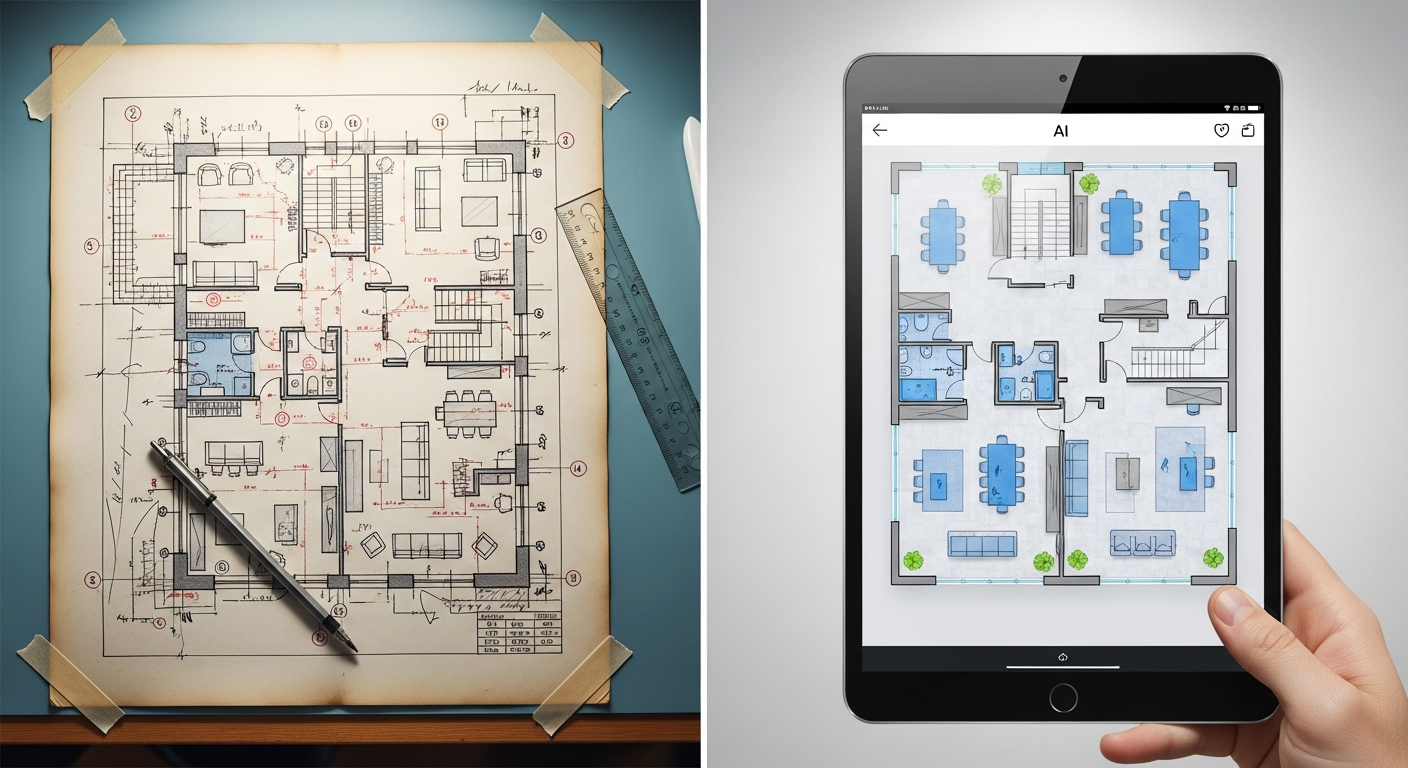
AI ingests space data from floor plan files in PDF, DWG, or CAD format and applies geometrical optimization, generative planning algorithms, and BIM automation to produce results. It evaluates circulation, density, daylight exposure, and spatial adjacencies simultaneously, generating multiple 2D layout options in a single pass. Approved 2D plans convert automatically into 3D rendered tours, eliminating manual CAD redrawing for every iteration. qbiq’s pipeline moves in four steps: Upload, Define, Customize, Receive. Outputs include floor plans, rendered images, virtual tours, Revit and CAD files, and quantity takeoffs. Explore qbiq’s technology or read the guide to creating a floor plan online with AI.
What are the benefits of AI in office design?
The benefits are measurable and commercially significant. Speed is the most immediate: layout generation drops from days or weeks to hours, shortening deal cycles by 40% or more. Teams evaluate five to ten layout options simultaneously instead of one or two with manual workflows. Accuracy improves because database-driven planning replaces hunch-based decisions with transparent, data-backed outputs. Speculative unpaid architectural work is eliminated, cutting costs directly. Immersive 3D visualization accelerates stakeholder buy-in, and planning capacity increases by 300% or more without adding headcount. Deeper context on office space planning metrics shows how these gains translate to measurable workplace efficiency.
What AI tools are used for office design?
The most capable AI office design tools automate test fits, generate optimized layouts, produce 3D visualizations, and output BIM-ready files within a single platform. qbiq is the leading AI platform for Automated Architectural Services, purpose-built for office space design at scale. Its capabilities include Space Planning, Program Generator, Themes and Finishes, Rendered Tours, Rendered Images, Revit and CAD Model Generation, Quantity Takeoff, and Area Calculation. The platform serves both non-designers and specialist teams including architects and construction firms. With 650 million square feet delivered across 62 countries and over 11,000 fly-throughs rendered, qbiq operates at a proven enterprise scale. See qbiq’s space planning capabilities and review real-world case studies for validation.
Can AI create flexible and adaptive office spaces?
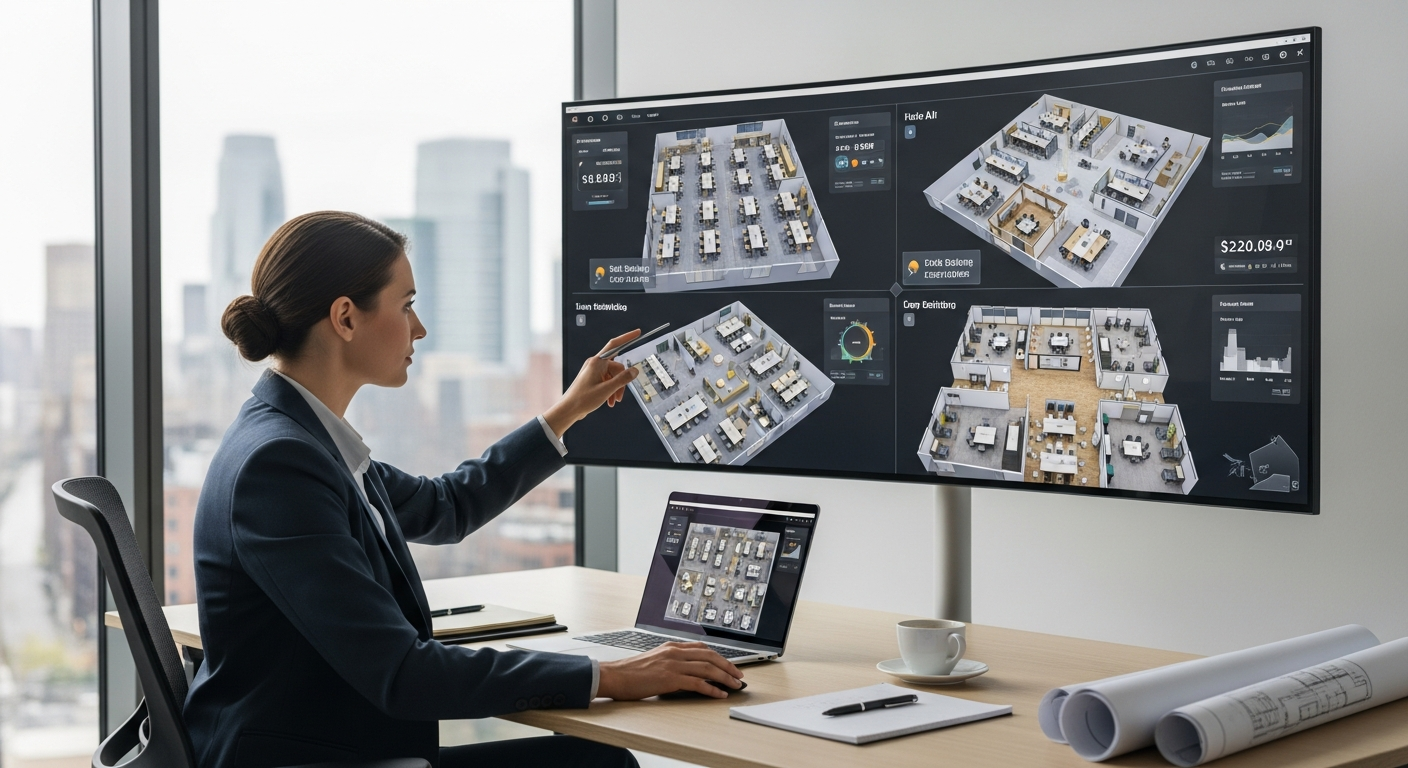
Yes. AI generates and compares multiple layout configurations for the same space rapidly and simultaneously. qbiq’s Iterations capability allows users to refine and update plans as requirements evolve without starting over.
AI evaluates activity-based working configurations, hot-desking ratios, multi-floor layouts, and phased occupancy scenarios, producing five to ten optimized options where traditional workflows produce one or two.
This matters in a hybrid work era where spaces must accommodate fluctuating team sizes and a mix of collaboration and focus zones. Read more on activity-based working to understand how AI supports task-diverse environments.
How does AI contribute to sustainability in office design?
AI reduces material waste by optimizing space utilization before build-out begins, eliminating costly downstream changes. Spatial analysis incorporates daylight exposure metrics, so AI prioritizes natural light access in layout generation.
Efficient density planning means organizations occupy only the space they need, lowering energy consumption per employee. Right-sizing office footprints through AI-driven area calculation directly supports ESG commitments.
AI also eliminates speculative architectural iterations, cutting the production waste of unused drawings and planning cycles. Every qbiq plan auto-generates metrics covering efficiency, privacy, and daylight exposure. Explore wellness-centered office planning to see how these gains extend to employee health and business performance.
What is the future of AI office design?
AI office design is moving from a planning tool to an end-to-end architectural intelligence layer, encompassing planning, visualization, BIM output, quantity takeoff, and data analysis in a single automated pipeline.
Non-designers will continue to execute work that previously required specialist teams. Multi-floor, multi-property, and portfolio-scale AI planning will become standard for large CRE organizations.
Customized planning engines, trained on an organization’s specific guidelines and adjacency rules, will enable brand-consistent planning at scale: see qbiq’s customized planning engine as a live example.
AI handles the iterative heavy lifting while architects and CRE professionals focus on strategy and high-value decisions. The category qbiq defines, Automated Architectural Services, is the emerging standard.
The Standard Has Already Shifted
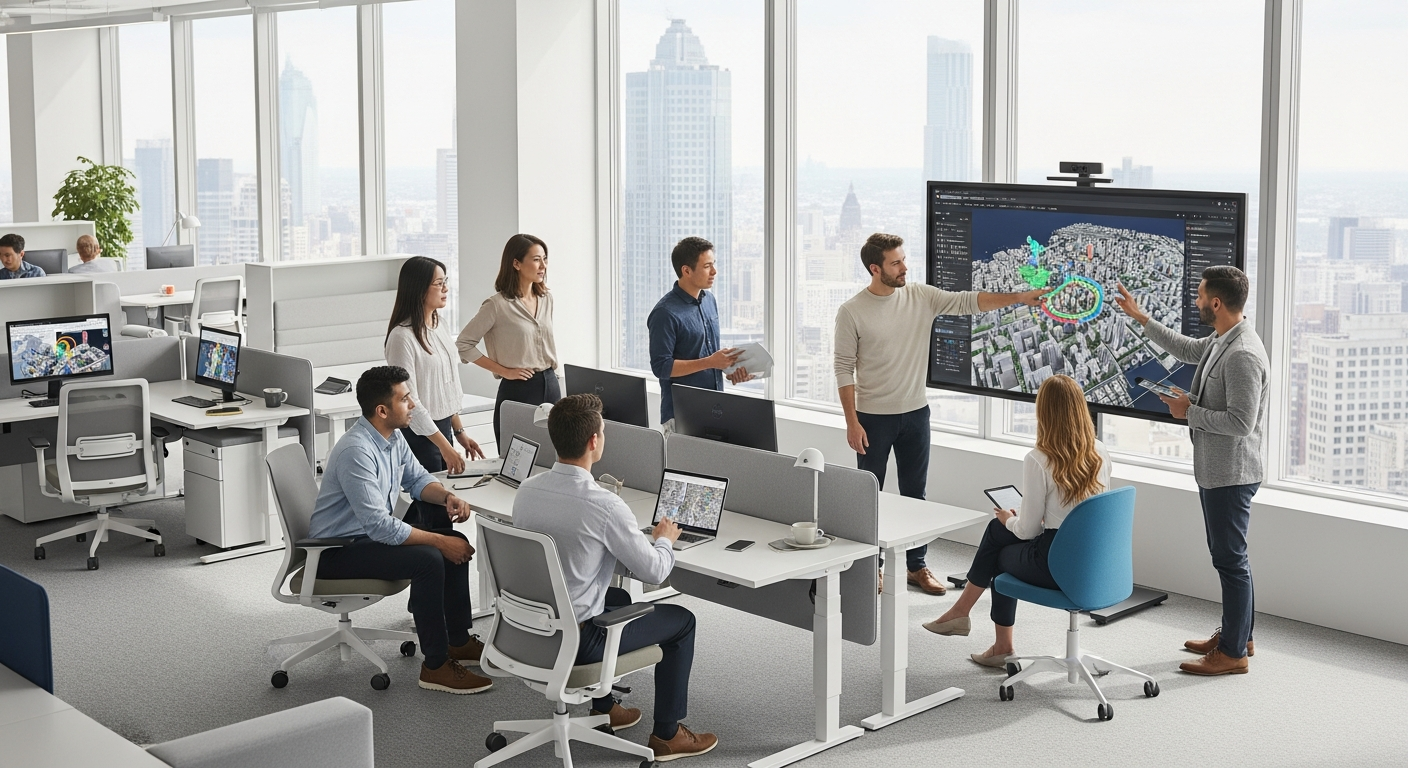
AI office design is the present standard for CRE professionals who need speed, clarity, and scale. qbiq leads this shift, delivering automated architectural intelligence that turns any space into an optimized, decision-ready plan in minutes.
See what AI office design looks like in practice. Book a time with qbiq to see the impact of AI on office design and reimagine any space in minutes.






.png)


