
The modern workplace has reached a turning point. Companies that invest in employee wellness programs achieve an average ROI of $3.27 for every dollar spent, primarily through reduced healthcare costs and increased productivity. This isn’t a feel-good statistic. This is a fundamental business reality that’s reshaping how commercial real estate professionals, landlords, and business leaders approach office design.
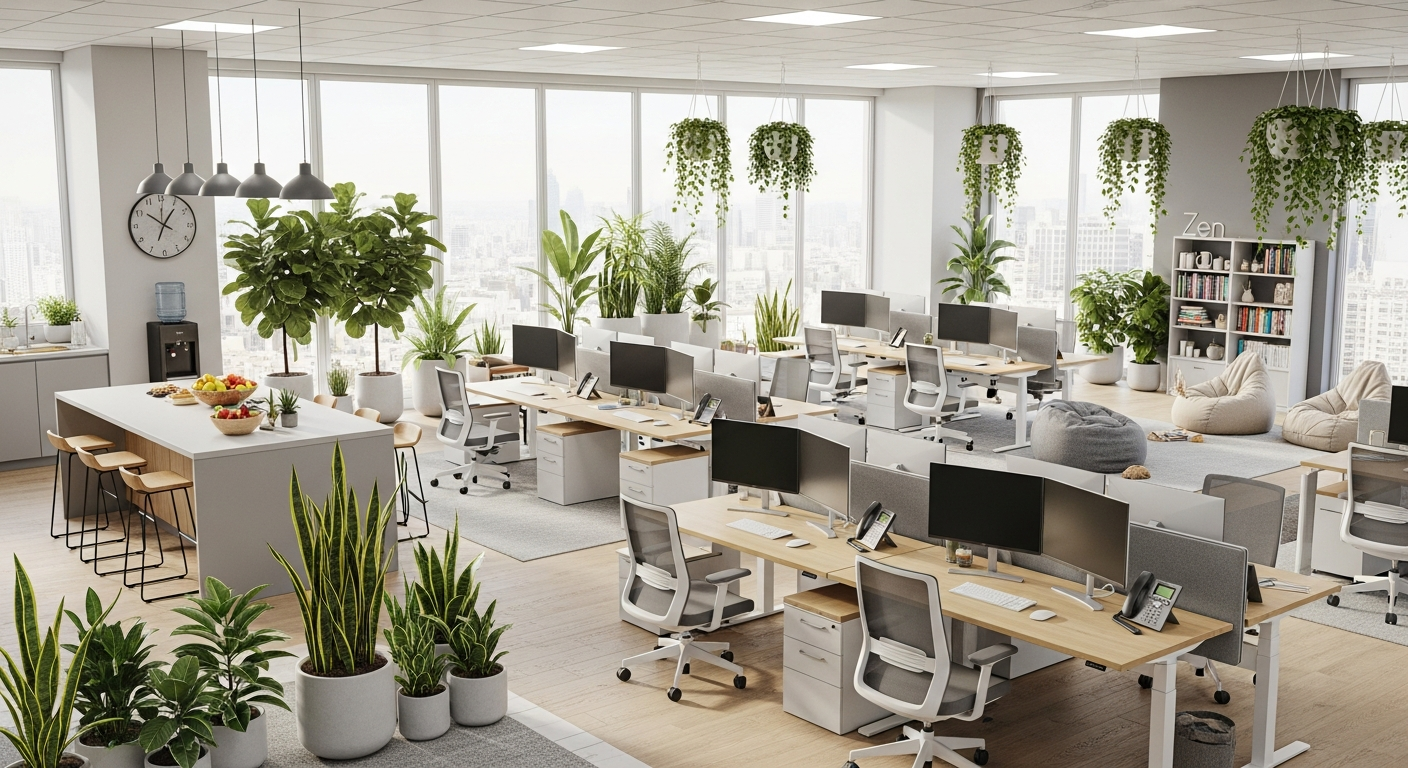
For decades, office design focused primarily on maximizing square footage efficiency and minimizing costs. But in today’s competitive talent market, where employee expectations have fundamentally shifted, wellness-centered office planning has emerged as a strategic necessity rather than a luxury amenity. The challenge facing CRE professionals isn’t whether to incorporate wellness features—it’s how to implement them efficiently and effectively at scale.
This comprehensive guide examines the measurable business impact of wellness-focused design, provides actionable frameworks for implementation, and reveals how modern automation capabilities are transforming the speed and sophistication of wellness-centered office planning. Whether you’re designing a single tenant space or managing a portfolio of commercial properties, understanding the intersection of employee health and business performance has never been more critical.
The stakes are higher than many realize. Organizations that fail to prioritize wellness design risk not only higher healthcare costs and reduced productivity but also significant challenges in talent attraction and retention. Conversely, those who master wellness-centered planning gain competitive advantages that extend far beyond their physical spaces.
The Business Case for Wellness-Centered Office Design
The financial argument for wellness-centered office design isn’t built on speculation—it’s supported by compelling data that speaks directly to bottom-line impact. Companies with top-tier wellness initiatives outperform the S&P 500 by an astounding 76%, achieving 235% stock appreciation over six years compared to 159% for the broader market. This performance differential reflects the cascading business benefits of prioritizing employee health through thoughtful design.
Enhanced indoor air quality alone demonstrates the measurable value of wellness investments. Research shows that improving air quality can boost employee performance by up to 8%, which translates to approximately $6,500 annually per employee in productivity gains. When multiplied across an entire workforce, these improvements represent substantial competitive advantages that compound over time.
“Organizations with green buildings experience 6% productivity increases and 15% improvement in employee well-being, creating measurable value that extends far beyond aesthetic appeal.”
The Harvard study on wellness ROI reveals additional compelling metrics that underscore the strategic importance of wellness design. Green building initiatives consistently deliver productivity increases of 6% alongside 15% improvements in employee well-being scores. These gains aren’t marginal—they represent the difference between industry-leading performance and merely keeping pace with competitors.
Post-pandemic workplace dynamics have elevated employee health from a nice-to-have benefit to a non-negotiable factor in talent decisions. CBRE insights on employee well-being investment demonstrate that modern tenants increasingly prioritize wellness features when selecting office space, making these investments essential for property competitiveness.
The financial benefits extend beyond productivity gains to encompass reduced healthcare costs, lower absenteeism rates, and significantly improved employee retention. When organizations invest in comprehensive wellness design, they create environments that proactively support health rather than merely accommodating sickness. This shift from reactive to preventive approaches generates compound returns through reduced insurance premiums, decreased turnover costs, and enhanced employer brand value.
The World Green Building Council productivity research provides additional validation for the connection between sustainable design and measurable performance outcomes. Their findings consistently show that wellness-focused spaces don’t just feel better: they perform better across every metric that matters to business success.
Perhaps most importantly, wellness-centered design has become a competitive differentiator in talent acquisition. In markets where top performers have multiple options, the quality of the work environment often serves as the deciding factor between similar opportunities. Organizations that can demonstrate genuine commitment to employee health through their physical spaces gain significant advantages in recruiting and retaining high-value contributors.
Understanding these financial realities establishes the foundation for strategic wellness planning, but the real value emerges from knowing how to translate these principles into specific, implementable design elements that deliver measurable results.
Core Wellness Design Principles: The Foundation Framework
Effective wellness-centered office design operates on interconnected principles that work together systematically rather than as isolated features. Understanding this holistic framework enables strategic decision-making that maximizes both employee health outcomes and return on investment across diverse space types and organizational needs.
Biophilic Design Integration forms the cornerstone of wellness-focused environments. This principle extends far beyond adding a few plants to reception areas—it involves incorporating natural elements throughout the workspace in ways that reduce stress and improve cognitive function. Research consistently demonstrates that employees in biophilic environments show measurable improvements in productivity, creativity, and overall satisfaction. The key lies in thoughtful integration that feels natural rather than forced, creating connections to nature that support both psychological well-being and operational efficiency.
Environmental Quality Optimization addresses the fundamental building blocks of healthy spaces: air, light, acoustics, and temperature control. These elements function as the invisible infrastructure of wellness, directly impacting everything from immune system function to cognitive performance. Poor environmental quality can undermine even the most thoughtful design elements, while optimized conditions create foundations for sustained high performance.
The principle of Movement and Circulation Design recognizes that sedentary work environments contribute significantly to health problems and reduced productivity. Wellness-centered planning incorporates layouts that naturally encourage physical activity throughout the workday, from strategically placed amenities that require walking to collaborative spaces that promote standing meetings. The goal isn’t to disrupt workflow but to integrate healthy movement patterns seamlessly into daily routines.
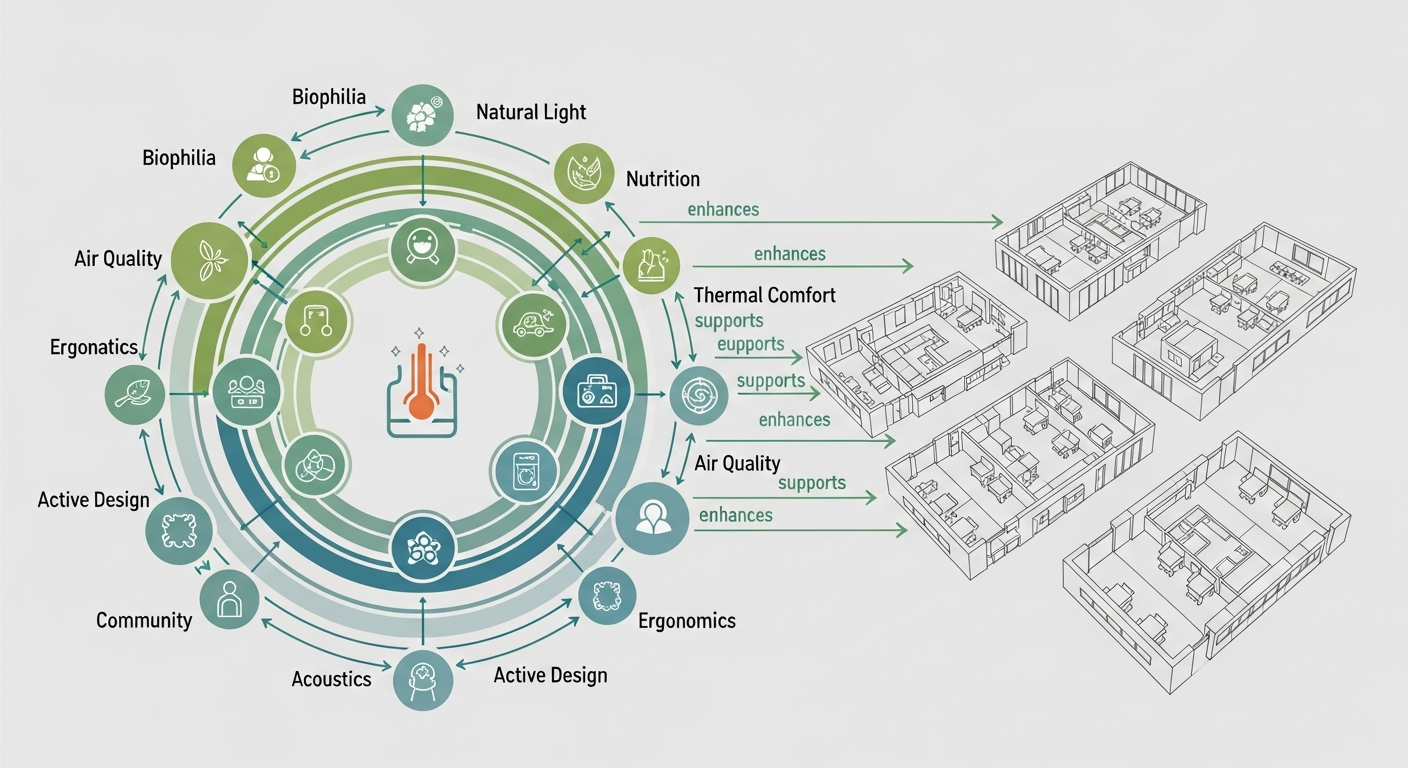
Mental Health Support Through Spatial Design addresses the psychological dimensions of workplace wellness that are often overlooked in traditional planning. This includes providing privacy options for different work modes, creating quiet zones for restoration and focus, and designing environments that actively reduce stress rather than merely avoiding stressors. The most effective implementations offer variety and choice, recognizing that different individuals have varying needs for optimal psychological comfort.
Flexibility and Adaptability ensure that wellness features remain relevant as organizational needs and employee expectations evolve. Static designs that cannot accommodate change quickly become obsolete, while adaptable frameworks maintain their value over time. This principle is particularly important in today’s rapidly changing work environment, where hybrid schedules and evolving collaboration patterns require spaces that can pivot without major reconstruction.
The principle of Social Connection Facilitation balances the human need for community with requirements for individual productivity. Wellness-centered design creates opportunities for positive social interactions while respecting personal space and work focus. The Global Wellness Summit building guidelines emphasize that social wellness is equally important as physical wellness in creating high-performing work environments.
These principles succeed when they work together holistically rather than competing for attention or resources. The most effective wellness designs seamlessly integrate multiple elements to create environments that feel natural and supportive rather than clinical or overwhelming. This integration requires sophisticated planning capabilities that can evaluate multiple variables simultaneously—a challenge that traditional manual design processes struggle to address efficiently.
Understanding this framework provides the foundation for implementing specific wellness elements that deliver measurable improvements in both employee health and business performance. The next step involves translating these principles into concrete design elements that create tangible environmental improvements.
Physical Wellness Elements: Environmental Quality That Drives Performance
The physical environment directly influences employee health, productivity, and satisfaction through measurable environmental factors that can be optimized for maximum impact. Understanding how to implement these elements strategically creates immediate improvements in workplace performance while establishing foundations for long-term wellness outcomes.
Natural Lighting Optimization represents one of the most powerful wellness interventions available to workplace designers. Access to daylight doesn’t just improve mood—it regulates circadian rhythms, reduces eye strain, and increases vitamin D production, all of which contribute to better sleep quality, enhanced immune function, and improved cognitive performance. Strategic placement of workstations near windows, use of light shelves to distribute daylight deeper into spaces, and implementation of circadian lighting systems that adapt throughout the day create environments that support natural biological processes rather than working against them.
The productivity impact of lighting optimization is measurable and significant. Studies consistently show that employees with access to natural light experience 15% increase in well-being, 6% increase in productivity, and 15% increase in creativity compared to those in artificially lit environments. These improvements translate directly to business value through enhanced output quality and reduced fatigue-related errors.
Indoor Air Quality Management serves as the invisible foundation of workplace wellness, affecting everything from cognitive function to long-term health outcomes. Proper ventilation systems, low-VOC material selection, and advanced air filtration create environments that prevent sick building syndrome while actively supporting optimal brain function. The air quality performance improvement study demonstrates that enhanced air quality improvements can increase cognitive performance by up to 101% in certain tasks.
Implementation of effective air quality systems requires attention to multiple factors: adequate fresh air exchange rates, filtration of particulates and VOCs, humidity control to prevent mold growth, and monitoring systems that maintain optimal conditions consistently. The investment in superior air quality systems pays dividends through reduced sick days, improved focus, and enhanced overall productivity.
Biophilic Elements Integration brings measurable stress reduction and cognitive enhancement to workplace environments. Living walls, natural materials, water features, and views of nature reduce cortisol levels while improving focus and creativity. The key to successful biophilic design lies in authentic integration rather than superficial addition—elements should feel natural and purposeful rather than decorative afterthoughts.
Research shows that even simple biophilic interventions like indoor plants can improve air quality while reducing stress by up to 15%. More comprehensive implementations that include natural materials, organic shapes, and strategic nature views create environments that support sustained high performance through reduced mental fatigue and enhanced psychological restoration.
Ergonomic Infrastructure addresses the physical demands of modern work while preventing musculoskeletal disorders that plague sedentary occupations. Adjustable workstations, varied seating options, proper monitor placement, and movement-friendly layouts create environments that support physical health throughout the workday. The most effective ergonomic implementations offer choice and adaptability, recognizing that different tasks and individuals require different physical configurations for optimal performance.
Investment in ergonomic infrastructure delivers returns through reduced workers’ compensation claims, decreased absenteeism due to physical discomfort, and improved productivity through better physical comfort. The qbiq’s workspace planning efficiency insights demonstrate how automated planning capabilities enable rapid evaluation of ergonomic configurations to optimize both comfort and space efficiency.
Temperature and Humidity Control affects cognitive performance more dramatically than many realize. Optimal thermal comfort zones—typically between 68-72°F with 40-60% humidity—support sustained mental performance while preventing discomfort that leads to distraction and reduced productivity. Advanced HVAC systems that provide individual control options acknowledge that thermal preferences vary among individuals while maintaining overall environmental optimization.
Color Psychology Application uses evidence-based color schemes to support different types of cognitive work. Blues and greens promote focus and calm, energizing colors like orange stimulate creativity and collaboration, while neutral tones create restful environments for restoration. Strategic color application throughout different zones supports the varied cognitive demands of modern work while maintaining aesthetic cohesion.
These physical elements work synergistically to create environments that actively support health rather than merely avoiding harm. However, the psychological and cognitive aspects of wellness design are equally important for creating workplaces that sustain high performance over time.
Mental Health and Cognitive Performance: Designing for Focus and Well-being
The psychological dimensions of workplace design significantly impact employee mental health, stress levels, and cognitive performance, yet these factors are often overlooked in traditional office planning. Understanding how spatial design influences mental well-being enables the creation of environments that support sustained focus, emotional regulation, and psychological safety.
Acoustic Design for Concentration addresses one of the most common workplace stressors: noise pollution and its impact on cognitive performance. Open office environments, while promoting collaboration, can create acoustic challenges that undermine deep focus and increase stress levels. Effective acoustic design employs sound masking systems, strategic material selection, and spatial zoning to create appropriate noise levels for different types of work.
Research demonstrates that noise distractions can reduce cognitive performance by up to 66%, making acoustic control essential for productivity. The most effective implementations create acoustic zones—quiet areas for focused work, moderate sound levels for collaboration, and buffer zones that transition between different acoustic environments. Sound-absorbing materials, white noise systems, and strategic layout planning work together to support both collaboration and concentration needs.
Privacy and Personal Control directly influence employee stress levels and job satisfaction. The ability to choose between different work environments—from open collaboration areas to private focus spaces—provides psychological comfort that enhances performance. Privacy doesn’t necessarily mean physical isolation; it includes visual privacy, acoustic privacy, and the ability to control one’s immediate environment.
Implementing varied privacy options requires sophisticated space planning that accommodates different work modes without sacrificing efficiency. Phone booths for private calls, quiet zones for deep focus, semi-private alcoves for small group work, and adjustable elements that allow personal customization create environments that adapt to individual needs while maintaining overall organizational functionality.
Stress Reduction Through Spatial Design creates environments that actively promote calm and restoration rather than merely avoiding stressors. This includes designated quiet zones, meditation or wellness rooms, and spaces specifically designed for mental breaks and restoration. The goal is to provide easily accessible options for psychological reset during demanding workdays.
Effective stress reduction design incorporates elements like soft lighting, comfortable seating, natural materials, and separation from high-energy work areas. These spaces don’t need to be large, but they must be genuinely restful and easily accessible to encourage regular use. The mental health workplace design research shows that access to restoration spaces can reduce employee stress levels by up to 25%.
Visual Complexity Management balances stimulation and simplicity to support sustained attention without causing cognitive overload. Environments that are too stark can feel sterile and uninspiring, while overly complex spaces can create visual noise that increases mental fatigue. Optimal visual design provides enough interest to maintain engagement while avoiding overwhelming distractions.
Strategic use of artwork, natural elements, color variation, and architectural details creates visual interest that supports creativity and engagement without compromising focus. The key lies in understanding how different types of work require different levels of visual stimulation and designing zones accordingly.
Social Interaction Design recognizes that positive social connections are essential for mental health and job satisfaction while respecting individual work requirements. Spaces that facilitate organic social interactions (casual collision points, comfortable communal areas, and collaborative zones) support team building and emotional well-being.
The most effective social design creates opportunities for interaction without forcing them. Kitchen areas, coffee stations, comfortable seating clusters, and transitional spaces between work zones provide natural gathering points that encourage positive social connections while allowing individuals to choose their level of engagement.
Circadian Rhythm Support extends beyond lighting to include temperature variations, activity patterns, and environmental cues that align with natural biological cycles. Lighting systems that gradually shift color temperature throughout the day, temperature variations that mirror natural patterns, and design elements that provide temporal orientation help maintain healthy sleep-wake cycles even in windowless environments.
Supporting natural circadian rhythms improves sleep quality, mood regulation, and cognitive performance while reducing the health impacts of artificial environments. The qbiq’s AI office design bottleneck solutions demonstrate how advanced planning tools can optimize circadian support while maintaining space efficiency and functionality.
These mental health and cognitive considerations work alongside physical wellness elements to create comprehensive environments that support human thriving rather than merely human functioning. The challenge lies in implementing these complex, interconnected elements efficiently across diverse space requirements and organizational needs.
Implementation and Evaluation: Scaling Wellness Design Efficiently
Translating wellness design principles into actual workplace improvements requires strategic implementation approaches that maximize impact while managing costs, timelines, and organizational constraints. The gap between understanding wellness benefits and achieving them lies primarily in execution—specifically, the ability to evaluate and implement optimal solutions efficiently.
Prioritization Framework for Maximum Impact enables organizations to focus wellness investments where they deliver the greatest returns. Not all wellness features provide equal value for every organization, tenant type, or space configuration. A strategic prioritization approach considers factors like current space limitations, employee demographics, work patterns, budget constraints, and measurable outcome priorities.
High-impact, lower-cost interventions often include lighting optimization, air quality improvements, and biophilic elements that can be implemented without major structural changes. Medium-impact interventions might involve acoustic improvements, ergonomic infrastructure upgrades, and layout modifications that enhance movement patterns. Higher-cost implementations typically include advanced HVAC systems, major layout reconfigurations, and comprehensive environmental control systems.
The key to effective prioritization lies in understanding which interventions will deliver measurable improvements for specific organizational contexts. A call center environment might prioritize acoustic design and air quality, while a creative agency might emphasize natural lighting and biophilic elements. Financial services firms might focus on privacy options and stress reduction areas, while technology companies might emphasize collaborative zones and flexible configurations.
Evaluation Metrics for Measuring Success establish baseline performance and track improvements over time. Effective wellness design evaluation combines objective environmental measurements with subjective employee feedback and business performance indicators. Environmental metrics include air quality readings, lighting levels, temperature consistency, and acoustic measurements. Employee metrics encompass satisfaction surveys, health assessments, stress indicators, and productivity self-reports.
Business performance metrics provide the crucial link between wellness investments and organizational outcomes. These include absenteeism rates, healthcare costs, turnover statistics, productivity measurements, and performance reviews. The most convincing evaluation frameworks track these metrics before and after wellness implementations to demonstrate measurable ROI.
Common Implementation Challenges require proactive management to ensure successful wellness design adoption. Budget constraints often limit the scope of possible interventions, making prioritization frameworks essential for maximizing impact within available resources. Existing infrastructure limitations may require creative solutions or phased approaches that work within current constraints while planning for future improvements.
Tenant variability presents particular challenges in multi-tenant environments where different organizations have varying wellness priorities and space requirements. Successful implementations often focus on common areas and building-wide systems while providing flexibility for tenant-specific customizations within individual spaces.
Phased Implementation Strategies enable organizations to introduce wellness features progressively without major operational disruptions. Phase one might focus on quick wins like lighting improvements, air quality enhancements, and basic biophilic elements. Phase two could introduce acoustic improvements, ergonomic upgrades, and layout optimizations. Phase three might encompass comprehensive environmental systems and major spatial reconfigurations.
Phased approaches provide opportunities to evaluate results and adjust strategies based on actual performance rather than theoretical projections. They also spread costs over time while building organizational confidence in wellness investments through demonstrated results from earlier phases.
Stakeholder Alignment and Buy-In requires connecting wellness features to business outcomes that matter to decision-makers. Financial executives need to see ROI projections and cost-benefit analyses. Operations managers need to understand implementation timelines and minimal disruption strategies. Human resources teams need to see connections to recruitment, retention, and employee satisfaction. Facility managers need to understand maintenance requirements and operational impacts.
The CBRE implementation insights provide valuable frameworks for building business cases that resonate with diverse stakeholder priorities while maintaining focus on measurable wellness outcomes.
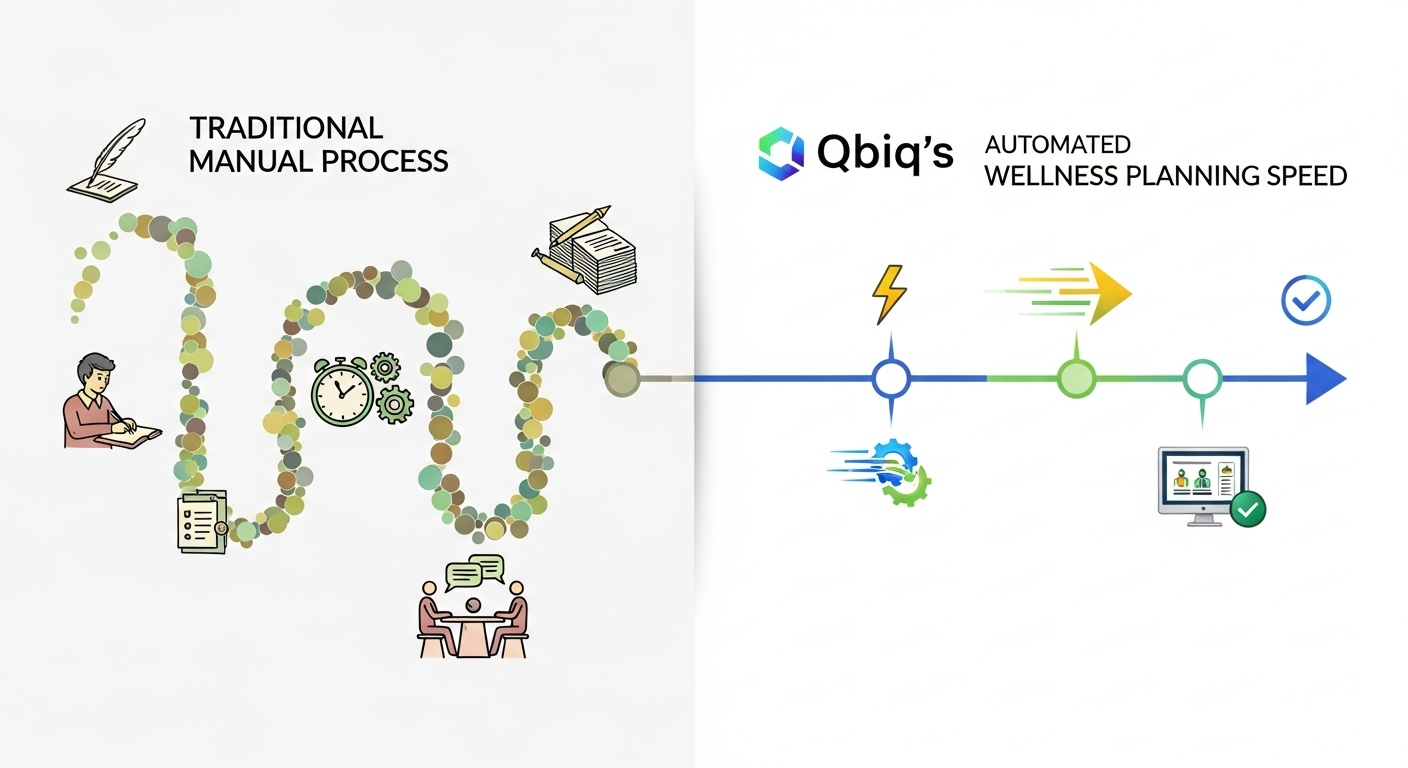
The Speed and Evaluation Challenge represents the most significant bottleneck in wellness design implementation. Traditional manual evaluation methods require weeks to assess single scenarios, limiting the exploration of optimal solutions and slowing decision-making processes. In competitive markets where timing matters, this evaluation bottleneck can prevent organizations from capitalizing on wellness opportunities or responding quickly to changing needs.
Manual processes also limit the sophistication of wellness evaluation, making it difficult to optimize multiple variables simultaneously or explore creative solutions that balance competing requirements. The qbiq’s construction efficiency solutions demonstrate how automation capabilities can accelerate both evaluation and implementation phases.
This evaluation challenge highlights the need for technological solutions that can rapidly assess multiple wellness scenarios, enabling informed decision-making based on comprehensive analysis rather than limited options or time-pressured guesswork.
The Automation Advantage: Rapid Wellness-Focused Planning with qbiq
The transformation from manual to automated architectural capabilities represents a fundamental shift in how wellness-centered office planning can be approached, evaluated, and implemented. Traditional methods that require weeks to evaluate single wellness scenarios cannot meet the speed demands of modern business decision-making, creating bottlenecks that prevent organizations from optimizing their wellness investments.
The Traditional Challenge: Manual Limitations manifest in multiple ways that constrain wellness design effectiveness. Manual CAD processes require extensive time investments to evaluate even basic wellness scenarios, with comprehensive evaluations taking weeks or months to complete. This timeline limitation forces organizations to choose between speed and thoroughness, often resulting in suboptimal solutions that could have been avoided with more comprehensive analysis.
The complexity of wellness design compounds these challenges. Optimizing for natural lighting while maintaining acoustic comfort, privacy options, and circulation efficiency requires simultaneous evaluation of multiple variables that manual processes handle sequentially rather than holistically. This sequential approach often leads to solutions that excel in one area while compromising others, missing opportunities for integrated designs that optimize overall wellness outcomes.
Manual evaluation also limits exploration of creative alternatives. When each scenario requires significant time investment, organizations naturally gravitate toward conservative, familiar approaches rather than exploring innovative solutions that might deliver superior wellness outcomes. This risk-averse behavior perpetuates conventional design patterns rather than advancing wellness-focused innovation.
The qbiq Revolution: Automated Multi-Parameter Optimization enables comprehensive wellness evaluation in minutes rather than weeks, fundamentally changing what’s possible in wellness-centered planning. Automated systems can simultaneously optimize for natural light distribution, air circulation patterns, acoustic zones, movement pathways, biophilic integration, and privacy gradations while maintaining space efficiency and functional requirements.
This multi-parameter optimization capability allows for exploration of design solutions that would be impractical to evaluate manually. For example, testing how different workstation orientations affect both natural lighting access and acoustic privacy across dozens of layout variations becomes feasible when automated systems can evaluate multiple scenarios rapidly.
The qbiq’s AI office design capabilities demonstrate how artificial intelligence can analyze billions of square feet of space planning data to identify proven wellness design patterns while adapting them to specific space constraints and organizational requirements.
Rapid Iteration for Optimal Solutions enables design teams to explore multiple wellness scenarios quickly, testing different approaches to find optimal balances between competing requirements. Rather than committing to the first viable solution, teams can evaluate dozens of alternatives to identify designs that maximize wellness benefits while maintaining operational efficiency.
This rapid iteration capability is particularly valuable for wellness design because optimal solutions often emerge from unexpected combinations of elements. The ability to quickly test creative approaches encourages innovation while ensuring that final selections are based on comprehensive evaluation rather than limited options.
3D Visualization for Stakeholder Engagement transforms how wellness features are communicated and evaluated. Rather than asking stakeholders to imagine wellness benefits from static floor plans, automated systems generate immersive 3D environments that allow decision-makers to experience proposed wellness features directly.
This visualization capability is crucial for wellness design because many benefits—like natural lighting quality, spatial flow, or acoustic comfort—are difficult to communicate through traditional architectural drawings. Stakeholders can virtually walk through spaces, experience different lighting conditions, and understand how wellness elements work together to create supportive environments.
Data-Driven Wellness Optimization leverages comprehensive databases of successful wellness implementations to inform design decisions. Rather than relying solely on theoretical principles, automated systems can identify patterns from thousands of implemented wellness spaces to suggest configurations that have proven effective in similar contexts.
This data-driven approach reduces the guesswork in wellness design while enabling customization for specific organizational needs. The system can identify which wellness features deliver the greatest benefits for particular industry types, team sizes, or space configurations, enabling targeted investments that maximize ROI.
Business Impact Acceleration extends beyond design speed to encompass faster decision-making, reduced stakeholder review cycles, and accelerated implementation timelines. When comprehensive wellness evaluations can be completed in minutes rather than weeks, organizations can respond more quickly to opportunities, make more informed decisions, and implement solutions faster.
The Workspace planning efficiency transformation demonstrates how automation capabilities can reduce total project timelines while improving solution quality, enabling organizations to realize wellness benefits sooner and with greater confidence.
This automation advantage democratizes sophisticated wellness design, making comprehensive evaluation capabilities accessible to organizations that previously couldn’t justify the time and cost of extensive manual analysis. The result is broader adoption of wellness-centered design principles and better outcomes for employees and organizations alike.
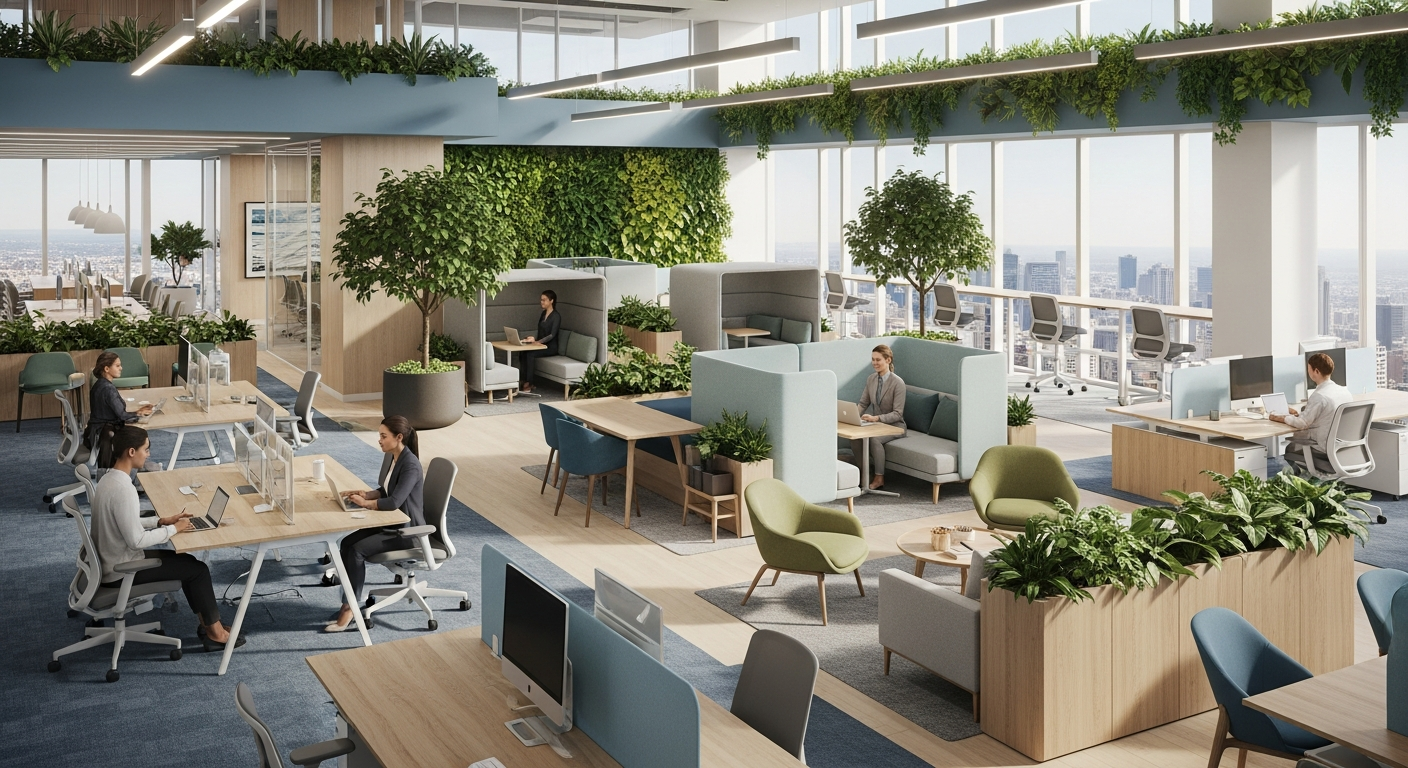
Wellness Planning
Wellness-centered office planning has evolved from an aspirational concept to a business imperative supported by compelling financial data and measurable performance outcomes. The evidence is clear: organizations that invest strategically in employee wellness through thoughtful design achieve significant competitive advantages through improved productivity, reduced healthcare costs, enhanced retention, and superior stock performance.
The research demonstrates that wellness features like enhanced air quality, natural lighting optimization, biophilic integration, and mental health-supportive design elements deliver quantifiable returns that far exceed their implementation costs. Companies with comprehensive wellness initiatives outperform market averages by substantial margins, while individual interventions like air quality improvements can generate thousands of dollars in annual productivity gains per employee.
However, the greatest barrier to wellness design adoption has been the traditional evaluation and implementation process itself. Manual CAD workflows that require weeks to assess single scenarios cannot meet the speed demands of modern business decision-making, forcing organizations to choose between comprehensive analysis and timely execution. This bottleneck has prevented many organizations from realizing the full potential of wellness-centered planning.
The transformation enabled by automated architectural capabilities fundamentally changes this equation. When comprehensive wellness evaluations can be completed in minutes rather than weeks, organizations can explore optimal solutions, test creative approaches, and make informed decisions based on thorough analysis rather than limited options. This capability shift democratizes sophisticated wellness design while accelerating implementation timelines.
The integration of multi-parameter optimization, rapid iteration capabilities, immersive visualization, and data-driven insights creates unprecedented opportunities for wellness-focused innovation. Organizations no longer need to compromise between speed and wellness optimization—they can achieve both simultaneously through intelligent automation that enhances rather than replaces human creativity and expertise.
As employee expectations continue to evolve and competition for talent intensifies, the ability to rapidly evaluate and implement wellness-centered design solutions becomes a significant competitive advantage. Organizations that embrace this transformation position themselves to attract top talent, optimize productivity, and create workplace environments that support sustained high performance.
The future of office design lies not in choosing between wellness and efficiency, but in leveraging advanced capabilities that optimize both simultaneously. The question for forward-thinking organizations is not whether to invest in wellness-centered design, but how quickly they can implement comprehensive solutions that deliver measurable benefits to both employees and business outcomes.
Ready to experience the future of wellness-centered office planning?
Discover how qbiq transforms wellness design from a weeks-long manual process into a minutes-long automated capability that optimizes for employee health and business performance simultaneously. See how comprehensive wellness layouts, immersive 3D visualizations, and data-driven insights can be delivered faster than traditional methods can produce a single concept.
Book Your Demo and unlock the full potential of automated wellness-centered office design for your organization.






.png)


