
Space planning is the foundation ofsuccessful office environments, yet many professionals approach it withoutunderstanding its core principles and transformative potential. Whether you’rea commercial real estate professional evaluating properties, a business leaderplanning your next office move, or an architect seeking to optimize yourapproach, mastering space planning fundamentals can dramatically impact yourproject outcomes and business success.
This comprehensive guide demystifies spaceplanning, breaking down the essential principles, processes, and businessconsiderations that every professional should understand. We’ll explore howstrategic space organization transforms not just physical environments, butoperational efficiency, employee productivity, and bottom-line results.
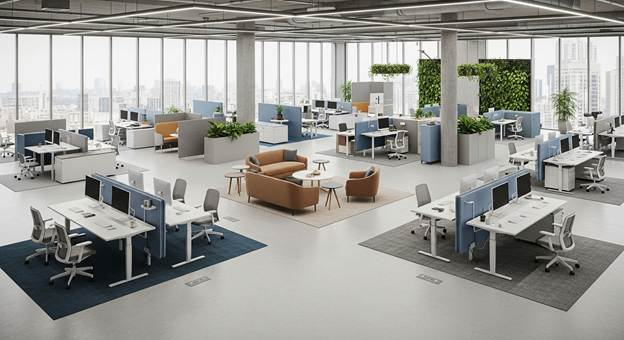
In today’s competitive commercial realestate landscape, the difference between a mediocre space and an exceptionalone often comes down to the quality of its planning. The most successfulprofessionals understand that space planning isn’t just about arrangingfurniture or maximizing square footage—it’s about creating environments thatdrive business results and human performance.
From the Fortune 500 company seeking tooptimize their headquarters footprint to the startup founder planning theirfirst office expansion, the principles remain constant while the applicationsvary dramatically. The stakes are high: poor space planning can costorganizations millions in lost productivity, increased real estate expenses,and missed opportunities, while exceptional planning creates competitiveadvantages that compound over time.
Defining Space Planning: Beyond FurnitureArrangement
Professional definition: Space planning isthe strategic organization and arrangement of interior spaces to optimizefunctionality, efficiency, and user experience within specific businesscontexts. Far more than aesthetic arrangement, it represents a systematicapproach to solving complex spatial challenges through evidence-based designdecisions.
At its core, space planning addresses threefundamental questions: How will people use this space? What activities need tohappen here? And how can we organize the environment to support thoseactivities most effectively? The answers drive everything from circulationpatterns and adjacency relationships to technology integration and futureadaptability requirements.
Consider the difference between an officethat merely accommodates 100 employees and one that genuinely supports theirwork. The first might squeeze in 100 desks and call it complete. The secondanalyzes workflow patterns, collaboration needs, privacy requirements, andgrowth projections to create an environment where those 100 employees canperform at their peak while the organization maintains flexibility for futurechange.

The scope extends far beyond aestheticsinto the realm of business strategy. While interior design focuses on creatingbeautiful, comfortable environments, space planning prioritizes functionaloutcomes that align with organizational objectives. A comprehensive spaceplanning principles guide emphasizes this distinction, noting that effectivespace planning begins with understanding business processes before consideringvisual elements.
In commercial contexts, space planningbecomes particularly complex because it must serve multiple masters: theproperty owner seeking to maximize value, the tenant requiring operationalefficiency, and the end users needing functional workspace. Successfullybalancing these competing interests requires both technical expertise andbusiness acumen.
The professional stakeholders involved inspace planning decisions typically include commercial real estate brokers,property managers, corporate facilities directors, architects, andincreasingly, technology specialists who understand how digital tools canenhance spatial outcomes. Each brings unique perspectives and requirements tothe planning process, making stakeholder coordination a critical component ofsuccess.
Modern space planning has evolved toincorporate sophisticated analytical approaches that were impossible just adecade ago. Today’s practitioners leverage data on occupancy patterns, userbehavior, and spatial performance to make informed decisions rather thanrelying solely on intuition and experience. qbiq’s space planning capabilitiesdemonstrate how advanced technology now enables rapid analysis and iteration ofspatial solutions, fundamentally changing what’s possible in professionalpractice.
The commercial focus of space planningmeans that every decision must be justified in business terms. Whetheroptimizing real estate costs, enhancing operational efficiency, or supportingorganizational culture, space planning interventions succeed only when theydeliver measurable value. This business orientation distinguishes professionalspace planning from residential interior design or artistic spatialcomposition.
Understanding space planning as a strategicbusiness tool rather than a design service opens up new possibilities forprofessional application and career development. The most successfulpractitioners combine spatial intuition with analytical rigor, creatingenvironments that not only function well today but adapt effectively totomorrow’s challenges.
The Core Principles of Effective SpacePlanning
Effective space planning rests on sixfundamental principles that guide decision-making across all project types andscales. These principles serve as both evaluation criteria for existing spacesand design drivers for new developments. Understanding them enablesprofessionals to assess space planning quality whether they’re commissioningnew work or reviewing proposals.
Functionality principles demand that everysquare foot serves its intended purpose efficiently while supporting specificbusiness activities. This goes beyond basic accommodation to consider howspatial arrangements either enhance or hinder the work that happens withinthem. A conference room that seats twelve but lacks proper acoustics ortechnology integration may technically function but fails to support effectivemeetings. Similarly, an open office that provides adequate square footage perperson but creates constant distraction serves its occupants poorly.
The functionality principle requires a deepunderstanding of how work actually happens, not just how it’s supposed tohappen according to organizational charts. Successful space planning observesactual behavior patterns, workflow requirements, and activity-specific needs tocreate environments that support rather than fight against natural workingpatterns.
Flow and circulation principles createlogical movement patterns that minimize conflicts and maximize productivitythroughout the space. Poor circulation design forces people to walk throughquiet work areas to reach collaboration spaces, disrupting both individualfocus and group activities. Effective circulation segregates different types ofmovement—daily traffic, visitor access, and service routes—while maintainingclear wayfinding and emergency egress.
Consider how circulation impacts not justconvenience but actual business outcomes. In a law firm, partners needefficient access to both associate work areas and client meeting spaces withoutcreating bottlenecks or compromising confidentiality. In a tech startup,circulation should encourage spontaneous collaboration while preserving focusedwork zones. The same principles apply differently based on organizationalculture and business requirements.
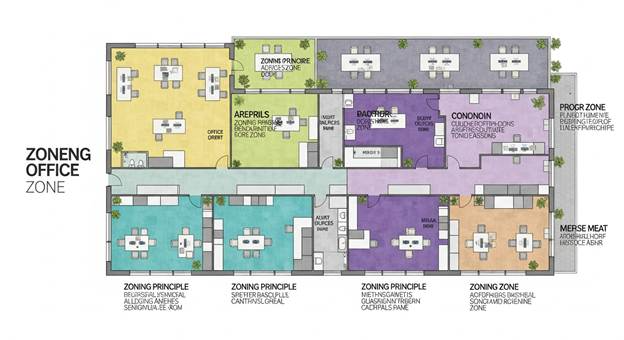
Zoning strategies divide spaces intofunctional areas that support different activities and behavioral requirements.The traditional approach identifies four primary zones: private spaces forfocused work, collaborative areas for group activities, service zones forsupport functions, and circulation paths connecting everything together.However, modern workplaces require more nuanced zoning that considers varyinglevels of privacy, collaboration intensity, and technology requirements.
Effective zoning creates clear boundariesbetween incompatible activities while maintaining flexibility for changingneeds. A sales team requires different spatial relationships than a softwaredevelopment group, even within the same organization. Understanding how to zoneeffectively for specific business functions while maintaining organizationalcohesion represents one of space planning’s greatest challenges.
Proportion and scale principles ensure thatspatial relationships feel appropriate and comfortable for human use whilesupporting intended activities. Oversized spaces can feel empty and unconduciveto collaboration, while undersized spaces create stress and reducedproductivity. The challenge lies in determining appropriate proportions forspecific uses rather than applying generic standards.
Scale considerations extend beyond roomdimensions to include ceiling heights, furniture proportions, and adjacencyrelationships. A private office feels cramped at 8x8 feet but a huddle roomfunctions well in that footprint. Understanding how scale impacts userexperience and behavior enables more sophisticated space planning decisions.
Flexibility and adaptability principlesdesign spaces that evolve with changing business needs rather than becomingobsolete when organizations grow or pivot. This requires understanding whichelements should remain fixed and which should accommodate change. Building coreinfrastructure to support multiple configurations while maintaining essentialfunctional relationships represents a key planning challenge.
Space planning definition and coretechniques emphasizes adaptability as increasingly critical in volatilebusiness environments. Organizations that can quickly reconfigure their spacesto support new initiatives gain competitive advantages over those locked intorigid layouts.
Human-centered design principles prioritizeuser comfort, accessibility, and behavioral patterns in spatial decisions. Thisinvolves understanding not just physical requirements but psychological andsocial needs as well. Spaces that technically meet functional requirements butignore human factors often fail to support their intended purposes effectively.
Human-centered space planning considersfactors like natural light access, acoustic comfort, temperature control, andsocial dynamics. It recognizes that productivity depends not just on havingadequate space but on creating environments where people genuinely want tospend time and can perform their best work.
These principles work together to createcoherent spatial strategies rather than functioning as independent checklists.The most effective space plans integrate all six principles into unifiedapproaches that serve both business objectives and human needs. Office spaceplanning comprehensive checklist provides practical frameworks for applyingthese principles systematically.
Mastering these principles enablesprofessionals to engage more effectively with space planning projects whetherthey’re hiring consultants, evaluating proposals, or developing in-housecapabilities. The principles provide common language and evaluation criteriathat improve communication and outcomes across all project stakeholders.
The Traditional Space Planning Process: Methodology and Timeline
Understanding conventional space planningmethodology provides essential context for evaluating both traditionalapproaches and emerging alternatives. The established process follows aphase-based structure that has served the industry well while revealinginherent limitations that drive innovation in contemporary practice.
Programming and discovery phases beginevery traditional space planning project with comprehensive analysis of userrequirements, site conditions, and project constraints. This involves extensivestakeholder interviews, activity analysis, and documentation of existingconditions. Professional programmers develop detailed space programs thatquantify requirements for different functional areas while identifying criticaladjacency relationships and special requirements.
The programming phase typically requiresseveral weeks for complex projects as planners work to understand not just whatspaces are needed but how they should relate to each other and support broaderorganizational objectives. This front-end investment proves crucial for projectsuccess but creates pressure to get everything right from the beginning,limiting opportunities for iterative refinement based on emerging insights.
Site analysis during programming involvesdetailed measurement of existing conditions, identification of structural andmechanical constraints, and evaluation of code compliance requirements. Thismanual process requires physical site visits, careful documentation, andcoordination with other consultants to understand what’s possible withinexisting limitations.
Schematic design phases translateprogrammatic requirements into preliminary spatial arrangements throughiterative sketching and layout development. Traditional practice relies heavilyon hand sketching and CAD development to explore alternative arrangements, testcirculation patterns, and refine functional relationships. This highly creativephase benefits from architectural expertise and spatial intuition whilerequiring significant time investment for each iteration.
The iterative nature of schematic designmeans that multiple alternatives must be developed, evaluated, and refinedbefore arriving at preferred directions. Each iteration cycle can take severaldays to complete as designers work through implications of different approachesand seek stakeholder feedback on evolving concepts.
Traditional schematic design emphasizesbroad conceptual development over detailed resolution, focusing on majorspatial relationships and circulation strategies rather than specific layoutsor furniture arrangements. This approach builds consensus around fundamentalapproaches before investing time in detailed development.

Design development phases refine approvedschematic concepts into detailed spatial solutions that address all functionalrequirements while resolving technical coordination issues. This involvesprecise space allocation, detailed furniture planning, and integration ofbuilding systems including HVAC, electrical, and technology infrastructure.
Design development represents the mosttime-intensive phase of traditional space planning as every detail must beworked out and coordinated with other building systems. Changes becomeincreasingly expensive as designs mature, creating pressure to minimizerevisions while ensuring that all requirements are properly addressed.
The technical complexity of designdevelopment requires specialized expertise in building codes, accessibilityrequirements, and systems coordination. Professional space planners mustunderstand how spatial decisions impact mechanical systems, structural loading,and technology distribution while maintaining focus on functional objectives.
Documentation and implementation phasescreate detailed construction documents that enable accurate projectimplementation while providing clear communication tools for all projectstakeholders. Traditional documentation requires extensive drawing production,specification writing, and coordination with other consultants to ensurecomplete and accurate project information.
Documentation phase timelines depend onproject complexity but typically require several weeks of intensive productionwork to create complete drawing sets and written specifications. The linearnature of traditional documentation means that changes late in the processrequire extensive rework across multiple documents.
Comprehensive space planning guide formodern workplaces details how traditional methodologies handle the coordinationchallenges inherent in complex commercial projects while highlighting time andresource requirements that impact project feasibility.
Stakeholder coordination throughout thetraditional process involves managing input from multiple parties includingproperty owners, tenant representatives, facility managers, and end users.Regular meetings and formal review cycles ensure that all perspectives areconsidered while maintaining project momentum toward final decisions.
The collaborative nature of traditionalspace planning requires skilled facilitation to balance competing interests andmaintain focus on achievable objectives. Professional space planners serve asboth technical experts and project coordinators, managing both designdevelopment and stakeholder relationships.
Time investment in traditional spaceplanning typically ranges from several weeks for straightforward projects toseveral months for complex assignments. Professional office space planningexplained provides industry perspectives on conventional timelines and resourcerequirements that impact project planning and budgeting.
Each phase builds on previous work whilerequiring separate time and resource commitments that can challenge projectschedules and budgets. Understanding traditional process requirements helpsprofessionals evaluate alternative approaches and set realistic expectationsfor space planning initiatives regardless of methodology employed.
The systematic nature of traditional spaceplanning ensures thorough consideration of all project requirements whilecreating comprehensive documentation for successful implementation. However,the time and resource requirements of conventional approaches have sparkedinterest in innovative methodologies that maintain quality while improvingefficiency and responsiveness to changing market demands.
Why Space Planning Matters: Business Impactand ROI
Space planning’s business impact extendsfar beyond creating attractive or comfortable environments to delivermeasurable returns on investment that directly affect organizationalperformance and real estate value. Understanding these financial implicationstransforms space planning from a discretionary expense into a strategicinvestment with quantifiable benefits.
Real estate cost optimization representsthe most immediately measurable benefit of professional space planning, withwell-executed projects reducing occupancy costs by 20-30% through improvedspace utilization and operational efficiency. These savings compound annually,creating substantial long-term value that far exceeds initial planninginvestments.
Consider a 50,000 square foot office leaseat $35 per square foot annually. A 25% improvement in space efficiency couldreduce space requirements to 37,500 square feet, generating annual savings of$437,500. Even accounting for one-time space planning costs, the return oninvestment typically exceeds 1000% over a standard lease term. This exampledemonstrates why sophisticated organizations prioritize space planning as acore business function rather than an afterthought.
Beyond immediate cost reduction, effectivespace planning enhances real estate portfolio performance by improving spaceutilization metrics, reducing vacancy periods, and increasing property values.Landlords who invest in professional space planning for their propertiesachieve faster lease-up times and command premium rents compared to genericspace offerings.
Productivity gains from optimizedenvironments generate ongoing value through enhanced employee performance,improved collaboration effectiveness, and reduced operational friction.Research consistently demonstrates that well-planned workspaces increase productivityby 12-25% while reducing employee stress and turnover costs.
The productivity impact operates throughmultiple mechanisms: reduced time waste from poor circulation design, enhancedfocus through effective acoustic planning, improved collaboration throughstrategic adjacencies, and increased employee satisfaction throughhuman-centered design approaches. Each mechanism contributes to measurableimprovements in organizational performance.
INSERT IMAGE HERE: Infographic showing costsavings and efficiency metrics from effective space planning implementation
A technology company with 200 employeesearning an average of $85,000 annually represents $17 million in totalcompensation. A 15% productivity improvement from better space planninggenerates $2.55 million in additional annual value—substantially more thantypical space planning investments. This calculation explains why leadingorganizations view space planning as revenue generation rather than costmanagement.
Deal velocity and market responsivenessimprove significantly when organizations can quickly evaluate and plan spacealternatives rather than spending weeks on traditional analysis. In competitivecommercial markets, the ability to move quickly on attractive opportunitiesoften determines success or failure in securing optimal real estate solutions.
ROI of professional space planning providescomprehensive analysis of how space planning investments translate intomeasurable business returns across different industry sectors and projecttypes.
Professional space planning acceleratesdecision-making by providing clear visualization of space potential, accuratecapacity analysis, and reliable cost projections. This enables faster movementthrough complex real estate transactions while reducing risks associated withspatial uncertainty.
Risk mitigation through proactive planningprevents costly mistakes that commonly arise from inadequate spatial analysis.Issues like insufficient HVAC capacity, poor egress planning, or incompatibleadjacencies can require expensive corrections if discovered after lease signingor construction completion.
The risk mitigation value of professionalspace planning often equals or exceeds direct cost savings by preventingproblems that could otherwise result in project delays, additional constructioncosts, or operational disruptions. Insurance against these risks justifiesspace planning investments even when direct benefits are difficult to quantify.
Market differentiation and competitiveadvantage result from superior space planning that attracts and retainshigh-quality tenants while supporting premium pricing strategies. Propertieswith professionally planned spaces consistently outperform comparable buildingsin both occupancy rates and rental revenues.
Strategic space management benefits incommercial real estate demonstrates how effective space planning createslasting competitive advantages that compound over time through improvedproperty performance and tenant satisfaction.
For tenant organizations, superior spaceplanning contributes to talent attraction and retention by creatingenvironments where high-performing employees want to work. In competitive labormarkets, workspace quality increasingly influences employment decisions, makingspace planning a talent management strategy as much as a real estate function.
ROI measurement and performance trackingenable continuous improvement in space planning approaches while demonstratingbusiness value to organizational stakeholders. Modern space planningincorporates performance metrics that quantify utilization rates, usersatisfaction, and operational efficiency to support data-driven decisionmaking.
The most sophisticated organizations trackspace planning ROI through multiple metrics including cost per employee, spaceutilization rates, employee satisfaction scores, and productivity measures.This data informs future space planning decisions while building business casesfor continued investment in spatial optimization.
Office layout mistakes that cost companiesmoney identifies common errors that reduce space planning ROI while providingframeworks for avoiding costly mistakes that compromise business outcomes.
Understanding space planning’s businessimpact enables professionals across commercial real estate to make moreinformed investment decisions, develop stronger business cases for spatialimprovements, and achieve superior results through strategic approaches tospace utilization and optimization.
The financial benefits of professionalspace planning typically manifest within months of implementation whilecontinuing to generate value throughout property ownership or lease terms. Thiscombination of immediate and long-term returns makes space planning one of thehighest-ROI investments available to commercial real estate professionals.
Common Space Planning Challenges in Commercial Real Estate
Despite space planning’s clear businessbenefits, professionals across commercial real estate encounter persistentchallenges that can compromise project outcomes and limit success.Understanding these common obstacles enables better project planning, morerealistic timeline development, and more effective solution identification.
Time constraints in competitive marketscreate pressure to deliver spatial solutions faster than traditionalmethodologies allow, often forcing professionals to choose between speed andquality when both are essential for success. Commercial real estate transactionsoperate on accelerated timelines that rarely accommodate traditional spaceplanning schedules, creating constant tension between thoroughness andresponsiveness.
Consider a corporate tenant facing leaseexpiration with limited renewal options. Traditional space planning mightrequire 6-8 weeks to properly evaluate alternatives, but competitive marketconditions demand decisions within 2-3 weeks. This timing mismatch forceseither rushed decisions with inadequate analysis or missed opportunities due todelayed responses.
The time pressure intensifies in hotmarkets where quality space gets absorbed quickly and property owners can beselective about tenant commitments. Professionals who cannot respond rapidlywith comprehensive spatial analysis find themselves consistently losingopportunities to faster-moving competitors.
Technology companies exemplify thischallenge as they often experience rapid growth that outpaces traditional spaceplanning timelines. When headcount increases 50% in six months, conventionalplanning approaches cannot keep pace with evolving requirements, forcingreactive rather than strategic space decisions.
Resource limitations and expertise accessconstrain many organizations’ ability to execute professional-quality spaceplanning when and where it’s needed most. Smaller firms and individualpractitioners often lack access to specialized architectural expertise whilelarger organizations struggle to scale space planning capabilities acrossdiverse portfolios.
The feast-or-famine nature of spaceplanning needs makes staffing decisions particularly difficult. Organizationsmay require intensive space planning support during expansion or relocationphases followed by months or years with minimal needs. This pattern makes itchallenging to maintain in-house capabilities while relying entirely onexternal consultants proves expensive and creates coordination challenges.

Geographic dispersion compounds resourcechallenges as organizations with national or international portfolios struggleto coordinate space planning across multiple markets with varying localrequirements and consultant networks. Maintaining consistent quality andapproach across diverse markets requires sophisticated project managementcapabilities that many organizations lack.
Iteration costs and revision cycles intraditional workflows create financial barriers to exploring alternativesolutions and refining approaches based on emerging insights. Each designiteration in conventional practice requires significant time investment fromskilled professionals, making exploration expensive and limiting the number ofalternatives that can be realistically evaluated.
The linear nature of traditional spaceplanning means that late-stage changes require extensive rework across multipleproject phases, creating powerful incentives to lock in decisions early ratherthan maintaining flexibility for optimization opportunities. This tensionbetween efficiency and refinement often compromises final outcomes.
Budget constraints frequently forcepremature design freeze decisions that prevent adequate solution developmentand testing. Organizations working with limited space planning budgets may getonly one or two iterations, reducing opportunities to discover superioralternatives or refine approaches based on stakeholder feedback.
Stakeholder alignment and coordinationchallenges become particularly complex in commercial real estate where spaceplanning decisions must satisfy property owners, tenant organizations, facilitymanagers, and end users with potentially conflicting priorities andpreferences. Managing these diverse interests while maintaining projectmomentum requires sophisticated facilitation skills and clear decision-makingframeworks.
Multi-tenant buildings present especiallycomplex stakeholder coordination challenges as individual tenant improvementsmust integrate with building systems and comply with landlord requirementswhile serving specific organizational needs. Balancing these competing demandsoften requires extensive negotiation and compromise that can compromise optimalspatial solutions.
Corporate relocations involve particularlycomplex stakeholder management as they typically affect multiple departmentswith different spatial requirements while operating under tight deadlines thatlimit consultation time. The challenge intensifies when organizations attemptto use relocations for cultural change initiatives that require both spatialand behavioral modifications.
Market responsiveness and adaptationrequirements challenge organizations to maintain spatial flexibility whilemeeting immediate operational needs. Business environments change rapidly,requiring space planning approaches that can accommodate uncertainty whiledelivering functional solutions for current requirements.
Business space planning optimization guideaddresses how commercial real estate professionals can better navigate thecompeting demands of immediate functionality and future adaptability.
Lease negotiation timelines often forcespace planning decisions before business requirements are fully clarified,requiring spatial solutions that can accommodate multiple potential scenarios.This uncertainty makes it difficult to optimize for specific uses whilemaintaining flexibility for alternative outcomes.
Scale limitations and portfolio managementcreate challenges for organizations managing space planning across multiplelocations or large portfolios. Traditional approaches that work well forindividual projects become unwieldy when applied to dozens or hundreds oflocations simultaneously.
Consistency requirements across corporateportfolios conflict with local market conditions and specific site constraints,requiring sophisticated balance between standardization and customization.Organizations struggle to maintain brand standards and operational consistencywhile adapting to diverse local conditions.
qbiq solutions for real estate serviceproviders demonstrates how modern technology platforms address traditionalscale limitations while maintaining quality and consistency across diverseproject portfolios.
Quality control across large portfoliosrequires standardized processes and evaluation criteria that can be challengingto implement and maintain with traditional methodologies. Organizations needsystematic approaches to ensure consistent space planning quality regardless ofproject size or location.
These challenges have driven significantinnovation in space planning methodology and technology, creating opportunitiesfor professionals who understand both traditional approaches and emergingsolutions to deliver superior results while managing the inherent complexitiesof commercial real estate space planning.
The Evolution: From Manual to Automated Space Planning
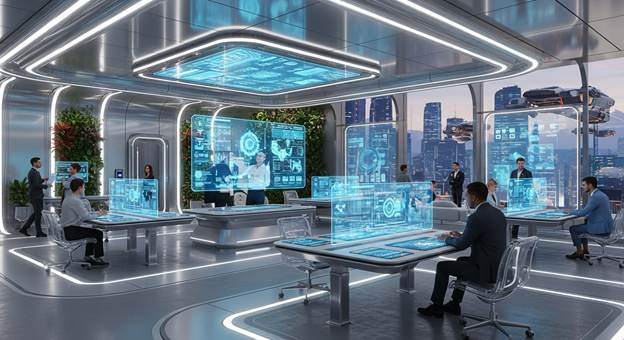
The transformation from manual to automatedspace planning represents one of the most significant innovations in commercialreal estate in the past decade, fundamentally changing what’s possible in termsof speed, quality, and accessibility while opening new opportunities forprofessional differentiation and competitive advantage.
Technology transformation and AIintegration have revolutionized traditional space planning workflows byautomating complex analytical tasks that previously required extensive manualeffort and specialized expertise. Advanced algorithms can now analyze spatialrelationships, optimize circulation patterns, and generate multiple layoutalternatives in minutes rather than weeks, while maintaining architecturalstandards and building code compliance.
The shift from manual drafting tointelligent automation represents more than simple digitization—it represents afundamental change in how spatial problems are approached and solved. Modernplatforms can simultaneously consider thousands of variables that wouldoverwhelm human designers while generating solutions that consistently meetprofessional standards.
Machine learning capabilities enableautomated systems to improve performance over time by learning from successfulprojects and user preferences. This creates continuously improving platformsthat become more sophisticated and valuable with increased usage, providingcompetitive advantages that compound over time.
Artificial intelligence integration extendsbeyond layout generation to include predictive analytics that forecast spaceutilization patterns, identify potential operational issues, and suggestoptimization opportunities based on comparable project data. This predictivecapability transforms space planning from reactive problem-solving to proactivestrategic planning.
Speed revolution and rapid iterationcapabilities enable professionals to explore multiple alternatives quickly andrespond to changing requirements in real-time rather than investing weeks indeveloping single solutions. Modern automated platforms can generate completespace plans with furniture layouts, circulation analysis, and capacitycalculations in minutes, enabling rapid comparison of alternatives anditerative refinement.
The speed advantage becomes particularlyvaluable in competitive commercial markets where quick response times determinesuccess in securing opportunities. Organizations that can provide comprehensivespatial analysis within hours rather than weeks gain significant competitiveadvantages in both landlord and tenant representation scenarios.
Rapid iteration capabilities support morethorough solution development by making it economically feasible to explorenumerous alternatives rather than settling for the first acceptable option.This exploratory approach often reveals superior solutions that would never bediscovered through traditional linear processes.
Real-time modification capabilities enableimmediate response to changing requirements or stakeholder feedback withoutstarting over from scratch. This responsiveness transforms space planning froma front-loaded process to an ongoing optimization activity that can adaptcontinuously to evolving needs.

Accessibility expansion and democratizationenable non-designers to create professional-quality space plans whilemaintaining architectural standards and best practices. Intuitive interfacesguide users through complex planning decisions without requiring specializedtraining or extensive experience, expanding space planning capabilitiesthroughout organizations.
The democratization of space planning toolsenables more frequent and responsive spatial optimization as organizations canconduct preliminary analysis internally before engaging external consultantsfor complex projects. This hybrid approach reduces costs while improvingoutcomes through better-informed consultant engagement.
Accessibility improvements benefit smalland medium-sized organizations that previously lacked access to professionalspace planning due to budget constraints or project scale limitations.Automated platforms enable sophisticated spatial analysis at price points thatmake professional-quality planning accessible to broader markets.
Geographic accessibility enables consistentspace planning capabilities across distributed portfolios without requiringlocal architectural resources in every market. Organizations can maintainconsistent standards and approaches while adapting to local conditions andrequirements.
Scalability improvements and portfoliomanagement enable simultaneous management of multiple projects with consistentquality and approach while reducing coordination overhead and resourcerequirements. Modern platforms can handle dozens or hundreds of concurrentprojects with automated quality control and standardized outputs.
Portfolio-scale space planning becomesfeasible through automated systems that can apply consistent standards andapproaches across diverse projects while accommodating local variations andspecific requirements. This capability particularly benefits large corporatetenants and real estate service providers managing extensive portfolios.
Scalability extends beyond project quantityto include scenario analysis capabilities that enable rapid evaluation ofmultiple alternatives across entire portfolios. Organizations can quicklyassess the spatial implications of different growth scenarios, organizationalrestructuring initiatives, or market changes.
Quality consistency and standardsenforcement through automated validation ensure that all generated solutionsmeet architectural standards, building code requirements, and organizationalpolicies regardless of user experience level. Automated systems eliminate thevariability inherent in manual processes while maintaining professional qualitystandards.
Built-in quality control mechanisms preventcommon errors that can compromise project outcomes or create implementationproblems. Automated platforms incorporate extensive rule sets that guide usersaway from problematic solutions while suggesting optimal alternatives.
Consistency benefits extend todocumentation and presentation standards that ensure professional-qualityoutputs regardless of individual user capabilities. This standardizationimproves communication with stakeholders while reducing the time required forpresentation preparation.
Business integration and workflowoptimization enable seamless integration with existing commercial real estateprocesses rather than requiring separate workflows or specialized expertise.Modern space planning platforms integrate with common business tools anddatabases while providing outputs in formats that support downstreamdecision-making and implementation processes.
qbiq’s automated space planning technologydemonstrates how intelligent platforms integrate with commercial real estateworkflows while maintaining professional standards and delivering rapid resultsthat support accelerated decision-making.
Integration capabilities include directconnections to building information systems, lease management platforms, andproject management tools that streamline information flow and reduce manualdata entry requirements. This integration reduces errors while improvingefficiency across entire project lifecycles.
Professional applications and careerdevelopment opportunities emerge as automated tools enable practitioners tofocus on higher-value strategic activities while maintaining involvement indetailed implementation work. Rather than replacing professionals, automationenhances capabilities and enables handling of larger, more complex projectswith the same resource commitments.
Solutions for landlords illustrate howautomated space planning transforms property management by enabling rapidresponse to tenant requirements and optimization of building performancethrough data-driven spatial analysis.
Solutions for architects and constructiondemonstrate how professionals can leverage automated tools to enhance serviceofferings while expanding project capacity and improving client satisfactionthrough faster response times and more thorough solution development.
The evolution from manual to automatedspace planning creates opportunities for professionals who understand bothtraditional principles and modern capabilities to deliver superior resultswhile building sustainable competitive advantages in rapidly changingcommercial real estate markets.
This technological transformationrepresents not just operational improvement but fundamental expansion of what’spossible in space planning practice, enabling more responsive, more thorough,and more accessible spatial solutions that better serve the evolving needs ofcommercial real estate professionals and their clients.
What’s Ahead
Space planning stands at the intersectionof design, business strategy, and technology, representing one of the mostimpactful yet underestimated capabilities in commercial real estate.Understanding its fundamentals empowers professionals across the industry tomake more informed decisions, achieve better outcomes, and deliver superiorvalue to their clients and organizations.
The journey through space planningprinciples reveals a discipline far more sophisticated than simple furniturearrangement or aesthetic improvement. From functionality and flow tohuman-centered design and future adaptability, effective space planning integratesmultiple complex considerations into unified strategies that serve bothimmediate needs and long-term objectives.
The business case for professional spaceplanning has never been stronger, with documented returns on investmentreaching 1000% or more through real estate cost optimization, productivitygains, and operational improvements. Yet many professionals still approachspatial decisions as afterthoughts rather than strategic investments, missingopportunities to create significant competitive advantages.
Traditional methodologies continue to serveimportant functions, particularly for complex projects requiring extensivestakeholder coordination and detailed technical development. However, theemergence of automated platforms has fundamentally expanded what’s possible interms of speed, accessibility, and scalability while maintaining professionalquality standards.
The challenges that have long plagued spaceplanning—time constraints, resource limitations, iteration costs, andcoordination complexity—are increasingly addressable through technologysolutions that enhance rather than replace professional expertise. The mostsuccessful practitioners will be those who understand both traditionalprinciples and modern capabilities, leveraging each approach where it providesoptimal value.
Perhaps most importantly, the evolution ofspace planning reflects broader trends in commercial real estate towarddata-driven decision making, responsive service delivery, and scalable solutiondevelopment. Professionals who master space planning fundamentals positionthemselves to participate in and benefit from these industry transformations.
The principles remainconstant—functionality, flow, zoning, proportion, flexibility, andhuman-centered design—but the tools and methods continue to evolve rapidly.Whether evaluating traditional approaches or exploring automated solutions, thekey is recognizing space planning as a strategic capability that directlyimpacts business success rather than a technical service to be minimized oroutsourced.
As commercial real estate becomesincreasingly competitive and complex, the ability to quickly analyze spatialalternatives, optimize layouts for specific business requirements, and adaptspaces to changing needs becomes a fundamental competitive advantage.Organizations and professionals who invest in understanding and applying spaceplanning principles will be best positioned to thrive in this dynamicenvironment.
The future belongs to those who canseamlessly blend spatial intuition with analytical rigor, traditional wisdomwith technological innovation, and individual creativity with scalablemethodology. Space planning mastery represents not just professional developmentbut strategic positioning for success in the evolving commercial real estatelandscape.
Ready to Transform Your Space Planning Approach?
The future of space planning is here, andit’s more accessible, faster, and more powerful than ever before. Whetheryou’re looking to optimize a single property, manage an entire portfolio, orenhance your professional service offerings, automated space planningtechnology can transform your approach while delivering measurable businessresults.
Ready to see how automated space planningcan transform your approach? Discover how qbiq’s AI-powered platform generatesprofessional architectural outputs in minutes, not weeks. Explore qbiq’s spaceplanning capabilities or book a demo to see the future of space planning inaction and unlock the potential of every space you encounter.





.png)


