
The commercial real estate landscape is experiencing a fundamental shift. While property developers and managers have traditionally relied on lengthy, manual architectural processes that could take months, AI-powered automated architectural services are now enabling the same level of professional planning in minutes. This comprehensive guide reveals how artificial intelligence is transforming architectural planning for office buildings, retail spaces, and commercial properties, and provides real estate professionals with practical implementation strategies to leverage these game-changing capabilities. Whether you’re a property developer, commercial broker, or building owner, you’ll discover how AI architecture can accelerate your projects, reduce costs, and unlock new possibilities for your commercial spaces.
Understanding AI Architecture: The New Foundation of Commercial Real Estate
The commercial real estate industry stands at a technological inflection point. Traditional architectural planning, which has remained largely unchanged for decades, is being revolutionized by artificial intelligence systems that can generate comprehensive building designs in minutes rather than months. AI architecture represents a paradigm shift from manual drafting and iterative design processes to intelligent, automated systems that can understand spatial requirements, optimize layouts, and ensure compliance with building codes—all while maintaining the creative vision and professional standards that commercial properties demand.
At its core, AI architecture leverages machine learning algorithms trained on vast databases of architectural knowledge, building codes, spatial relationships, and design principles. These systems can interpret natural language requirements like “design a 50,000 square foot office building with flexible workspace configurations and LEED Gold compliance” and generate detailed floor plans, 3D models, and technical specifications that meet professional architectural standards. This isn’t simply computer-aided drafting—it’s intelligent design generation that considers everything from traffic flow patterns to natural lighting optimization.
The market data supporting this transformation is compelling. According to NAIOP research on AI’s growing impact, artificial intelligence applications in real estate are projected to grow from $222 billion in 2024 to $303 billion in 2025, representing a remarkable 36% compound annual growth rate. This explosive growth reflects not just technological advancement, but urgent market demand for faster, more efficient development processes.
The shift from traditional manual processes to AI-driven automated planning addresses several critical industry pain points. Commercial real estate development traditionally involves multiple rounds of architectural consultation, design iteration, and approval processes that can extend project timelines by months or even years. Each modification requires scheduling meetings, coordinating between architects and developers, and waiting for revised drawings. AI architecture compresses this entire cycle into hours or days, enabling real-time design exploration and rapid response to changing market conditions or tenant requirements.
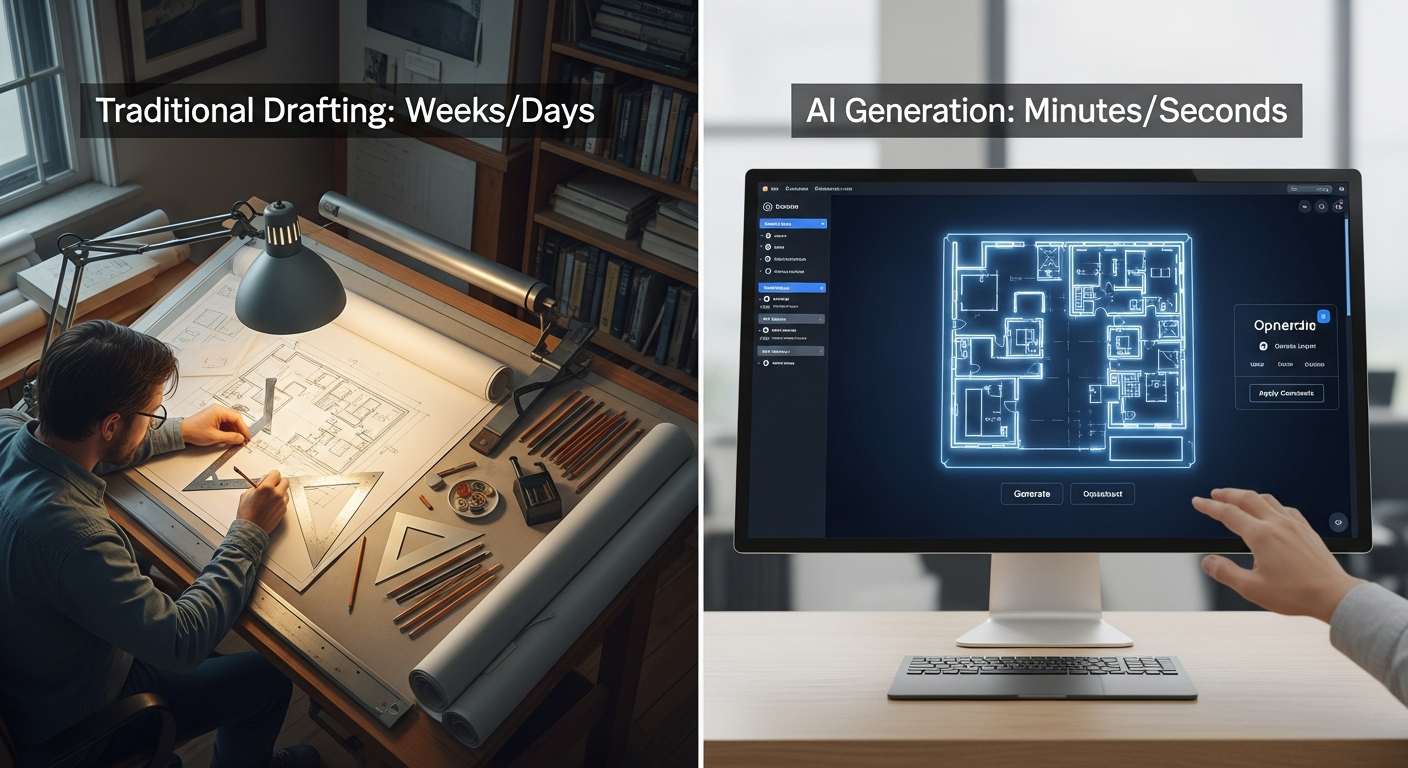
Perhaps most significantly, AI architecture democratizes professional design capabilities for commercial real estate professionals who may not have extensive architectural backgrounds. Property managers can instantly test different space configurations for prospective tenants. Developers can explore multiple design scenarios to optimize rental income potential. Investment firms can rapidly assess the renovation potential of acquisition targets. This accessibility doesn’t compromise quality—it extends professional-grade design capabilities to decision-makers who previously depended entirely on external architectural consultants.
The technology encompasses several key capabilities that are particularly relevant to commercial real estate applications. Generative design algorithms can create multiple layout options based on specified parameters, allowing developers to compare different approaches to space utilization and tenant flow. Space optimization systems analyze traffic patterns, natural lighting, and functional relationships to maximize the efficiency and appeal of commercial spaces. Automated compliance checking ensures that generated designs meet local building codes, accessibility requirements, and industry standards without manual verification. Real-time planning capabilities enable instant modifications as project requirements evolve.
Consider the implications for tenant negotiations—a process that traditionally required architects to create custom layouts for each prospective tenant, often taking weeks and costing thousands of dollars per proposal. AI architecture enables property managers to generate professional-quality space plans during initial tenant meetings, dramatically accelerating the leasing process and reducing the cost barrier to exploring multiple configuration options.
The gap between increasing demand for flexible commercial spaces and traditional architectural bottlenecks is becoming more pronounced as business needs evolve rapidly. Forbes analysis on AI market growth highlights how AI-powered retrofit planning is emerging as real estate’s next big investment frontier, particularly as existing buildings require adaptation for hybrid work models and changing tenant expectations.
This foundation of understanding reveals why AI architecture represents more than a technological upgrade—it’s becoming an essential capability for commercial real estate professionals who want to remain competitive in an increasingly fast-paced market environment.
Transforming Commercial Property Development: Key Benefits of AI Architecture
The transformation that AI architecture brings to commercial property development extends far beyond simple automation—it fundamentally alters the economics, timelines, and strategic possibilities of real estate projects. For property developers, managers, and investors, these changes translate into measurable competitive advantages that directly impact profitability and market position.
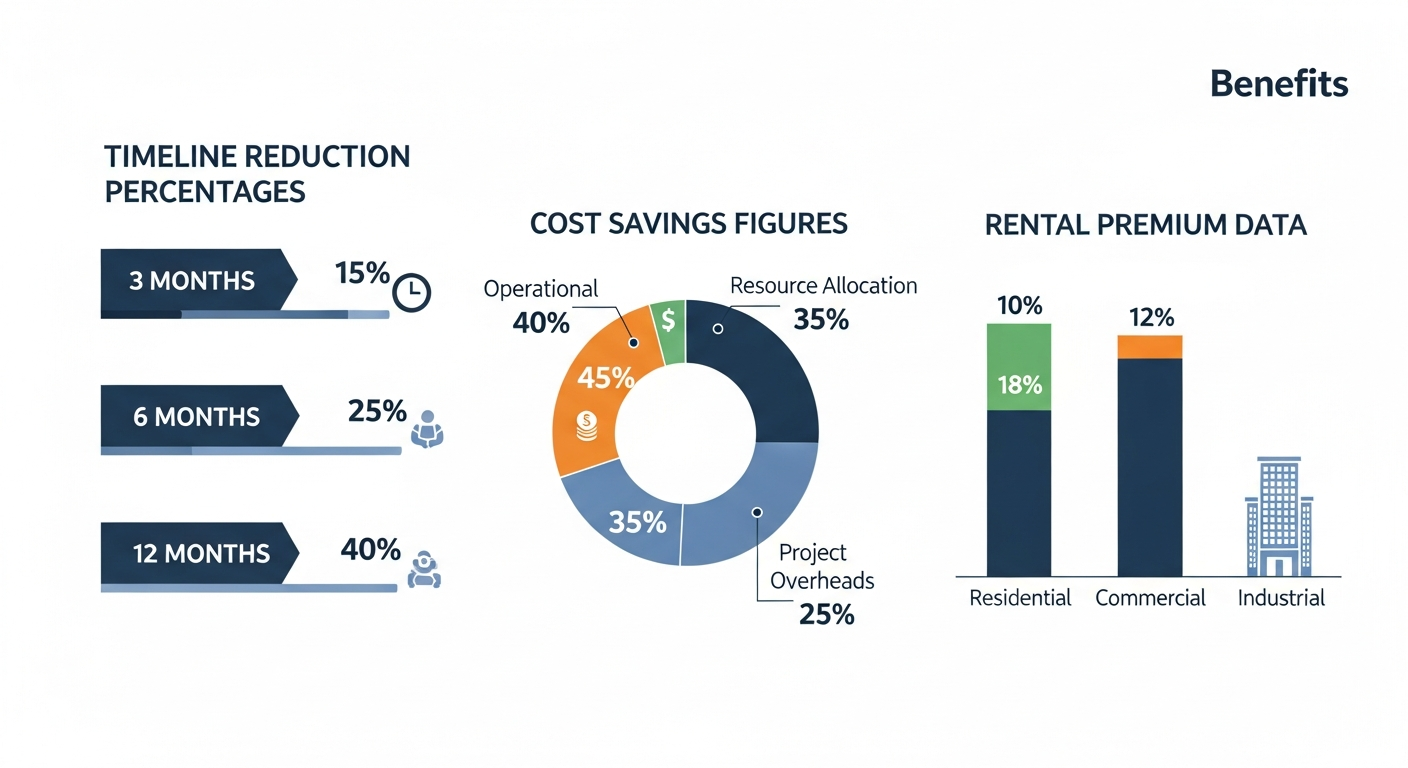
Accelerated Timeline Benefits represent perhaps the most immediately visible transformation. Traditional design validation processes that previously consumed weeks or months can now be completed in hours. When a potential tenant expresses interest in a space, property managers can generate professional test fits during the initial meeting rather than scheduling follow-up presentations weeks later. This acceleration is particularly valuable in competitive leasing markets where speed often determines whether opportunities are captured or lost to more responsive competitors.
The timeline compression extends throughout the entire development cycle. Design iteration, which traditionally required scheduling meetings with architects, waiting for revised drawings, and coordinating stakeholder reviews, can now happen in real-time. Changes to space layouts, tenant configurations, or building specifications can be visualized and validated instantly, allowing development teams to make informed decisions without the delays inherent in traditional processes.
Consider the impact on pre-development activities. Site analysis, feasibility studies, and initial design concepts that previously required weeks of architectural consultation can be generated and refined continuously as market conditions or project parameters evolve. This agility enables developers to respond quickly to changing opportunities, whether adapting to new tenant requirements or pivoting project concepts based on market feedback.
Cost Efficiency gains from AI architecture manifest across multiple dimensions of commercial real estate operations. Direct design costs can be reduced by 60-80% for initial planning phases, as AI systems eliminate the need for extensive architectural consultation during early project stages. This cost reduction is particularly significant for speculative developments or multiple scenario evaluations where traditional architectural costs would accumulate rapidly.
Energy efficiency represents another substantial cost benefit. According to energy cost reduction studies, AI-powered building systems are slashing energy costs by 30%, with some advanced implementations achieving even higher efficiencies. These reductions come from intelligent space optimization that maximizes natural lighting, optimizes HVAC zoning, and coordinates building systems for peak efficiency.
The cost benefits extend to operational phases as well. Buildings designed with AI optimization typically require 20-40% less energy for heating, cooling, and lighting systems compared to traditionally designed spaces. For a 100,000 square foot office building, this can translate to $75,000-150,000 in annual energy savings, providing substantial returns on AI architecture investments.
Enhanced Decision-Making Capabilities emerge from AI architecture’s ability to generate multiple design scenarios instantly. Developers can explore dozens of layout configurations, comparing their implications for rental income, operational efficiency, and tenant satisfaction. This scenario generation capability transforms strategic planning from intuition-based decisions to data-driven analysis.
Investment analysis becomes more sophisticated when multiple design alternatives can be evaluated simultaneously. Developers can quantify the rental income implications of different space configurations, assess the cost-benefit ratios of various amenity packages, and optimize building designs for specific tenant types or market segments. This analytical capability supports more informed investment decisions and better risk management.
The technology also enables continuous optimization throughout the building lifecycle. As tenant needs evolve or market conditions change, AI architecture systems can rapidly generate renovation options and assess their financial implications. This ongoing adaptability helps maintain building competitiveness and maximize long-term asset value.
Improved Tenant Attraction capabilities stem from both the speed of response that AI architecture enables and the sophistication of space optimization it delivers. Buildings designed with AI optimization can command rental premiums up to 9% higher than standard properties, according to PropertyShark analysis on rental premiums. These premiums reflect tenant willingness to pay more for spaces that offer superior efficiency, flexibility, and technological sophistication.
Tenant retention also improves when buildings can adapt quickly to changing space requirements. The ability to rapidly reconfigure spaces for expanding or contracting tenants reduces turnover and vacancy periods, directly impacting building profitability. Some AI-optimized buildings report 25% longer average lease terms due to their adaptability to evolving tenant needs.
Risk Mitigation through automated compliance checking and code validation significantly reduces the costly design errors that plague traditional development processes. Building code violations discovered during construction can cost $50,000-200,000 to remedy, depending on the scope of required changes. AI architecture systems include built-in compliance validation that identifies potential issues before they reach the construction phase.
The technology also reduces project risk by enabling more thorough scenario planning and feasibility analysis. Developers can test multiple approaches to challenging sites or complex requirements before committing to specific design directions, reducing the likelihood of costly mid-project changes or design failures.
Scalability Advantages become particularly valuable for developers managing multiple properties or expanding into new markets. AI architecture systems can apply consistent design standards and optimization principles across entire portfolios while adapting to local requirements and market conditions. This scalability enables more efficient growth and standardized quality across diverse properties and geographic markets.
These transformative benefits position AI architecture as more than a technological tool—it becomes a strategic capability that fundamentally enhances how commercial real estate professionals develop, manage, and optimize their properties.
Real-World Applications: AI Architecture Across Commercial Property Types
The versatility of AI architecture becomes most apparent when examining its applications across different types of commercial properties. Each property category presents unique challenges and opportunities that AI systems address through specialized optimization algorithms and design approaches tailored to specific functional requirements and market dynamics.
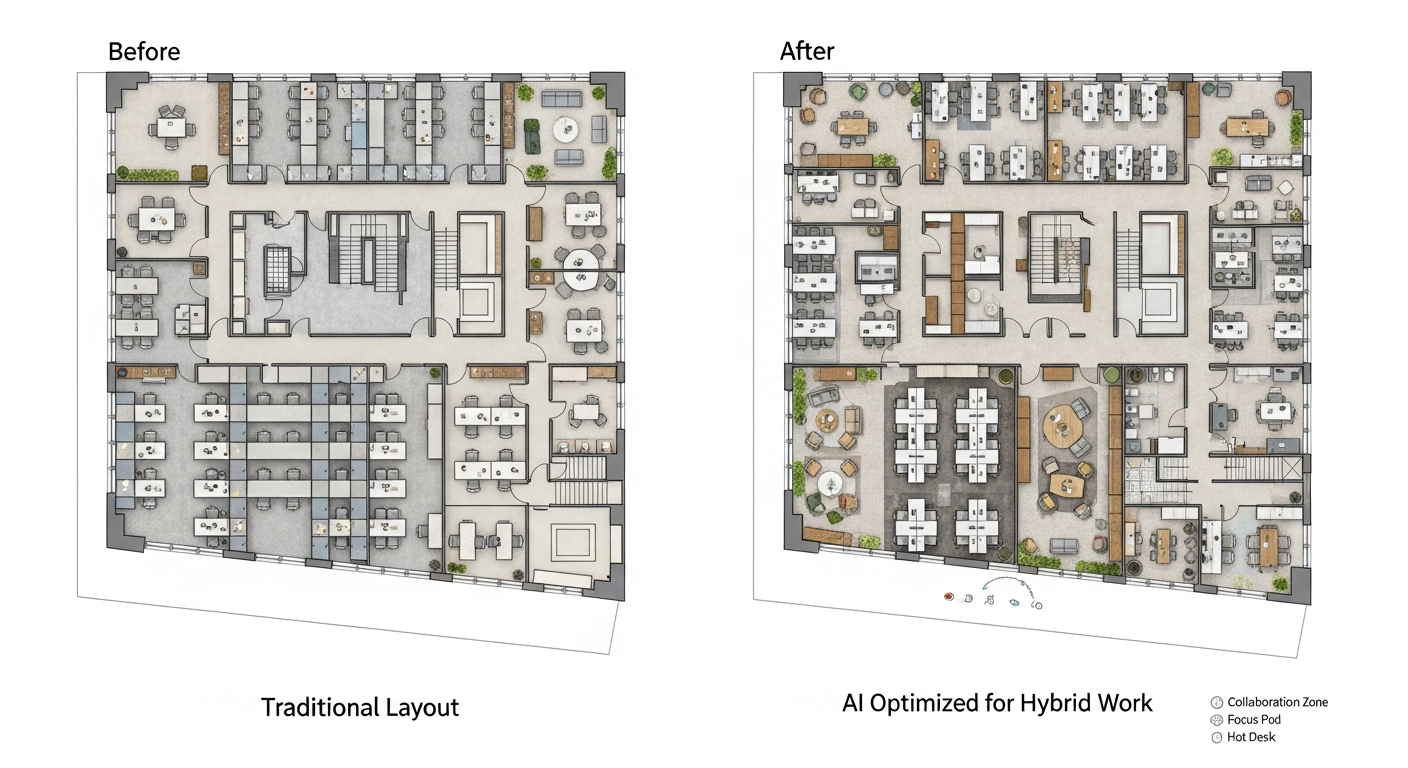
Office Building Applications have evolved significantly in response to the hybrid work revolution. With 80% of employees now preferring hybrid work arrangements, traditional office design assumptions about fixed workstations and dedicated spaces have become obsolete. AI architecture addresses this shift by optimizing flexible workspace configurations that can adapt to varying occupancy levels and collaboration needs throughout the week.
Modern AI systems can design office layouts that maximize the efficiency of shared spaces while maintaining the professional atmosphere that tenants expect. These systems analyze traffic flow patterns, natural lighting availability, and acoustic requirements to create environments that support both focused individual work and collaborative team activities. The technology can optimize the placement of conference rooms, open work areas, private offices, and collaborative spaces to minimize conflicts and maximize productivity.
AI-driven space planning for office buildings also addresses the growing demand for wellness-focused environments. The systems can optimize air circulation patterns, maximize access to natural light, and design spaces that encourage movement and social interaction. These health-conscious design elements are increasingly important for tenant attraction and retention, particularly as companies prioritize employee wellbeing as a competitive advantage for talent acquisition.
Tenant customization capabilities represent another significant advantage for office applications. AI architecture can rapidly generate space plans tailored to specific tenant requirements during lease negotiations. Whether a tenant needs open collaboration areas, private offices, specialized equipment spaces, or unique security requirements, the AI system can explore multiple configurations and present options that maximize both tenant satisfaction and rental efficiency.
Retail Space Optimization leverages AI’s ability to analyze customer flow patterns, product placement strategies, and spatial efficiency requirements unique to commercial retail environments. According to retail planogram optimization research, AI-driven planogram generation can reduce design time by over 98% while improving sales efficiency through optimized product placement and customer navigation patterns.
AI systems designed for retail applications consider factors that traditional architectural planning often overlooks. Customer dwell time analysis helps optimize the placement of high-margin products in zones where shoppers naturally pause or congregate. Traffic flow modeling ensures that store layouts guide customers through optimal purchasing journeys while maintaining efficient staff operations and inventory management.
The technology proves particularly valuable for retail chains seeking to maintain brand consistency while adapting to diverse store formats and local market conditions. AI architecture can apply corporate design standards while optimizing each location for its specific customer demographics, site constraints, and competitive environment. This capability enables rapid expansion while maintaining the operational efficiency that retail profitability demands.
Seasonal adaptability represents another retail-specific advantage. AI systems can design spaces that can be efficiently reconfigured for different merchandise mixes, promotional events, or seasonal requirements. This flexibility helps retailers maximize revenue per square foot throughout the year while minimizing the costs and disruptions associated with frequent layout changes.
Mixed-Use Development presents complex coordination challenges that AI architecture addresses through integrated planning capabilities. These projects require balancing residential, commercial, and retail components within single properties while optimizing shared infrastructure, parking, and public spaces. AI systems can coordinate these diverse requirements while maximizing the synergies between different property uses.
The technology excels at analyzing the interactions between different property components. Retail placement can be optimized to serve both resident needs and external customer traffic. Parking allocation can be balanced between residential, office, and retail requirements while minimizing conflicts during peak usage periods. Common areas and amenities can be designed to enhance the value proposition for all property users while maintaining operational efficiency.
AI architecture also addresses the regulatory complexity of mixed-use developments by ensuring compliance with zoning requirements, building codes, and accessibility standards across all property components. This comprehensive compliance validation reduces the risk of costly design changes during the approval process and accelerates project timelines.
Case Study Spotlight demonstrates the tangible impact of AI architecture implementation. A prominent NYC office building achieved $250,000 in annual operational savings through AI-powered energy management systems with a documented 2-year return on investment. The building’s AI system optimizes heating, cooling, lighting, and ventilation based on real-time occupancy patterns, weather conditions, and energy pricing.
The case study, detailed in commercial building energy savings research, reveals how AI architecture extends beyond initial design to ongoing operational optimization. The system continuously learns from building performance data, tenant behavior patterns, and external conditions to refine its optimization algorithms and maximize efficiency gains over time.
Tenant satisfaction metrics from the project show measurable improvements in comfort, air quality, and space functionality compared to pre-AI baseline measurements. These improvements translated into higher tenant retention rates and enabled rental rate increases that further enhanced the project’s financial returns.
Adaptive Reuse Projects benefit significantly from AI architecture’s ability to assess existing building constraints and optimize renovation strategies for new commercial purposes. The technology can analyze structural limitations, mechanical systems, and spatial relationships to identify the most cost-effective approaches for building conversion or modernization.
AI systems excel at identifying creative solutions for challenging existing building constraints. They can optimize layouts that work within existing column grids, maximize the use of available natural lighting, and coordinate new systems with existing infrastructure. This capability is particularly valuable for historic building conversions or industrial-to-commercial transitions where structural and regulatory constraints limit traditional design approaches.
Multi-Location Consistency capabilities enable portfolio developers and management companies to apply standardized design principles across different markets while adapting to local requirements and opportunities. AI architecture systems can maintain brand consistency and operational efficiency while optimizing each property for its specific market conditions and tenant base.
This scalability becomes particularly valuable for companies expanding into new geographic markets. The AI system can apply proven design principles from successful properties while adapting to local building codes, climate conditions, and market preferences. This capability reduces the learning curve and risk associated with geographic expansion while maintaining operational efficiency across diverse properties.
These real-world applications demonstrate how AI architecture transforms from theoretical technology to practical tool that addresses the specific challenges and opportunities present in different commercial property types and market situations.
How AI Streamlines Architectural Design: From Concept to Construction
The integration of artificial intelligence into architectural design processes represents a fundamental reimagining of how commercial buildings progress from initial concepts to construction-ready documentation. This transformation affects every stage of the design workflow, creating new efficiencies while maintaining the professional standards and creative vision that commercial real estate demands.
Automated Schematic Design Generation begins with AI systems that can interpret natural language requirements and translate them into comprehensive architectural concepts. When a developer inputs parameters like “75,000 square foot office building with flexible workspace, ground floor retail, and parking for 200 vehicles,” the AI system draws upon its trained knowledge of spatial relationships, building codes, and design principles to generate multiple schematic options within minutes.
This process goes far beyond simple template application. The AI analyzes the site conditions, local building codes, climate factors, and functional requirements to create designs that address real-world constraints and opportunities. The system considers factors like solar orientation for energy efficiency, traffic patterns for optimal site access, and spatial adjacencies that support the intended building functions.
The speed of this initial design generation enables a fundamentally different approach to project development. Instead of spending weeks or months developing a single design concept with traditional architectural consultation, developers can explore dozens of alternatives and identify the most promising directions before investing in detailed design development. This front-loaded exploration reduces the risk of costly design changes later in the development process.
Quality control mechanisms ensure that generated designs meet professional architectural standards. The AI systems include validation algorithms that check for structural feasibility, code compliance, and functional efficiency. These automated quality checks catch potential issues that might not be identified until much later in traditional design processes, preventing costly revisions during construction documentation or permitting phases.
Integration with Building Information Modeling (BIM) creates seamless workflows between AI-generated concepts and detailed construction documentation. Modern AI architecture systems can export their designs directly into industry-standard BIM platforms like Revit, ArchiCAD, or Bentley MicroStation, maintaining design intent while enabling traditional architectural teams to develop detailed construction documents.
This integration addresses one of the primary concerns about AI architecture—the ability to interface with existing professional workflows and software systems that construction teams rely upon. By maintaining compatibility with established BIM standards, AI architecture becomes a powerful front-end tool that enhances rather than disrupts proven construction documentation processes.
The BIM integration also enables continuous design optimization throughout the project lifecycle. As detailed engineering analysis reveals opportunities for improvement or modification, those changes can be fed back into the AI system to generate updated design alternatives. This iterative refinement process combines the speed of AI generation with the precision of detailed engineering analysis.
Data consistency between AI design generation and BIM documentation reduces errors and omissions that commonly occur when designs are manually transferred between different software platforms. Automated data transfer ensures that dimensions, specifications, and spatial relationships remain accurate throughout the design development process.
Text-to-Layout Capabilities represent one of the most user-friendly aspects of modern AI architecture systems. Commercial real estate professionals can describe their requirements in natural language and receive comprehensive floor plans that include walls, doors, windows, furniture arrangements, and even specialized equipment layouts. This accessibility enables non-technical users to engage directly with the design process without requiring specialized architectural software knowledge.
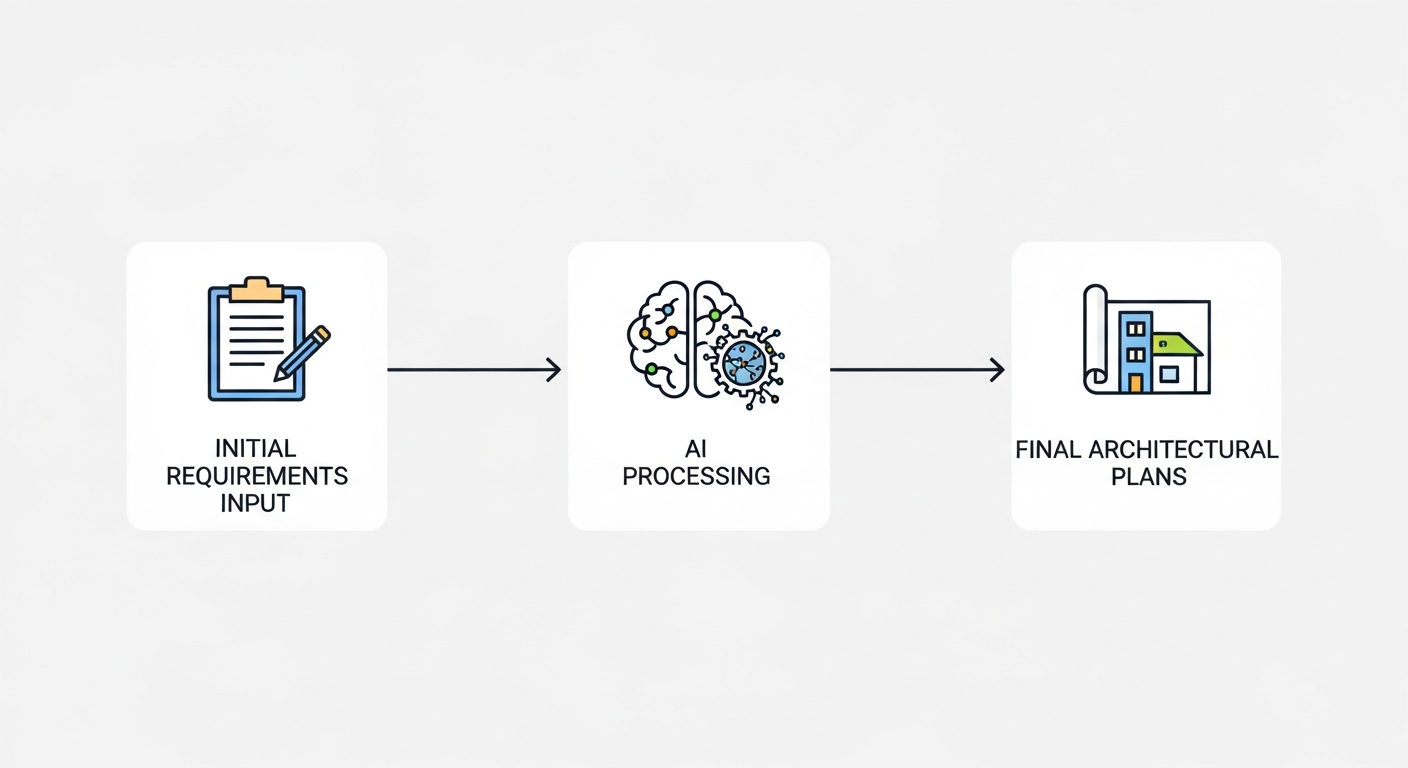
The sophistication of text interpretation continues to improve as AI systems learn from larger datasets of architectural projects and user interactions. Current systems can understand complex requirements like “open office layout with 150 workstations, 12 conference rooms of varying sizes, executive suite with private entrance, and collaboration areas near natural lighting” and generate designs that address all specified elements while optimizing their spatial relationships.
Context awareness enables these systems to make intelligent assumptions about unspecified requirements. When generating office layouts, the AI automatically includes appropriate corridor widths, emergency exits, restroom facilities, and mechanical spaces based on building codes and functional requirements. This comprehensive approach means that initial AI-generated designs address most of the practical considerations that would otherwise require multiple rounds of architectural consultation.
Real-Time Iteration and Optimization capabilities transform design review processes from scheduled meetings with printed drawings to interactive sessions where modifications can be visualized and tested instantly. When stakeholders request changes to layouts, space allocations, or functional arrangements, the AI system can generate updated designs within seconds, enabling collaborative design refinement that maintains project momentum.
This real-time responsiveness proves particularly valuable during tenant negotiations or investor presentations where design modifications may be requested during meetings. Instead of scheduling follow-up meetings to review revised drawings, decisions can be made and validated immediately, accelerating project timelines and reducing the number of required stakeholder interactions.
The optimization algorithms continue to learn from user feedback and design performance data. As buildings are occupied and operational data becomes available, those insights can be incorporated into the AI system’s knowledge base to improve future design recommendations. This continuous learning process means that AI architecture systems become more sophisticated and effective over time.
Multi-variable optimization enables simultaneous consideration of factors that would be difficult to balance manually. The AI can optimize layouts for energy efficiency, construction cost, tenant satisfaction, and rental income potential simultaneously, identifying design solutions that achieve the best overall balance of competing objectives.
Compliance Automation addresses one of the most time-consuming and error-prone aspects of traditional architectural design. AI systems include comprehensive databases of local building codes, accessibility requirements, fire safety regulations, and industry standards. These databases are continuously updated to reflect changing regulations and new requirements.
Automated compliance checking occurs throughout the design process rather than as a final validation step. As designs are generated or modified, the system immediately identifies potential code violations or regulatory conflicts, enabling immediate correction rather than discovering issues during later design phases or permit review processes.
The sophistication of compliance checking extends to complex interactions between different code requirements. The system can identify situations where accessibility requirements conflict with fire egress paths, or where structural requirements impact space planning objectives. These conflict identification capabilities help avoid the costly design revisions that often occur when multiple regulatory requirements interact in unexpected ways.
Documentation generation for permit applications can be automated based on the AI-generated designs and compliance validation. This automation reduces the time and cost associated with permit preparation while ensuring that all required documentation is complete and accurate.
Collaborative Workflows enable AI architecture to enhance human expertise rather than replace it. The technology serves as a powerful tool that amplifies the capabilities of architects, engineers, and real estate professionals while maintaining human oversight and creative direction for project-specific decisions.
Integration with project management platforms enables seamless coordination between AI design generation and traditional project workflows. Design updates can trigger automatic notifications to relevant team members, and project timelines can be updated based on AI-generated design progress. This integration ensures that AI architecture enhances overall project coordination rather than creating isolated design activities.
The collaborative approach also enables specialized expertise to be applied where it provides the most value. While AI handles routine design generation and compliance checking, human professionals can focus on creative problem-solving, stakeholder coordination, and strategic decision-making that require experience and judgment. This division of responsibilities maximizes the efficiency and effectiveness of the entire design team.
Version control and design history tracking ensure that the evolution of AI-generated designs can be documented and reviewed as needed for project management or regulatory compliance purposes. This documentation provides the audit trail that traditional architectural projects require while maintaining the speed and efficiency advantages of AI generation.
ROI and Cost Analysis: The Financial Case for AI Architecture
The financial justification for AI architecture adoption extends beyond simple cost reduction to encompass comprehensive value creation across multiple aspects of commercial real estate development and operations. Understanding these financial benefits requires examining both direct cost savings and indirect value creation that compound over time to deliver substantial returns on investment.
Implementation ROI Timelines for AI architecture typically follow predictable patterns based on project size and application scope. For portfolio properties with multiple buildings or frequent design requirements, payback periods commonly range from 18-24 months as design efficiencies accumulate across multiple projects. Individual large-scale developments often achieve 2-3 year payback periods through combination of design cost savings, accelerated timelines, and operational efficiency improvements.
Consider a development firm managing 20 commercial properties with average sizes of 100,000 square feet. Traditional architectural consultation for space planning, lease modifications, and building improvements typically costs $150,000-250,000 annually across the portfolio. AI architecture implementation can reduce these costs by 60-70%, generating immediate annual savings of $90,000-175,000. When combined with operational benefits and improved property performance, total annual value creation often exceeds $300,000-500,000 for portfolios of this size.
The scalability of benefits means that larger portfolios achieve proportionally better returns. Development companies managing 50+ properties or operating in multiple markets can achieve payback periods of 12-18 months due to the compound benefits of consistent design standards, reduced consultant dependency, and accelerated project timelines across their entire operation.
Single project applications show varying ROI timelines based on project complexity and scope. A 500,000 square foot mixed-use development might invest $100,000-150,000 in AI architecture implementation and achieve savings of $75,000-125,000 annually through design efficiency, energy optimization, and operational improvements, resulting in payback periods of 15-24 months.
Operational Cost Savings represent the most substantial long-term financial benefits of AI architecture implementation. According to comprehensive cost savings analysis, energy management reductions of 15-25% are consistently achievable through AI-optimized building design and systems integration.
For a typical 200,000 square foot office building with annual energy costs of $400,000, a 20% reduction translates to $80,000 in annual savings. Over a 10-year period, these savings total $800,000, substantially exceeding typical AI implementation costs while providing ongoing operational benefits that enhance building competitiveness and profitability.
Maintenance cost reductions of 40-60% through predictive capabilities represent another significant operational benefit. AI systems can optimize building systems for longevity and efficiency while predicting maintenance requirements before equipment failures occur. For commercial buildings, maintenance costs typically range from $2-4 per square foot annually. A 50% reduction for a 200,000 square foot building represents annual savings of $200,000-400,000.
HVAC optimization represents the largest component of operational savings for most commercial buildings. AI architecture can design systems that operate 30-40% more efficiently than traditional approaches while maintaining superior comfort conditions. These efficiencies come from optimal zone design, intelligent scheduling based on occupancy patterns, and continuous optimization based on performance data.
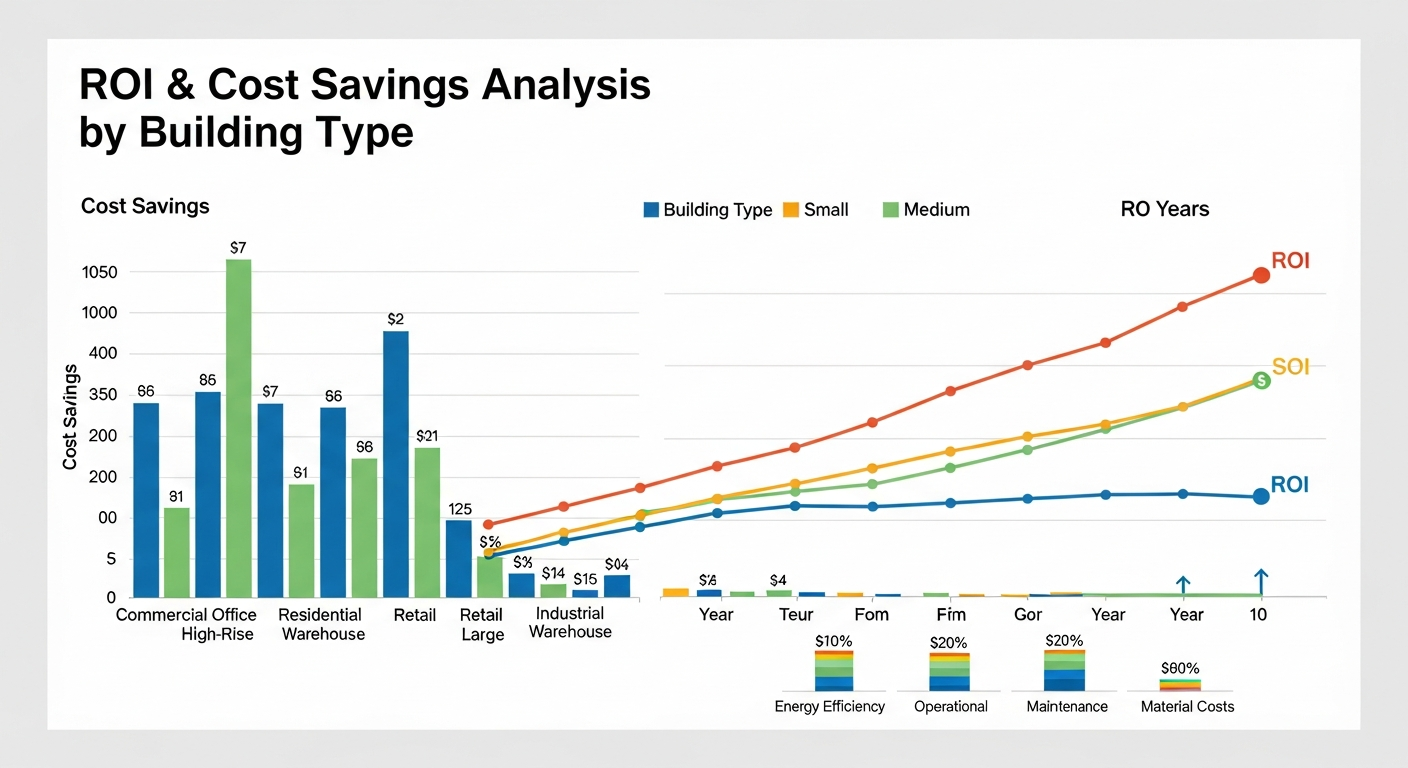
Project Acceleration Benefits create value through multiple channels that compound to provide substantial financial returns. Faster time-to-market reduces carrying costs during development phases, enabling earlier revenue generation and improved project cash flows. For a $50 million commercial development, accelerating occupancy by 3-6 months can improve project returns by $2-5 million through reduced financing costs and earlier rental income.
The acceleration benefits extend to tenant leasing and building modifications throughout the property lifecycle. Buildings that can respond quickly to tenant requirements experience higher retention rates, shorter vacancy periods, and premium rental rates. Some AI-enabled buildings report 20-30% shorter average vacancy periods compared to traditional properties, directly impacting annual revenue and investment returns.
Reduced design iteration cycles enable more thorough exploration of optimization opportunities during initial development phases. Traditional projects often lock in design decisions early due to time and cost constraints, potentially missing opportunities for significant long-term improvements. AI architecture enables comprehensive optimization that maximizes building performance and financial returns over the entire asset lifecycle.
Design Efficiency Gains reduce the direct costs associated with architectural consultation while improving design quality and optimization. Traditional architectural fees for commercial projects typically range from 3-8% of total construction costs. AI architecture can reduce these fees by 50-70% for routine design work while maintaining professional oversight for complex creative and technical decisions.
The efficiency gains extend beyond initial design to ongoing building modifications and improvements. Tenant improvements, space reconfigurations, and building upgrades can be designed and optimized rapidly without extensive consulting fees. This capability enables more responsive building management and better tenant service while controlling operational costs.
Portfolio standardization through AI architecture creates additional efficiency benefits for multi-property operations. Consistent design approaches reduce contractor learning curves, enable bulk purchasing advantages, and streamline property management procedures. These standardization benefits can reduce overall development and operational costs by 10-15% across large portfolios.
Risk Reduction Value quantifies the savings achieved by avoiding design errors, compliance issues, and construction problems that plague traditional development processes. Building code violations discovered during construction typically cost $25,000-100,000 to remedy, depending on the scope and timing of required changes. AI architecture’s automated compliance checking virtually eliminates these costly surprises.
Design optimization reduces the risk of functional problems that become apparent only after building occupancy. Poor space planning, inadequate natural lighting, or inefficient traffic flows can reduce building attractiveness and rental rates. AI-optimized designs that address these issues from the beginning maintain higher occupancy rates and rental premiums throughout the building lifecycle.
Construction coordination problems often result from incomplete or inconsistent design documentation. AI architecture systems generate comprehensive, consistent documentation that reduces field conflicts and change orders during construction. These reductions can save 2-5% of total construction costs on large projects.
Competitive Advantage Premium enables AI-enabled buildings to command higher rental rates and achieve superior investment returns compared to traditionally designed properties. Market analysis from real estate development ROI studies validates that smart buildings with AI optimization can achieve rental premiums of 5-15% depending on the market and building type.
Asset value improvements from AI optimization extend beyond rental income to overall investment returns. Buildings with demonstrated operational efficiency, adaptive capability, and smart technology integration typically trade at premium valuations in commercial real estate markets. These premiums reflect both current income advantages and future-proofing value that sophisticated investors recognize and value.
The financial case for AI architecture becomes compelling when all these benefit categories are considered together. While individual components might justify implementation, the combination of design cost savings, operational efficiency improvements, risk reduction, and competitive advantages creates a comprehensive value proposition that substantially exceeds implementation costs across multiple time horizons and application scenarios.
Implementation Guide: Getting Started with AI Architecture
Successfully implementing AI architecture requires strategic planning that balances organizational readiness, project selection, and change management to maximize value while minimizing disruption to existing operations. This implementation framework provides commercial real estate professionals with actionable steps to begin leveraging AI architectural services effectively and efficiently.
Organizational Readiness Assessment begins with evaluating current design workflows, technology infrastructure, and team capabilities to identify the optimal integration points for AI architecture. Organizations already using BIM software, cloud-based project management platforms, and digital collaboration tools typically experience smoother AI implementation due to existing technology adoption and change management capabilities.
Staff technical comfort levels significantly influence implementation success. Teams familiar with architectural software, data analysis, or technology platforms generally adapt more quickly to AI tools. However, the user-friendly interfaces of modern AI architecture platforms mean that extensive technical training is rarely required. Most commercial real estate professionals can achieve productive use of AI architecture tools within 1-2 weeks of focused training.
Current project volume and design requirements help determine the optimal scale for initial AI implementation. Organizations managing multiple properties, frequent tenant improvements, or regular space planning needs achieve faster returns on AI investment due to higher utilization of the technology. Single-project applications can be successful but may require larger projects to justify implementation costs.
Existing vendor relationships and workflow dependencies require careful consideration during AI implementation planning. Organizations heavily dependent on traditional architectural firms may need to coordinate AI adoption with existing consultant relationships, either by integrating AI tools into current workflows or gradually shifting toward AI-enabled design processes.
Project Selection Criteria focus on identifying initial applications that maximize learning opportunities while demonstrating clear value to stakeholders and building organizational confidence in AI architecture capabilities. Ideal initial projects combine moderate complexity with clear success metrics and limited downside risk.
Tenant improvement projects represent excellent starting applications for AI architecture because they typically involve standardized space types, well-defined requirements, and clear success metrics related to design speed and tenant satisfaction. These projects also occur frequently enough to provide multiple learning opportunities while building organizational expertise with AI tools.
Space planning for speculative developments offers another valuable initial application. These projects benefit significantly from AI’s ability to rapidly generate multiple layout alternatives for market testing and tenant presentation purposes. The speed and cost advantages of AI architecture become immediately apparent in these applications.
Building renovations and adaptive reuse projects can benefit from AI architecture’s ability to optimize designs within existing constraints. However, these applications may be more challenging for initial implementation due to the complexity of incorporating existing building conditions into AI design generation processes.
Portfolio standardization projects enable organizations to apply AI architecture across multiple properties simultaneously, maximizing the learning curve and demonstrating scalability benefits. These applications work particularly well for organizations managing similar property types across multiple locations.
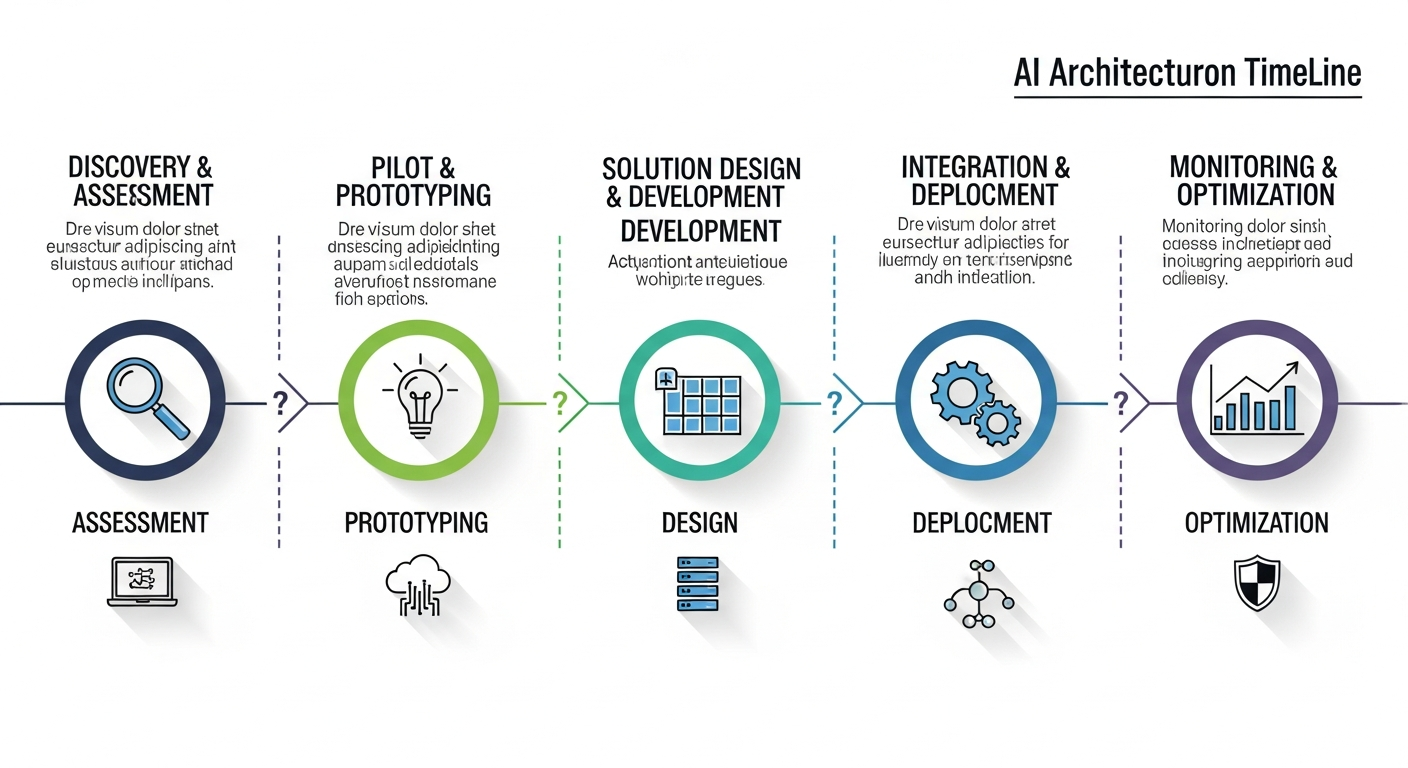
Integration Planning coordinates AI architecture implementation with existing workflows, software systems, and stakeholder processes to ensure seamless adoption without disrupting ongoing operations. Successful integration requires understanding current design processes and identifying specific points where AI tools can enhance efficiency without requiring wholesale workflow changes.
BIM software integration typically provides the most seamless transition path for organizations already using these platforms. Most AI architecture systems can export directly to major BIM platforms, enabling AI design generation to feed into existing documentation and construction management workflows. This integration approach maintains familiar tools and processes while adding AI capabilities at the front end of design workflows.
Project management platform integration ensures that AI-generated designs coordinate properly with project schedules, approval processes, and stakeholder communication requirements. Many AI architecture platforms include API connections to popular project management tools, enabling automated workflow triggers and progress tracking.
Vendor coordination becomes important when AI architecture implementation affects relationships with existing architectural consultants, engineers, or design firms. Some organizations successfully integrate AI tools into collaborative workflows with external consultants, while others use AI capabilities to reduce dependency on outside design services.
Client and stakeholder communication processes may require adjustment to account for the speed and flexibility of AI design generation. Traditional design review cycles based on scheduled meetings and printed drawings may need to evolve toward more interactive, real-time design collaboration enabled by AI tools.
Training and Adoption Strategies focus on building internal capabilities while maintaining operational continuity during the transition period. Effective training programs combine hands-on practice with real projects, enabling teams to develop AI architecture skills while delivering business value.
Pilot project approaches enable teams to learn AI architecture capabilities on real projects with limited scope and clear success criteria. These learning projects provide practical experience while building confidence in AI tools and identifying optimization opportunities for broader implementation.
Champion identification within organizations accelerates adoption by creating internal expertise and advocacy for AI architecture capabilities. Designating specific team members as AI architecture specialists enables more focused training investment while creating internal support resources for broader organizational adoption.
Gradual capability expansion typically works better than attempting to implement all AI architecture capabilities simultaneously. Organizations often begin with basic space planning and layout generation before expanding into more advanced optimization features, energy analysis, or complex building system coordination.
External training resources and support services can accelerate learning curves and reduce implementation risks. Many AI architecture platforms provide comprehensive training programs, user communities, and technical support services that supplement internal learning efforts.
Vendor Evaluation Framework enables organizations to select AI architecture platforms and service providers that best match their specific requirements, technical infrastructure, and growth objectives. Evaluation criteria should balance current needs with future scalability and integration requirements.
Platform capabilities assessment focuses on the specific design types, building categories, and optimization features most relevant to the organization’s current and anticipated project requirements. Some AI platforms excel at office space planning while others provide superior retail optimization or mixed-use coordination capabilities.
Integration compatibility ensures that selected AI architecture platforms can work effectively with existing software systems, workflow processes, and technical infrastructure. Organizations heavily invested in specific BIM platforms, project management tools, or data systems should prioritize AI solutions with proven integration capabilities.
Training and support services evaluation becomes particularly important for organizations new to AI architecture or with limited internal technical expertise. Comprehensive training programs, responsive technical support, and active user communities can significantly accelerate successful implementation.
Cost structure analysis should consider both initial implementation costs and ongoing operational expenses, including software licenses, training requirements, and support services. Total cost of ownership calculations help compare different platforms and implementation approaches over realistic time horizons.
Scalability assessment evaluates how well different AI architecture solutions can grow with organizational requirements and project complexity. Solutions that work well for single projects may not provide the portfolio management capabilities needed for larger real estate operations.
Success Metrics and Monitoring establish clear benchmarks for measuring AI architecture implementation success and identifying opportunities for continuous improvement. Effective metrics combine quantitative performance indicators with qualitative user satisfaction and capability development measures.
Design efficiency metrics track improvements in design speed, iteration cycles, and cost reduction compared to traditional architectural processes. These measurements provide clear documentation of AI implementation benefits and support expansion decisions.
Project timeline improvements measure the acceleration benefits achieved through AI architecture adoption. Tracking changes in design development time, approval cycles, and overall project delivery schedules quantifies one of the most significant benefits of AI implementation.
Quality indicators monitor design accuracy, compliance adherence, and stakeholder satisfaction to ensure that efficiency gains don’t compromise professional standards or project outcomes. User feedback from tenants, investors, and project teams provides valuable insights into design effectiveness and areas for improvement.
Cost tracking encompasses both direct savings from reduced design consultancy expenses and indirect benefits from operational efficiency improvements, reduced project risks, and accelerated revenue generation. Comprehensive cost analysis supports ROI validation and future investment decisions.
Capability development assessment monitors the growth of internal AI architecture expertise and organizational change management success. These qualitative measures help ensure that technology implementation translates into sustainable competitive advantages and organizational capabilities.
This comprehensive implementation framework provides the foundation for successful AI architecture adoption while positioning commercial real estate organizations to maximize the transformative potential of intelligent design technologies.
Conclusion
AI architecture represents more than a technological upgrade. It’s a fundamental shift toward faster, smarter, and more profitable commercial real estate development. The evidence is clear: property developers and managers who embrace automated architectural services today are achieving measurable competitive advantages through reduced costs, accelerated timelines, and enhanced building performance. From the 36% market growth in AI real estate applications to the documented $250,000 annual savings in individual building case studies, the business case for AI architecture is both compelling and immediate. As tenant expectations evolve toward smart, flexible spaces and market pressures demand greater efficiency, AI architecture moves from competitive advantage to business necessity. The question for commercial real estate professionals is not whether to adopt these capabilities, but how quickly they can be integrated to unlock the full potential of every property in their portfolio.
Let’s Build Better
Ready to transform your commercial real estate projects with AI-powered architectural planning? Discover how qbiq’s automated architectural services can help you reimagine any space in minutes, reduce project timelines, and unlock scalable potential across your property portfolio. Whether you’re planning office buildings, retail spaces, or mixed-use developments, qbiq’s AI platform empowers you to make faster, more informed decisions without relying on traditional architectural bottlenecks. Explore qbiq’s AI Architecture Platform and see how leading real estate professionals are already revolutionizing their approach to commercial property development. Start with a project assessment today and experience the future of architectural planning.






.png)


