
Financial institutions face a unique challenge: creating office spaces that meet stringent regulatory requirements while maintaining operational efficiency and client confidence. Unlike typical commercial spaces, financial services offices must navigate complex compliance frameworks, implement robust security measures, and design for privacy - all while enabling productive workflows and positive client experiences.
This specialized approach to office planning requires expertise that goes far beyond standard architectural considerations. When a regional bank evaluates a new headquarters location, they can’t simply focus on square footage and lease rates. They must consider whether the space can accommodate SEC-compliant document storage, whether the trading floor layout prevents unauthorized screen viewing, and whether client meeting areas provide the acoustic privacy required for confidential financial discussions.
For financial institutions evaluating new spaces or optimizing existing ones, understanding these requirements is crucial for mitigating risk, ensuring compliance, and creating spaces that truly serve their business objectives. The stakes are high: poor office planning decisions can result in regulatory violations, security breaches, and operational inefficiencies that impact both profitability and client trust.
The complexity of these requirements has traditionally made financial services office planning a lengthy, expensive process requiring coordination between compliance officers, security experts, architects, and operational teams. However, emerging technologies are transforming this landscape, enabling institutions to achieve comprehensive planning solutions in a fraction of the time while ensuring all requirements are systematically addressed.
The Regulatory Foundation: Understanding Compliance Requirements in Office Design
Financial services office planning begins with a fundamental understanding that these spaces are not merely places of business—they are extensions of the regulatory framework that governs the industry. Every design decision, from the placement of workstations to the configuration of meeting rooms, must align with a complex web of federal and state regulations that protect customer information, ensure business continuity, and maintain market integrity.
The Securities and Exchange Commission’s Regulation S-P establishes comprehensive requirements for protecting customer financial information through both digital and physical safeguards. This regulation doesn’t just govern how data is stored electronically—it mandates specific administrative and physical controls that directly impact office design. For instance, areas where customer information is accessed or stored must have restricted physical access, secure document handling procedures, and environmental protections against unauthorized viewing.
These requirements translate into concrete spatial planning decisions. Customer service areas must be designed to prevent unauthorized individuals from viewing computer screens or overhearing confidential conversations. Document storage areas require controlled access, appropriate filing systems, and protection from both physical and environmental threats. Even seemingly simple decisions, like the placement of printers handling customer documents, must consider regulatory requirements for securing sensitive information throughout its lifecycle.
FINRA Rule 4370 adds another layer of complexity by mandating business continuity planning that extends far beyond traditional disaster recovery. This rule requires financial institutions to maintain operational capabilities during significant business disruptions, which means office infrastructure must be designed with resilience in mind. Emergency power systems, redundant communications capabilities, and alternative workspace arrangements are not optional amenities—they are regulatory requirements that must be built into the physical space.
The spatial implications of business continuity planning are substantial. Trading operations require backup workstations with full market access capabilities. Client service areas need alternative communication systems that can maintain regulatory compliance during primary system failures. Document storage and retrieval systems must remain accessible even during extended power outages or building system failures.
The Sarbanes-Oxley Act introduces additional requirements for secure recordkeeping and internal controls that influence both office design and access protocols. SOX compliance demands that financial records be maintained in secure environments with detailed access logs and tamper-evident storage systems. This often requires dedicated records management areas with specialized security systems, climate controls, and access restrictions that go far beyond typical office security measures.
The Gramm-Leach-Bliley Act’s privacy provisions create requirements for physical separation and protection of customer data areas that must be considered during the initial space planning phase. Areas where customer information is processed, discussed, or stored require enhanced privacy controls, including acoustic separation, visual barriers, and access restrictions. These requirements often conflict with modern open office designs, requiring creative architectural solutions that balance regulatory compliance with operational efficiency.
For organizations handling payment card data, PCI DSS standards introduce additional requirements that affect workspace configuration and security zones. These standards mandate physical security controls around card data environments, including restricted access areas, surveillance systems, and secure storage facilities. The spatial requirements for PCI compliance often necessitate dedicated secure zones within the office environment, complete with separate access controls and environmental monitoring systems.
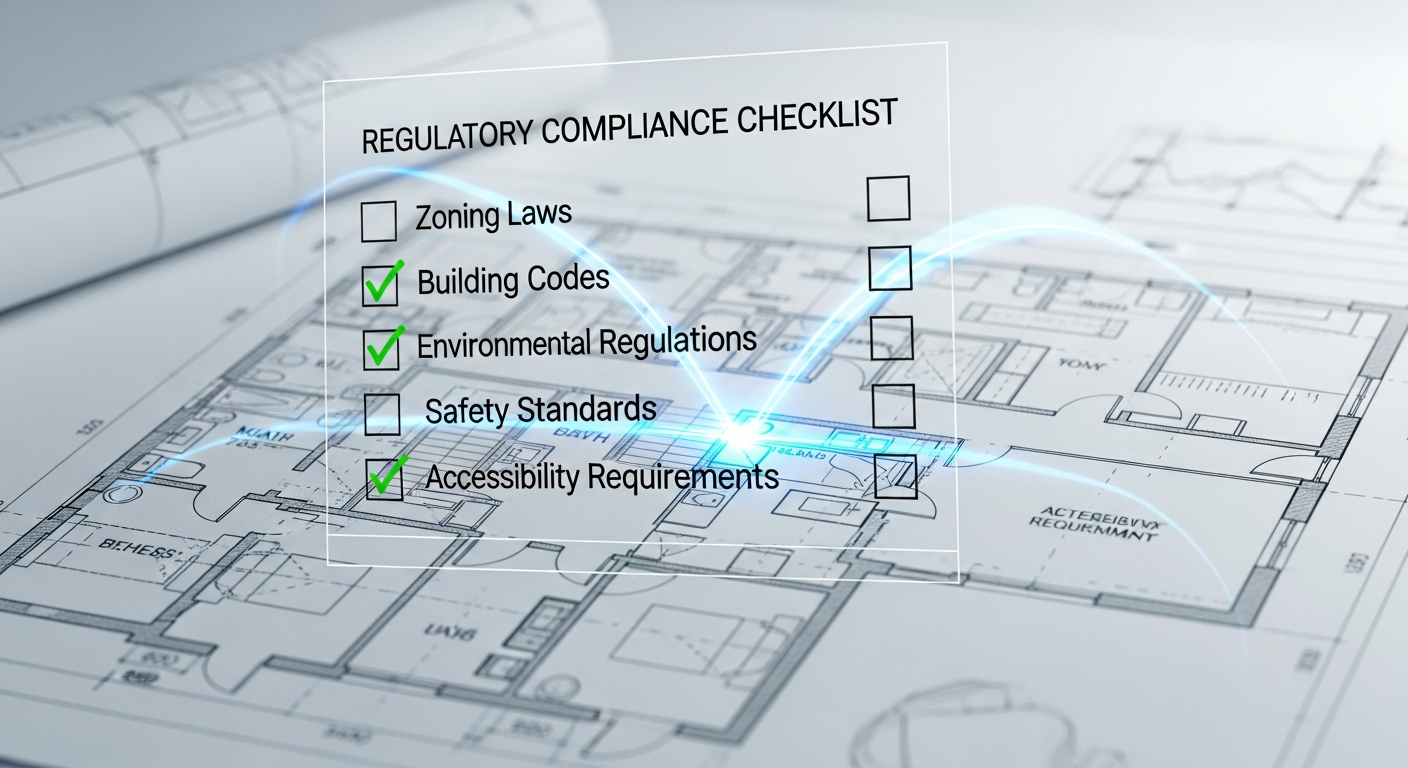
Understanding the business risk associated with regulatory violations is crucial for financial institutions evaluating office planning decisions. Regulatory penalties for compliance failures can reach millions of dollars, but the indirect costs—including damaged client relationships, increased regulatory scrutiny, and operational disruptions—often exceed direct financial penalties. A poorly designed office space that enables a data breach or compliance violation can result in consequences that far exceed the initial cost savings from cutting corners on regulatory-compliant design.
The ABS Physical Security Guidelines for Financial Institutions provide international perspective on how regulatory requirements translate into physical security architecture. These guidelines demonstrate that regulatory compliance in office design is not merely an American concern—financial institutions worldwide must grapple with similar challenges in creating spaces that meet both operational needs and regulatory mandates.
The challenge for financial institutions is that these regulatory requirements create a complex web of spatial needs that cannot be addressed through standard commercial office planning approaches. Traditional architects and space planners, while expert in their fields, often lack the specialized knowledge required to translate regulatory compliance requirements into effective spatial design solutions.
This regulatory complexity creates a foundation that influences every subsequent design decision, from the broad strokes of space allocation to the minute details of furniture placement and technology integration.
Physical Security Architecture: Building Protection into Every Square Foot
The regulatory foundation establishes what must be protected, but physical security architecture determines how that protection is implemented throughout the office environment. Financial services office security goes far beyond installing a few cameras and card readers—it requires a comprehensive approach that integrates multiple layers of protection into the fundamental design of the space.
The layered security approach forms the backbone of effective financial services office design. This concept requires creating distinct security zones throughout the office, each with appropriate access controls and protection levels corresponding to the sensitivity of activities conducted within that zone. Public areas like lobbies and client meeting spaces require basic security measures focused on visitor management and general surveillance. Semi-restricted areas, such as general office spaces, need enhanced access controls and activity monitoring. Highly restricted areas, including trading floors, server rooms, and executive suites, demand the most sophisticated security measures.
Creating these security layers requires careful consideration of traffic flow patterns and physical barriers. Each transition between security zones must be controlled through appropriate access points, whether that’s a simple card reader for general office access or a security vestibule with multi-factor authentication for highly sensitive areas. The challenge lies in implementing these controls without creating operational bottlenecks that impede daily business activities.
Perimeter security design establishes the first line of defense for financial institutions, but it must be implemented with sophistication that goes beyond basic commercial building security. Controlled entry points must accommodate varying levels of access for employees, clients, vendors, and visitors while maintaining strict security protocols. This often requires multiple entry systems: a main entrance for general access, secure entrances for employees with appropriate credentials, and service entrances with enhanced screening procedures.
The placement of these entry points significantly impacts both security effectiveness and operational efficiency. Main entrances must provide clear sightlines for security personnel while creating welcoming environments for clients. Employee entrances must accommodate peak traffic flows while maintaining security screening capabilities. Service entrances require sufficient space for delivery processing and vendor management without compromising the security of the main facility.
Surveillance positioning throughout financial services offices requires balancing comprehensive monitoring coverage with privacy considerations and regulatory compliance. Unlike retail environments where extensive surveillance is expected, financial services offices must carefully consider where cameras can be placed to ensure security without violating employee privacy rights or client confidentiality requirements. Trading floors require surveillance capabilities that can monitor for unauthorized access and suspicious activities while avoiding the capture of proprietary trading information. Client meeting areas need security monitoring that protects against unauthorized access without compromising the confidential nature of financial discussions.
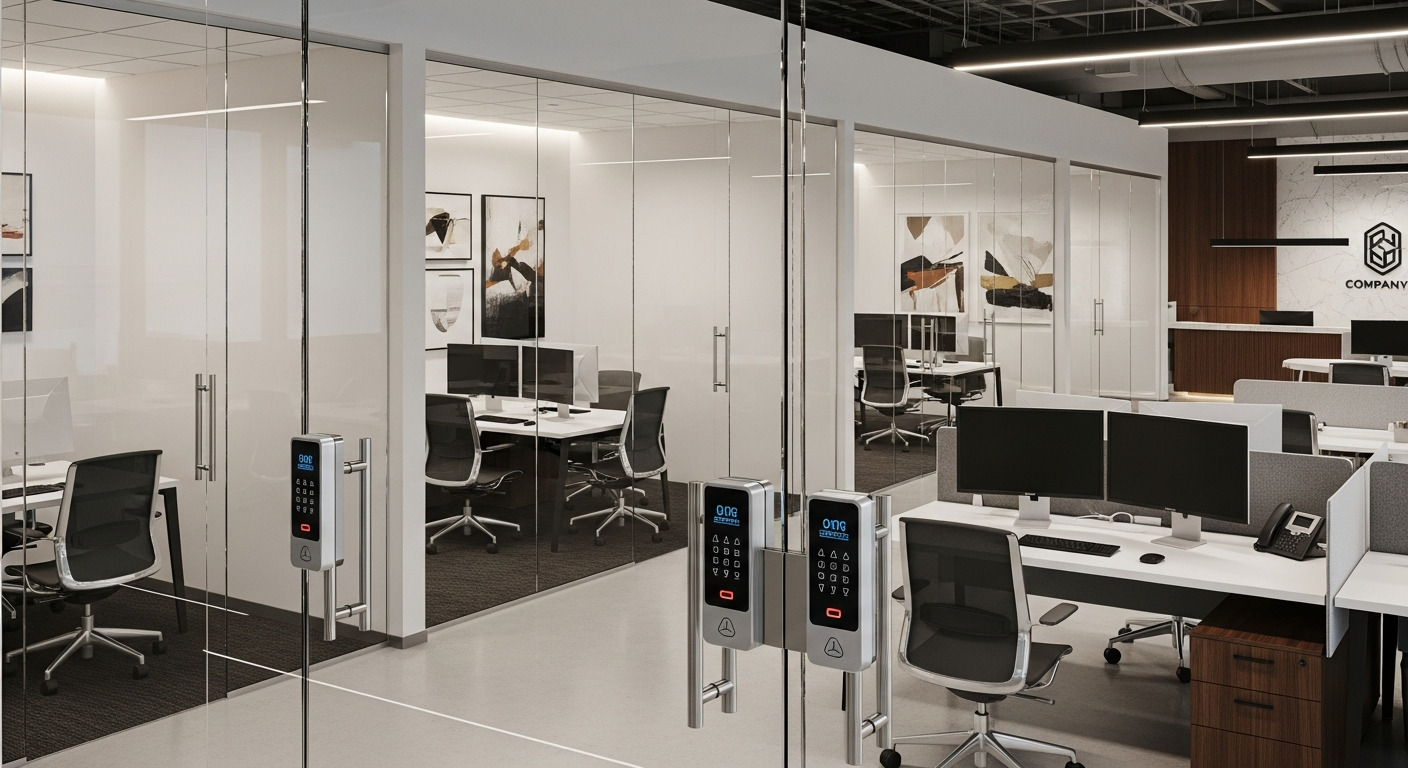
Multi-factor authentication systems introduce specific spatial requirements that must be planned during the initial design phase. Security vestibules—small enclosed areas between two sets of controlled doors—are often necessary for areas with the highest security requirements. These vestibules must accommodate the technology required for identity verification, including card readers, biometric scanners, and communication systems, while providing sufficient space for individuals to complete the authentication process comfortably.
The spatial considerations for effective authentication extend beyond the vestibule itself. Approach areas must provide adequate space for individuals to prepare for authentication without creating crowding or security vulnerabilities. Exit areas must allow for smooth traffic flow while maintaining security protocols. The placement of authentication systems must consider both the technical requirements of the security equipment and the human factors involved in daily use.
Intrusion detection systems require careful integration into the office design to provide comprehensive coverage without interfering with daily operations. Motion sensors must be positioned to detect unauthorized access while accommodating normal employee movement patterns. Door and window sensors require integration with the building’s architectural elements. Glass break detectors need strategic placement that considers both the layout of windows and the acoustic characteristics of the space.
The effectiveness of intrusion detection systems depends heavily on their integration with other security measures and building systems. Detection zones must align with access control areas to provide coordinated response capabilities. Emergency lighting and communication systems must remain functional during security incidents. Environmental systems must continue operating to protect sensitive equipment and documents even during security lockdowns.
Material selection for security-critical areas represents a significant departure from standard commercial office construction. Doors in sensitive areas must provide appropriate levels of tamper resistance while maintaining fire safety compliance and accessibility requirements. This often means specifying reinforced frames, high-security locks, and impact-resistant materials that cost significantly more than standard commercial door systems.
Window specifications in financial services offices must consider both security and operational requirements. Ground-floor windows may require security film or specialized glazing to prevent forced entry. Upper-floor windows in sensitive areas may need privacy treatments that prevent unauthorized viewing while maintaining natural light. The challenge lies in implementing these security enhancements without creating an institutional atmosphere that negatively impacts employee morale or client perception.
Wall construction in secure areas often requires specifications that exceed standard commercial building codes. Trading floors may need acoustic barriers to prevent eavesdropping on proprietary communications. Server rooms require specialized construction for electromagnetic shielding. Executive areas may need enhanced privacy barriers that provide both acoustic and visual separation.
Physical security design considerations for commercial buildings emphasize the importance of integrating security measures during the design phase rather than attempting to retrofit them later. This integrated approach ensures that security measures enhance rather than compromise the functionality of the space while achieving the comprehensive protection required in financial services environments.
The commercial building access control systems must be designed to accommodate the complex access requirements of financial institutions. Unlike simple office environments where most employees have similar access needs, financial institutions require granular control systems that can accommodate varying levels of access based on job function, security clearance, and operational requirements.
These complex security requirements create a framework that must be seamlessly integrated with privacy considerations to create office environments that protect both information and individual confidentiality.
Privacy by Design: Creating Confidential Zones for Financial Operations
Privacy considerations in financial services office design extend far beyond basic confidentiality requirements—they encompass the creation of specialized environments where sensitive financial operations can be conducted with complete confidence in information security. This privacy-by-design approach requires understanding how different financial activities generate unique privacy challenges that must be addressed through sophisticated architectural solutions.
Trading floor privacy represents one of the most complex challenges in financial services office design. Modern trading operations involve accessing proprietary market information, executing large transactions that could impact market prices, and conducting confidential communications with clients and counterparties. The workstation arrangement on trading floors must prevent unauthorized individuals from viewing trading screens, while acoustic design must ensure that confidential phone conversations cannot be overheard by unauthorized personnel.
The spatial planning for trading floors requires balancing operational efficiency with privacy protection. Traders need multiple monitors displaying market data, trade execution platforms, and communication systems, but these screens must be positioned to prevent viewing by individuals without appropriate authorization. This often requires innovative desk configurations, strategic placement of privacy screens, and careful consideration of sightlines throughout the trading area.
Communication privacy on trading floors extends beyond preventing eavesdropping on phone conversations. Modern trading involves instant messaging, video conferences with global counterparties, and collaboration on complex transactions that require absolute confidentiality. The acoustic design must accommodate these various communication methods while ensuring that sensitive information remains protected. This often requires a combination of sound masking systems, acoustic barriers, and strategic spacing that allows for effective collaboration while maintaining privacy boundaries.
Client meeting areas in financial services offices require privacy capabilities that far exceed typical business meeting spaces. Financial planning discussions, investment strategy sessions, and wealth management consultations involve highly personal and sensitive information that requires comprehensive privacy protection. These areas must provide both acoustic privacy to prevent eavesdropping and visual privacy to protect confidential documents and screen information.
The acoustic design for client meeting areas must consider both airborne sound transmission and structure-borne vibrations that could allow conversations to be overheard in adjacent spaces. High-quality acoustic insulation, solid core doors, and specialized ceiling and floor treatments are often necessary to achieve the level of sound isolation required for confidential financial discussions. Sound masking systems may be required in areas where natural background noise is insufficient to protect conversation privacy.
Visual privacy in client meeting areas requires careful consideration of window treatments, glass specifications, and sightline management. Meetings involving confidential financial information cannot risk unauthorized viewing from adjacent spaces, outdoor areas, or through reflective surfaces. This often requires sophisticated window film applications, strategically placed privacy barriers, and lighting design that prevents shadows or reflections from revealing confidential information.
Executive spaces in financial institutions require enhanced privacy controls that accommodate the sensitive nature of strategic decision-making and confidential communications. Executive offices, board rooms, and strategic planning areas must provide environments where highly sensitive information can be discussed without risk of unauthorized access or surveillance.
The privacy requirements for executive spaces often include specialized communication infrastructure that provides secure voice and data communications capabilities. This infrastructure must be designed and installed during the initial construction phase, as retrofitting secure communication systems is often prohibitively expensive and may compromise the building’s structural integrity.
Environmental controls for executive spaces extend beyond basic comfort considerations to include security and privacy requirements. Separate HVAC systems may be necessary to prevent acoustic transmission through air ducts. Specialized lighting controls may be required to prevent information leakage through window reflections. Even electrical systems may require special consideration to prevent electromagnetic interference that could compromise secure communications.
Server rooms and data centers within financial services offices require privacy and security measures that approach those found in dedicated data facilities. These areas must provide environmental controls that protect sensitive equipment while maintaining the access restrictions necessary for regulatory compliance. Physical access must be strictly controlled and logged, with biometric authentication often required for entry.
The environmental requirements for financial services data centers include precise temperature and humidity controls, backup power systems, and specialized fire suppression systems that protect equipment without damaging sensitive documents or electronic media. These systems must be designed to operate independently during building emergencies while maintaining the security and access controls required for regulatory compliance.
Data center layout within financial offices must consider both operational efficiency and security requirements. Server racks must be positioned to allow for maintenance access while maintaining clear sight lines for surveillance systems. Cable management must provide secure routing that prevents unauthorized access to network connections. Storage systems must accommodate both active data processing and long-term archival requirements while maintaining appropriate access controls for different types of information.
Acoustic design considerations throughout financial services offices require understanding how sound travels through modern building systems and implementing appropriate countermeasures. Open ceiling designs that are popular in contemporary offices can create acoustic challenges in environments where conversation privacy is critical. Sound masking systems must be carefully designed to provide appropriate privacy protection without creating unpleasant working conditions.
The acoustic challenges are compounded by the variety of communication methods used in modern financial services operations. Traditional phone conversations require different acoustic considerations than video conferences, which in turn have different requirements than face-to-face meetings. The acoustic design must accommodate all these communication methods while maintaining privacy for each.
Visual privacy solutions require innovative approaches that maintain the collaborative benefits of modern office design while providing appropriate protection for confidential information. Strategic placement of workstations, meeting rooms, and collaborative areas can create natural privacy barriers that don’t feel restrictive. Frosted glass applications can provide visual separation while maintaining natural light transmission. Digital privacy screens can provide temporary privacy for computer monitors when confidential information is displayed.
Trading room and control room cybersecurity measures emphasize the importance of integrating physical and digital security measures to create comprehensive privacy protection. The physical design of trading environments must support the technological security measures that protect against cyber threats while maintaining the operational efficiency required for effective trading operations.
The architectural security integration demonstrates how privacy requirements can be seamlessly integrated into attractive, functional office designs that don’t feel institutional or restrictive. The key is understanding how privacy requirements can be addressed through creative design solutions that enhance rather than detract from the overall office environment.
These comprehensive privacy considerations must be balanced with operational efficiency requirements to create office environments that protect confidential information while enabling productive financial services operations.
Operational Efficiency Within Constraints: Maximizing Function While Meeting Requirements
The challenge of creating operationally efficient financial services offices lies in optimizing functionality within the constraints imposed by security, privacy, and regulatory requirements. This balancing act requires sophisticated understanding of how financial professionals work, how information flows through organizations, and how security measures can be implemented without creating operational bottlenecks that impede business effectiveness.
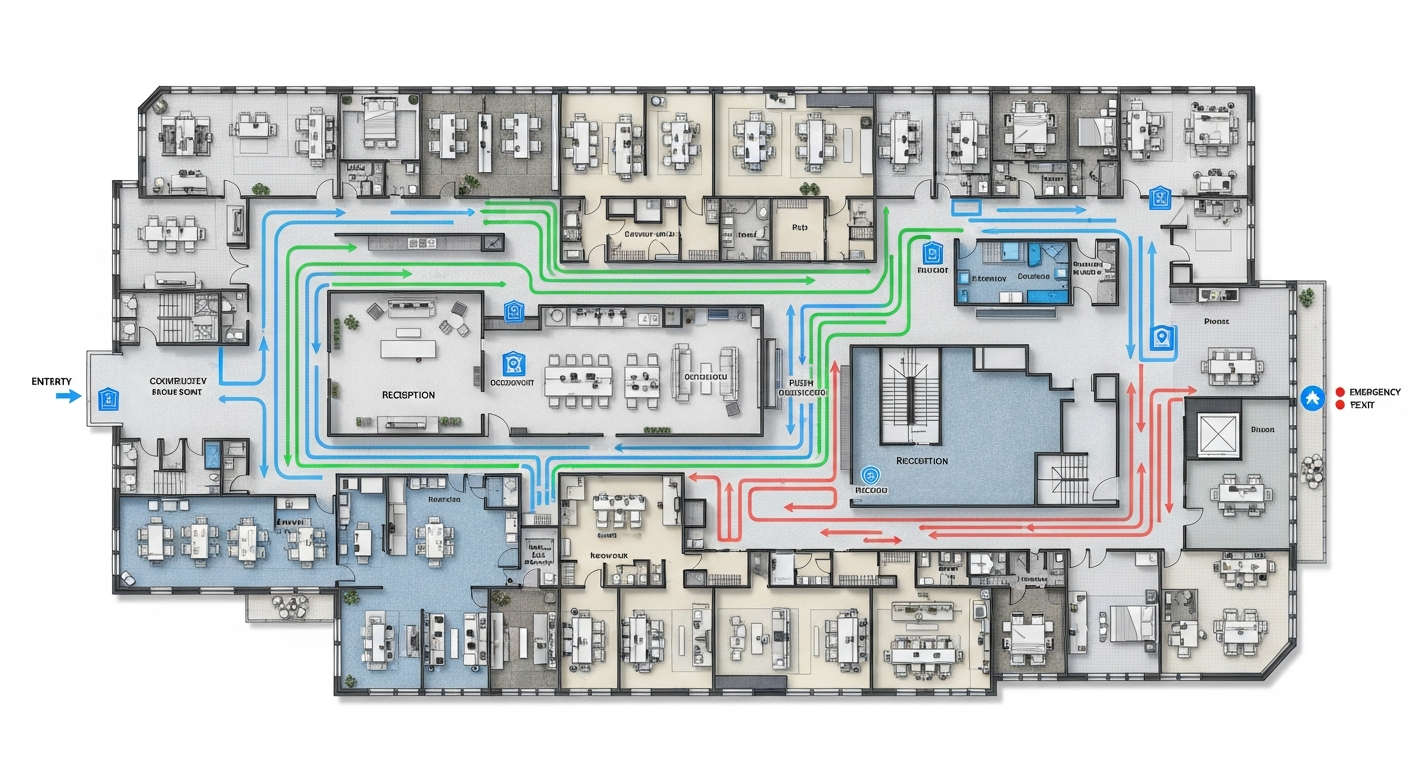
Traffic flow design in financial services offices must accommodate the complex access requirements while maintaining efficient movement patterns for daily operations. Unlike typical office environments where most employees have similar access privileges, financial institutions have employees, contractors, and visitors with widely varying authorization levels. The circulation design must enable appropriate access to different areas while maintaining security protocols and preventing unauthorized access to sensitive zones.
The main circulation spine of a financial services office often serves as a natural security boundary, with general office areas accessible to most employees and restricted areas requiring additional authorization. This circulation system must accommodate peak traffic flows, such as the beginning and end of trading sessions, while maintaining security screening capabilities and emergency egress requirements.
Secondary circulation patterns must consider the operational relationships between different departments and functions. Trading operations may require direct access to research and risk management areas while maintaining separation from general administrative functions. Client-facing areas must provide convenient access for visitors while maintaining appropriate separation from sensitive operational areas. The circulation design must facilitate these operational relationships while maintaining the security boundaries required for regulatory compliance.
Emergency egress planning in financial services offices presents unique challenges that don’t exist in typical commercial environments. Standard emergency egress routes may conflict with security perimeters that cannot be compromised even during emergency situations. Secured areas containing sensitive information or valuable assets may require specialized emergency procedures that maintain security while ensuring occupant safety.
The design challenge involves creating emergency egress systems that meet fire safety codes while maintaining appropriate security protocols. Emergency exits from secured areas may require delayed egress systems that provide security while allowing emergency evacuation. Stairwells and emergency routes may need surveillance systems and access controls that remain functional during emergency situations.
Emergency communication systems must provide clear evacuation instructions while maintaining security protocols for sensitive areas. Public address systems must be designed to avoid broadcasting emergency information that could compromise security operations. Emergency lighting must illuminate evacuation routes while maintaining security lighting in sensitive areas.
Natural surveillance principles offer opportunities to enhance security through strategic space planning that creates beneficial sightlines and visibility patterns. Open office designs can be adapted to financial services requirements by creating clear sight lines that enable security monitoring while maintaining appropriate privacy for confidential activities.
The application of natural surveillance in financial services offices requires understanding which areas benefit from increased visibility and which require enhanced privacy. General office areas can often benefit from open designs that enable natural monitoring and create collaborative environments. However, sensitive areas like trading floors, client meeting rooms, and executive spaces require careful balance between appropriate oversight and necessary privacy.
Workstation design and placement can contribute to natural surveillance while maintaining operational efficiency. Strategic placement of supervisory positions can provide natural oversight of trading and operational areas while ensuring that supervisors remain accessible for consultation and decision-making. Collaborative areas can be positioned to benefit from natural foot traffic while maintaining appropriate privacy for confidential discussions.
Technology integration in financial services offices must accommodate both operational requirements and security protocols without creating conflicting system demands. Modern financial operations require extensive technology infrastructure for trading systems, communication platforms, data processing, and client service applications. This technology must be integrated seamlessly with security systems, access controls, and surveillance infrastructure.
The challenge lies in creating technology environments that support efficient operations while maintaining the security and monitoring capabilities required for regulatory compliance. Network infrastructure must provide the high-speed, low-latency connections required for trading operations while incorporating the security measures necessary to protect against cyber threats. Communication systems must provide clear, reliable connectivity for client interactions while maintaining the privacy and recording capabilities required for compliance.
Workstation technology must accommodate the multiple monitor displays, communication devices, and specialized applications used in financial services while integrating with security systems for user authentication and activity monitoring. Power and data distribution systems must provide reliable service for mission-critical operations while incorporating the backup systems and security measures required for business continuity.
Space utilization optimization within financial services environments requires understanding how regulatory and security constraints affect traditional office efficiency metrics. Standard space planning approaches that maximize density and minimize square footage per employee may not be appropriate for environments where regulatory compliance requires specific spatial allocations for secure storage, confidential meeting areas, and emergency procedures.
The optimization challenge involves finding creative solutions that achieve efficient space utilization while satisfying all regulatory and security requirements. Multi-use spaces that can serve different functions at different times may provide efficiency gains while maintaining compliance. Flexible furniture systems that can adapt to changing operational needs may provide better space utilization than fixed installations.
Storage requirements in financial services offices often exceed those found in typical office environments, as regulatory compliance may require maintaining physical documents, backup systems, and emergency supplies. The space planning must accommodate these storage requirements while maintaining efficient access and appropriate security controls.
Employee experience considerations become particularly important in environments where security and compliance requirements could create restrictive or uncomfortable working conditions. The design challenge involves implementing necessary security measures while maintaining positive workplace environments that support productivity and job satisfaction.
Natural light access, acoustic comfort, and ergonomic considerations must be balanced with security and privacy requirements. Visual privacy measures should not eliminate access to natural light. Acoustic privacy solutions should not create isolating or uncomfortable sound environments. Security measures should enhance rather than impede the daily work experience.
Collaborative spaces require special consideration in financial services environments where confidential information is frequently discussed. These spaces must provide appropriate privacy and security while encouraging the collaboration and communication necessary for effective financial services operations. Technology integration in collaborative spaces must support both formal presentations and informal discussions while maintaining appropriate recording and monitoring capabilities.
Physical security and design integration demonstrates how security requirements can be seamlessly integrated into functional, attractive office environments that support rather than impede operational efficiency. The key insight is that security measures should be designed as integral components of the office environment rather than added-on systems that conflict with operational needs.
Creating secure environments in commercial buildings provides additional perspective on how comprehensive security measures can be implemented without compromising the functionality and attractiveness of office environments. These approaches demonstrate that security, compliance, and operational efficiency are not mutually exclusive goals but can be achieved simultaneously through sophisticated design integration.
These operational challenges highlight why traditional office planning approaches struggle to optimize financial services environments and create opportunities for innovative solutions that can transform the planning process.
The Automation Advantage: How qbiq Transforms Financial Services Office Planning
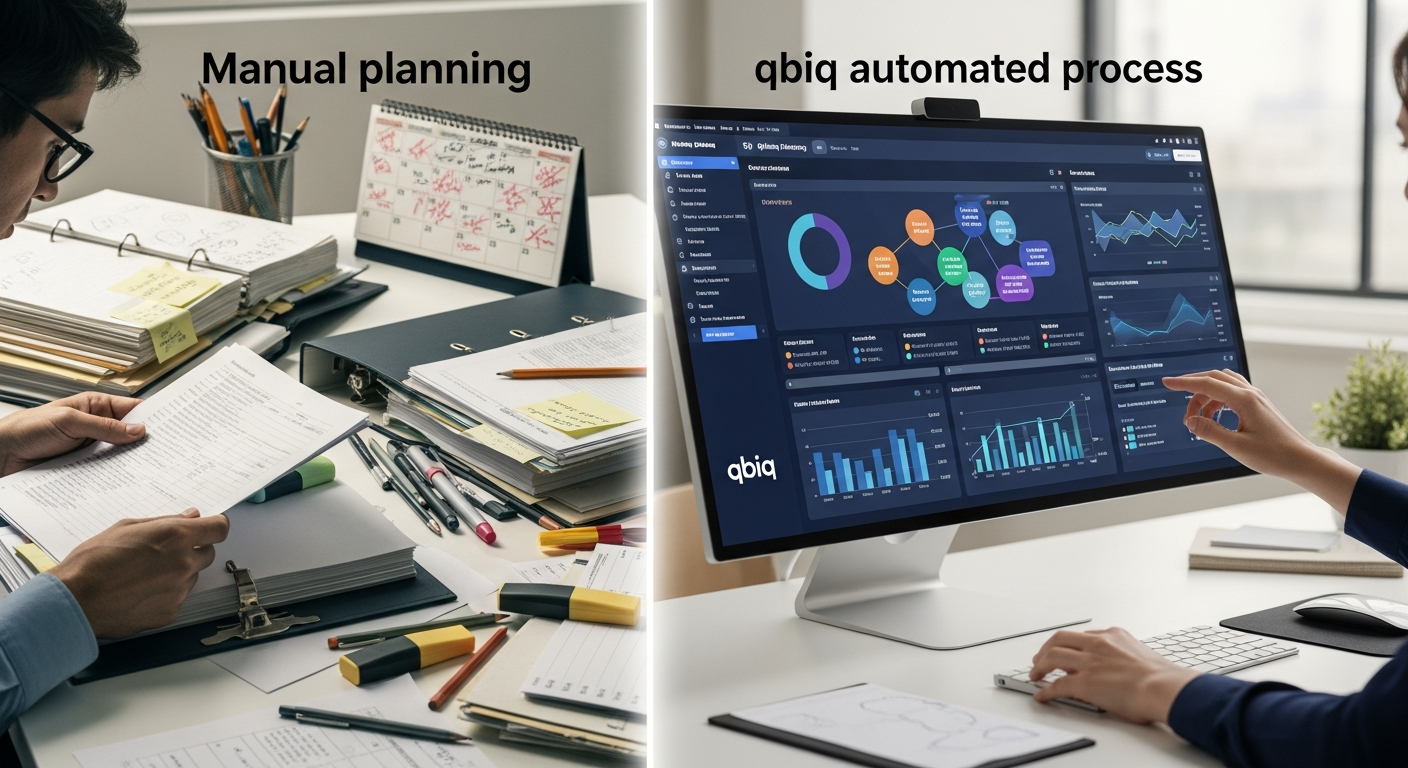
The complexity inherent in financial services office planning—balancing regulatory compliance, security requirements, privacy needs, and operational efficiency—has traditionally made this process lengthy, expensive, and prone to oversight. Manual planning approaches require extensive coordination between specialized consultants, lengthy iteration cycles, and significant risk of missing critical requirements. However, automated architectural intelligence is transforming this landscape, enabling financial institutions to achieve comprehensive planning solutions with unprecedented speed, accuracy, and optimization.
The speed advantage offered by automation represents a fundamental shift in how financial institutions can approach office planning decisions. Traditional manual processes often require weeks or months to evaluate a single space option, incorporating regulatory requirements, security specifications, and operational needs. Multiple iterations to optimize layouts and configurations can extend project timelines by months, delaying occupancy and increasing carrying costs for both existing and new spaces.
Automated planning systems can perform comprehensive analysis of space options, regulatory compliance, and optimization scenarios in minutes rather than months. This dramatic reduction in analysis time enables financial institutions to evaluate significantly more options, conduct more thorough optimization studies, and make faster decisions about space commitments. The ability to rapidly analyze multiple scenarios enables better decision-making by providing comprehensive data on the implications of different space choices.
This speed advantage becomes particularly valuable in competitive real estate markets where desirable spaces may have limited availability windows. Financial institutions using automated planning can quickly assess whether a space can meet their specific requirements and generate preliminary layouts and cost estimates while competing offers may still be under manual review by other potential tenants.
Comprehensive scenario modeling capabilities enable evaluation of multiple security and privacy configurations simultaneously, providing decision-makers with clear data on the trade-offs between different approaches. Traditional planning processes typically evaluate one primary option with limited variations due to the time and cost required for each iteration. Automated systems can simultaneously evaluate dozens of different configurations, access control strategies, and space optimization approaches.
This comprehensive modeling extends beyond basic layout considerations to include detailed analysis of traffic flow patterns, security zone effectiveness, emergency egress optimization, and technology integration requirements. Each scenario can be evaluated for regulatory compliance, security effectiveness, operational efficiency, and cost implications, providing decision-makers with unprecedented insight into the implications of different planning approaches.
The modeling capabilities include sensitivity analysis that shows how changes in requirements or constraints affect space planning outcomes. If regulatory requirements change or security threats evolve, automated systems can quickly recalculate optimal configurations without requiring complete re-planning efforts. This adaptability provides significant value in dynamic regulatory environments where requirements may change during planning or development phases.
Risk mitigation through automated planning represents one of the most significant advantages for financial institutions, where planning oversights can result in regulatory violations, security vulnerabilities, or operational inefficiencies with serious business consequences. Manual planning processes rely on human expertise and coordination between multiple specialists, creating opportunities for miscommunication, oversight, or conflicting requirements.
Automated systems incorporate comprehensive regulatory knowledge and compliance checking into every planning iteration, ensuring that all applicable requirements are systematically addressed. Regulatory updates can be incorporated into planning systems, providing automatic compliance verification for new requirements. Security standards and best practices can be embedded in planning algorithms, ensuring that appropriate measures are included in every configuration.
The risk mitigation extends beyond compliance to include operational and financial risks. Automated systems can identify potential operational bottlenecks, security vulnerabilities, or inefficiencies that might not be apparent during manual planning processes. Cost estimation and budget analysis can be integrated into planning iterations, providing early identification of potential budget issues or optimization opportunities.
Capacity multiplication through automation enables financial institutions to evaluate more options with existing staff resources, effectively multiplying the planning capacity of internal teams. Traditional planning processes require significant input from compliance officers, security experts, and operational specialists who have primary responsibilities beyond space planning. The extensive coordination required often limits the number of options that can be thoroughly evaluated.
Automated planning systems can perform initial analysis and optimization without requiring extensive input from specialized staff, enabling evaluation of multiple options before engaging expert resources for final review and refinement. This approach allows specialized staff to focus on strategic decisions and final optimization rather than basic compliance checking and preliminary analysis.
The capacity multiplication also enables more thorough exploration of creative solutions and innovative approaches that might not be considered during manual planning due to time constraints. Automated systems can explore unconventional configurations, innovative security approaches, or creative space utilization strategies that could provide significant advantages but require extensive analysis to validate.
Consistency in planning outcomes becomes particularly valuable for financial institutions with multiple locations or ongoing space planning needs. Manual processes can result in inconsistent approaches to similar challenges, varying levels of regulatory compliance, or different interpretations of security requirements. Automated systems ensure that all regulatory and security requirements are systematically addressed across every planning iteration and every location.
This consistency extends to documentation and reporting, ensuring that all planning decisions are supported by comprehensive analysis and regulatory compliance verification. Standardized reporting formats enable better comparison between options and more efficient review processes. Consistent planning approaches across multiple locations can also provide operational benefits by standardizing security procedures, access controls, and emergency protocols.
Data-driven decision making becomes possible when comprehensive metrics on compliance coverage, security effectiveness, and operational efficiency are available for every planning option. Traditional planning processes often rely on subjective assessments and limited quantitative analysis due to the complexity and time required for thorough evaluation.
Automated systems can provide detailed metrics on space utilization efficiency, security coverage effectiveness, regulatory compliance levels, and operational flow optimization for every configuration option. These metrics enable objective comparison between alternatives and support evidence-based decision-making. Cost-benefit analysis becomes more comprehensive when detailed performance data is available for different planning approaches.
The data-driven approach also enables continuous improvement in planning outcomes by analyzing performance data from implemented spaces and incorporating lessons learned into future planning iterations. Machine learning capabilities can identify patterns and optimization opportunities that might not be apparent through manual analysis.
qbiq’s automated space planning capabilities provide comprehensive office planning solutions that integrate regulatory compliance, security requirements, and operational optimization into automated workflows. The platform’s ability to simultaneously optimize multiple objectives while maintaining regulatory compliance provides financial institutions with planning capabilities that were previously unavailable through manual processes.
qbiq’s customized planning engine can be tailored to specific regulatory environments, security requirements, and operational needs of different types of financial institutions. This customization ensures that automated planning solutions address the unique challenges faced by different organizations while maintaining the comprehensive analysis capabilities that provide competitive advantages.
The transformation from manual to automated planning represents a paradigm shift that enables financial institutions to achieve better planning outcomes with greater efficiency and reduced risk, creating opportunities for strategic advantages in space planning and facility optimization.
Implementation Strategy: Practical Steps for Financial Institutions
Successfully transitioning from manual to automated office planning requires a strategic approach that addresses both technical implementation and organizational change management. Financial institutions must carefully plan this transition to maximize benefits while ensuring continuity of planning capabilities and maintaining regulatory compliance throughout the implementation process.
Regulatory audit and requirement documentation form the foundation for any successful implementation of automated planning systems in financial services environments. Before engaging with automated planning tools, institutions must comprehensively document their specific regulatory requirements, compliance obligations, and security standards. This documentation serves as the baseline for configuring automated systems and validating that planning outcomes meet all applicable requirements.
The regulatory audit process should include review of all applicable federal and state regulations, industry standards, and internal compliance policies that affect office planning decisions. SEC requirements for customer information protection, FINRA business continuity mandates, SOX compliance obligations, and GLBA privacy provisions must be thoroughly documented with specific implications for space planning and office design. Industry-specific requirements, such as PCI DSS standards for payment processing or state banking regulations, must also be incorporated into the requirement documentation.
Internal compliance policies often include requirements that exceed regulatory minimums, reflecting institutional risk tolerance and best practices developed through experience. These internal requirements must be documented and incorporated into automated planning configurations to ensure that planning outcomes align with institutional standards and expectations.
The requirement documentation should also include operational standards and preferences that affect space planning decisions. Trading floor configurations, client service protocols, and security procedures should be documented to ensure that automated planning systems generate solutions that support actual operational needs rather than theoretical compliance requirements.
Stakeholder alignment between compliance, security, operations, and real estate teams represents a critical success factor for successful implementation. Each of these functional areas brings essential expertise and requirements to the office planning process, but they often have different priorities and perspectives that must be reconciled during implementation.
Compliance teams bring regulatory expertise and risk management perspectives that are essential for ensuring that automated planning solutions meet all legal and regulatory requirements. These teams must be involved in system configuration and validation to ensure that planning outcomes satisfy compliance obligations. Security teams provide expertise on physical security requirements, threat assessment, and risk mitigation strategies that must be incorporated into planning algorithms.
Operations teams understand the day-to-day workflow requirements, collaboration needs, and efficiency considerations that determine whether office configurations will support effective business operations. Real estate teams bring expertise on market conditions, lease negotiations, and facility management considerations that affect the viability and cost-effectiveness of different planning options.
The stakeholder alignment process should include collaborative development of planning criteria, success metrics, and decision-making processes that will govern the use of automated planning systems. Clear agreements on priorities, trade-off criteria, and approval processes will ensure that automated planning tools generate solutions that meet the needs of all stakeholder groups.
Regular communication and feedback processes should be established to ensure that stakeholder perspectives continue to be incorporated as automated planning systems are refined and optimized based on implementation experience.
Pilot project approaches provide opportunities to test automated planning capabilities with specific compliance scenarios before implementing comprehensive planning workflows. Pilot projects should be selected to include representative examples of the planning challenges faced by the institution while limiting scope and risk during initial implementation.
Effective pilot projects might include planning for a single department relocation, optimization of an existing floor layout, or evaluation of alternative configurations for a specific space type. The pilot scope should be sufficient to test the full range of automated planning capabilities while providing meaningful results that can validate the benefits and identify areas for improvement.
Pilot project success criteria should be established before implementation begins, including specific metrics for planning speed, compliance verification, solution quality, and stakeholder satisfaction. These metrics will provide objective data on the benefits of automated planning and identify any adjustments needed before broader implementation.
The pilot project should also include testing of integration capabilities with existing systems and workflows to ensure that automated planning can be seamlessly incorporated into current planning processes. Documentation and reporting capabilities should be evaluated to ensure they meet institutional standards and support existing approval and decision-making processes.
Integration with existing security systems and compliance management processes ensures that automated planning solutions work effectively within current institutional infrastructure. Most financial institutions have significant investments in security systems, compliance management platforms, and operational workflows that must be considered during implementation.
Security system integration may include connections to access control systems, surveillance platforms, and intrusion detection systems to ensure that planning solutions are compatible with existing security infrastructure. Compliance management integration may include connections to regulatory reporting systems, audit management platforms, and risk assessment tools.
The integration approach should prioritize maintaining existing system functionality while adding automated planning capabilities. Disruption to current operations should be minimized through careful planning and phased implementation approaches that allow for testing and validation before full deployment.
Data integration requirements should be carefully evaluated to ensure that automated planning systems can access necessary information about regulatory requirements, security standards, and operational needs. APIs and data exchange protocols should be established to support ongoing synchronization between automated planning systems and other institutional systems.
Training considerations for teams transitioning from manual to automated planning workflows must address both technical skills and process changes. Staff members who have been responsible for manual planning processes will need training on automated system capabilities, interface usage, and new workflow procedures.
The training program should include both technical instruction on system operation and strategic training on how to effectively use automated capabilities to improve planning outcomes. Change management support may be necessary to help staff adapt to new roles and responsibilities as automated systems take over routine analysis tasks.
Training should also address how automated planning results should be interpreted and validated, ensuring that staff members understand both the capabilities and limitations of automated systems. Quality assurance procedures should be established to ensure that automated planning results meet institutional standards before implementation.
Ongoing training and support processes should be established to ensure that staff capabilities keep pace with system enhancements and regulatory changes that affect planning requirements.
Measuring success through comprehensive metrics on compliance coverage, planning speed, and risk reduction provides objective validation of implementation benefits and identifies opportunities for continued improvement. Success metrics should address all major objectives for automated planning implementation, including efficiency gains, compliance improvements, and risk mitigation.
Compliance coverage metrics should track the comprehensive inclusion of regulatory requirements in planning solutions and validate that automated systems consistently address all applicable regulations and standards. Planning speed metrics should measure the reduction in time required for planning analysis and optimization compared to manual processes.
Risk reduction metrics should evaluate the identification and mitigation of planning risks through automated analysis capabilities. Quality metrics should assess the effectiveness and usability of planning solutions generated through automated processes.
Regular performance reviews should be conducted to evaluate progress against success metrics and identify adjustments needed to optimize automated planning capabilities. Feedback from stakeholders should be systematically collected and incorporated into ongoing system refinement and enhancement processes.
qbiq case studies provide examples of successful implementations in complex regulatory environments, demonstrating how financial institutions have achieved significant improvements in planning efficiency and effectiveness through automated planning solutions. These case studies offer insights into best practices and lessons learned that can inform implementation strategies for other institutions.
qbiq help center resources provide comprehensive technical documentation and support materials to assist with implementation planning and ongoing system optimization. These resources include detailed configuration guidance, integration instructions, and troubleshooting support to ensure successful deployment of automated planning capabilities.
The implementation strategy should be viewed as an investment in institutional capabilities that will provide ongoing benefits through improved planning efficiency, enhanced compliance assurance, and reduced risk exposure in office planning decisions.
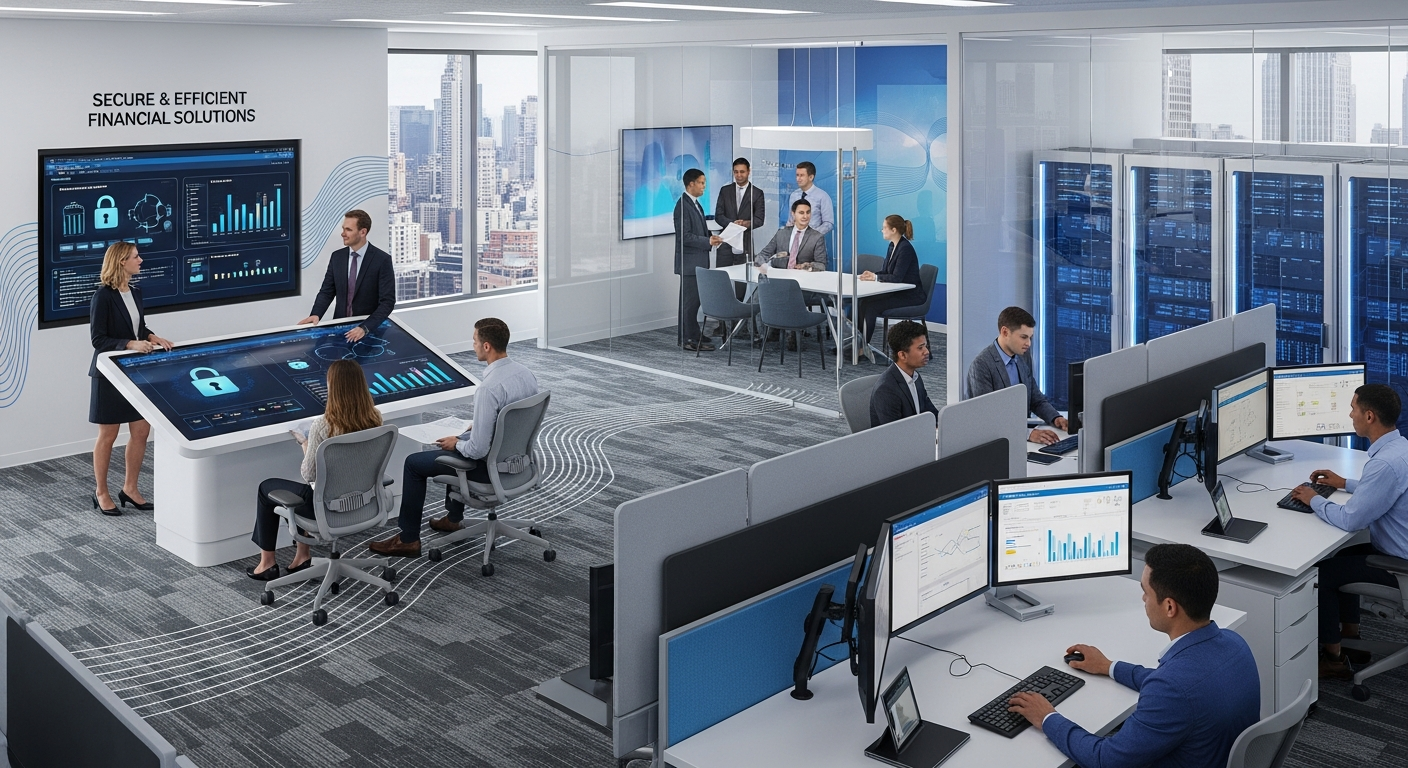
Moving Financial Institutions Forward
Financial services office planning represents one of the most complex challenges in commercial real estate, requiring expertise across regulations, security, privacy, and operational efficiency. The traditional approach—relying on manual processes, hoping disparate experts can coordinate effectively, and accepting lengthy planning cycles—exposes institutions to compliance risks, security vulnerabilities, and operational inefficiencies that can impact both bottom-line results and client confidence.
The stakes have never been higher for getting office planning right. Regulatory enforcement has intensified, security threats have evolved, and client expectations for confidentiality and professionalism continue to rise. Meanwhile, competitive pressures demand operational efficiency and cost optimization that traditional planning approaches struggle to deliver. Financial institutions can no longer afford the risk and inefficiency inherent in manual planning processes.
The transformation to automated architectural intelligence changes this equation entirely. What once required weeks of coordination between compliance officers, security experts, and architects can now be accomplished in minutes, with comprehensive validation of all requirements and multiple optimization scenarios. Financial institutions no longer need to choose between speed and thoroughness, or between compliance and operational excellence.
The benefits extend beyond mere efficiency gains. Automated planning systems provide comprehensive risk mitigation by systematically addressing all regulatory requirements and security standards in every planning iteration. Consistency across multiple locations and planning projects eliminates the variability and oversight risks inherent in manual processes. Data-driven decision making becomes possible when comprehensive metrics on compliance coverage, security effectiveness, and operational efficiency are available for every option.
Perhaps most importantly, automation multiplies institutional capabilities without requiring additional specialized staff. The same compliance officers, security experts, and operational specialists who previously spent weeks on basic planning analysis can now focus their expertise on strategic decisions and final optimization. This capacity multiplication enables more thorough evaluation of options, more creative exploration of solutions, and better strategic alignment of space planning with business objectives.
The question is no longer whether your institution can afford to modernize its office planning approach—it’s whether you can afford not to. While competitors struggle with manual processes that limit their options and extend their decision timelines, forward-thinking institutions are leveraging automated planning to evaluate more spaces, optimize configurations more thoroughly, and make faster decisions with greater confidence in compliance and security outcomes.
The complexity of financial services office planning will only continue to increase as regulations evolve, security threats advance, and operational requirements become more sophisticated. Institutions that continue to rely on manual planning approaches will find themselves increasingly disadvantaged, while those that embrace automation will gain sustainable competitive advantages in space planning efficiency, compliance assurance, and operational optimization.
Ready to transform how your financial institution approaches office planning? Discover how qbiq’s automated architectural capabilities can ensure compliance, enhance security, and optimize operations simultaneously. Schedule a demonstration to see how leading financial institutions are revolutionizing their workspace planning in minutes, not months.






.png)


