
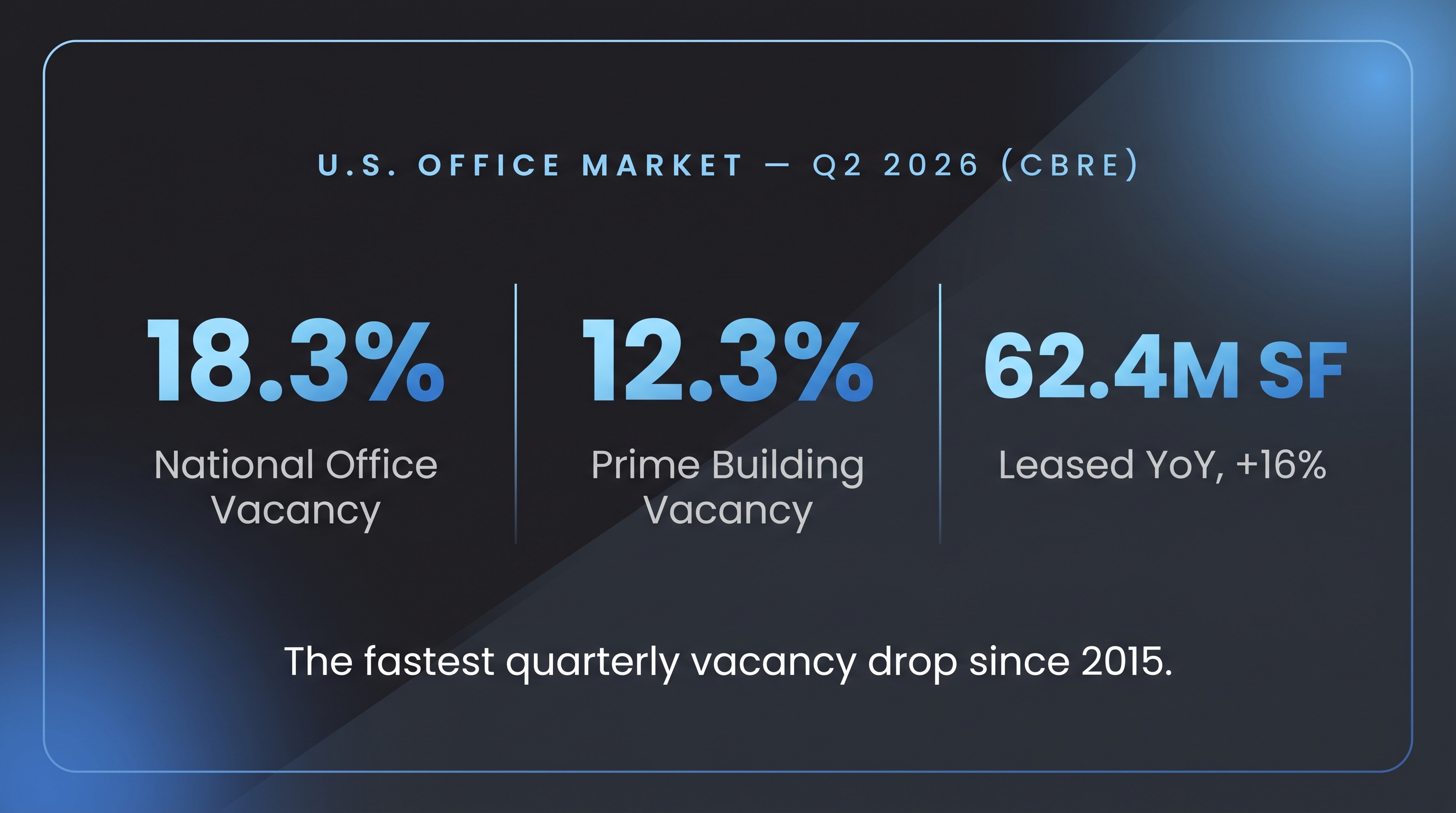
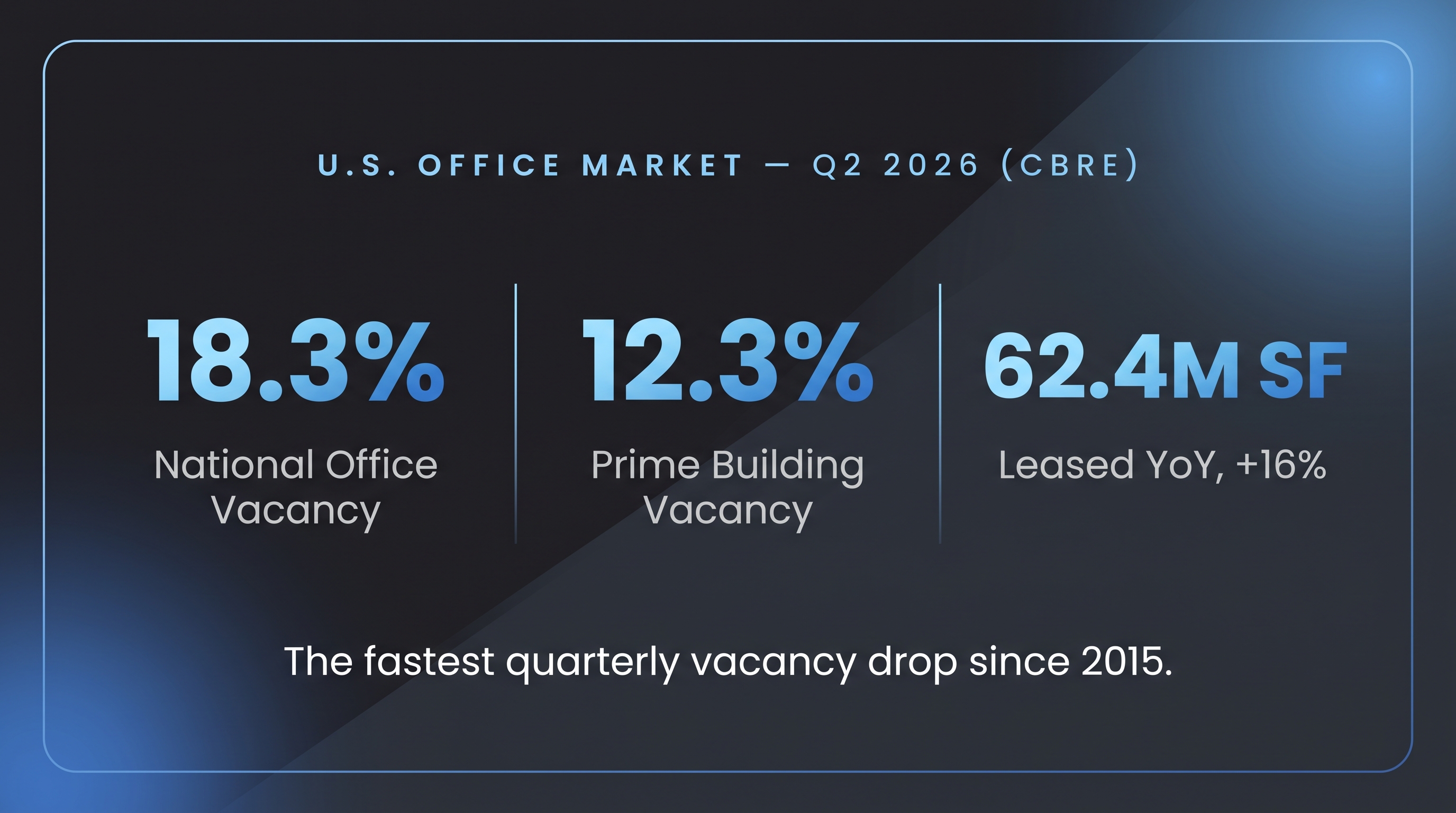
According to CBRE's Q2 2026 U.S. Office Market Report, office vacancy posted its fastest quarterly drop since 2015. National vacancy fell 30 bps to 18.3%; in prime buildings, it dropped 40 bps to 12.3% (Midtown Manhattan prime is down to just 2.2%). Leasing rose 16% year-over-year to 62.4 million sq. ft., and the construction pipeline sits 87% below its 2020 peak — the ninth straight quarter of positive demand outpacing new supply.
Translation: tenants have less to choose from, and they're moving faster. The owners who win the lease aren't the ones with the best building. They're the ones who can show a prospect what their space could be before a competitor even finishes the floor plan.
Most owners still can't do that. Here's why, and what changed for one that could.
The bottleneck was never the building
Ask any owner what slows down a lease, and the building is rarely the problem. It's the pitch.
A prospect walks an empty floor. They're asked to imagine reception here, a kitchen there, twelve desks along that wall. Most people can't do that reliably — and the ones who can still won't commit to a five-year lease based on a mental sketch.
Turning that empty floor into a real layout, a rendering, a rough budget is genuine architectural work — and done by hand, floor by floor, it takes a week or more. That's not a knock on the architects doing it; it's just what manual production time looks like at this level of quality. But a week is a long time in a market moving this fast. It's long enough for a tenant to sign somewhere else, or lose the urgency that got them looking in the first place.
What changed at AmTrustRE
AmTrustRE ran into exactly this. Every vacancy needed a custom pitch, and every pitch needed a full design turnaround before it could go in front of a prospect.
"qbiq has fundamentally changed how we showcase vacancies to potential tenants," said Jonathan Bennett, CEO of AmTrustRE. "Instead of waiting a week for an architect, we now get a complete future-fit package in a day."
That's not architecture being replaced — it's architectural output arriving on a different timeline. qbiq isn't a substitute for the expertise; it's a same-day starting point that qbiq's own architecture team and the owner's project stakeholders build the final pitch from, instead of everyone waiting a week for the first draft.
A week to a day isn't a marginal improvement. It's the difference between pitching a building and pitching a workplace — while the prospect is still deciding.
What "a day" actually gets you
The package isn't a single rendering. It's the full case for the space:
A rendered 3D tour a prospect can walk through remotely, before they've booked a second site visit. Multiple layout alternatives, so the pitch isn't "here's one idea" but "here's the version that fits how you actually work." A bill of quantities with real cost estimates, so the conversation moves past "what could this look like" straight to "what would this cost." And design analytics that turn "trust us" into a data-backed answer — drawn from a dataset of over 775 million square feet of verified design data, the same foundation behind qbiq's broader Space Intelligence platform.
None of that requires the prospect to imagine anything. It requires them to react to something real — and reacting is faster than imagining.
Why this matters more this year than last
In a soft market, a slow pitch just means a slower close. In a market where vacancy is falling this fast and supply this tight, a slow pitch means losing the tenant to a landlord who answered first.
The math is simple: fewer available floors, more tenants competing for them, and a shrinking window between "interested" and "signed." The owners who close that window — design turnaround included — are the ones converting the current market into signed leases instead of extended vacancies.
The takeaway
A vacant floor doesn't lease itself, and neither does a floor plan a prospect has to picture in their head. In a market this tight, the fastest credible pitch wins the deal — not the fanciest one.
The question worth asking about your own vacancies isn't "how good is the space." It's "how long does it take a tenant to see themselves in it."
That's what qbiq is: the Space Intelligence platform — starting with AI space planning.
Want to hear more about what qbiq can do for your business? Request a demo





.png)


