
Picture this: You’re a commercial real estate broker standing in the middle of a vacant 25,000 square foot office space on the 15th floor of a downtown high-rise. The morning light streams through floor-to-ceiling windows, illuminating the possibilities within these empty walls. Across from you stands the decision-making team from a rapidly growing tech company—200 employees strong and searching for their new headquarters.
“This space has incredible potential,” you begin, gesturing toward the open expanse. “But I know what you’re thinking: How do we know if our entire team will fit? Where would the engineering department sit relative to product management? How do we create collaborative spaces while maintaining focus zones?”
These questions aren’t just about square footage. They’re about envisioning a future where space becomes a strategic asset that drives productivity, culture, and business success. This is where office space planning transforms from a conceptual exercise into a critical business function that can make or break major real estate decisions.
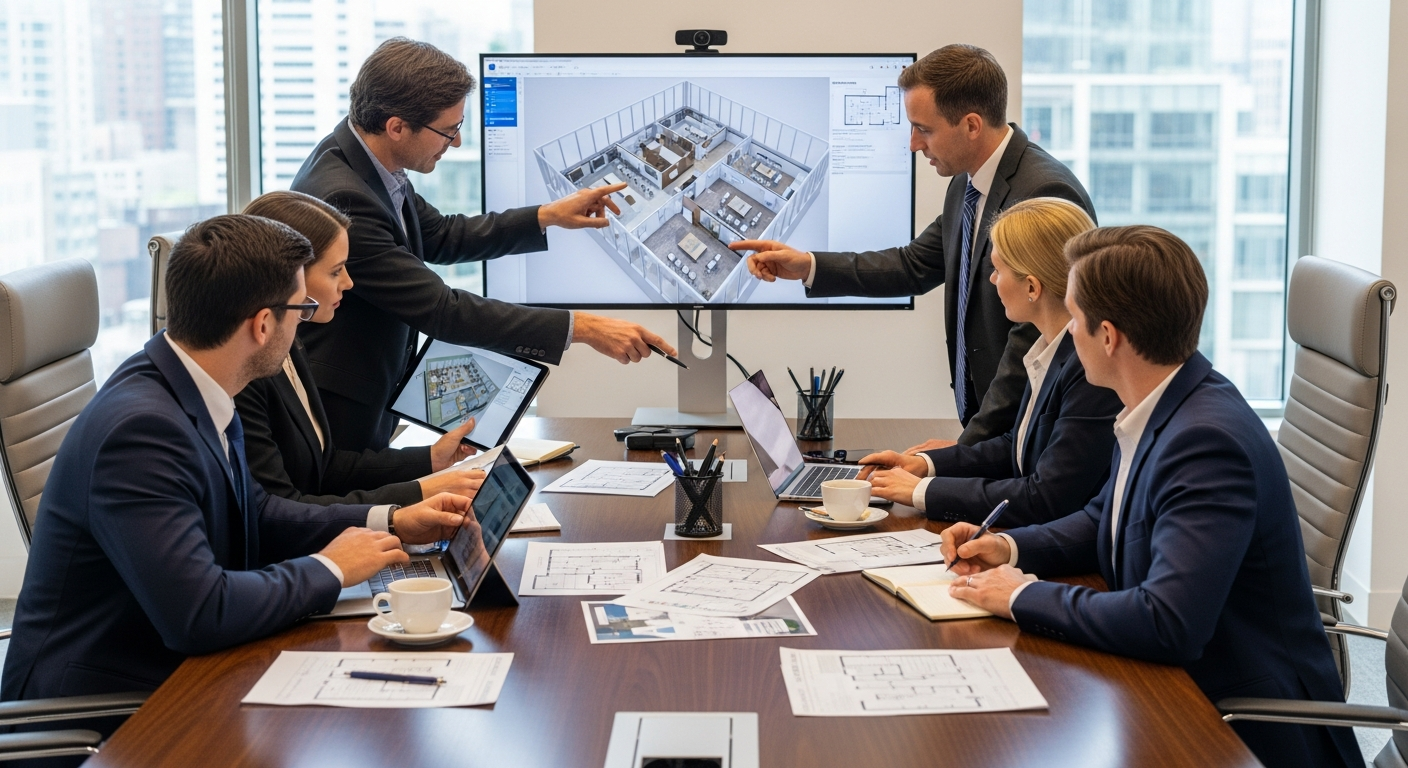
Office space planning has evolved far beyond simply arranging furniture on a floor plan. In today’s competitive commercial real estate landscape, it’s become a sophisticated discipline that bridges architecture, business strategy, and technology. For CRE professionals, mastering space planning is more than satisfying client needs. It’s about accelerating deal velocity, reducing risk, and delivering experiences that set you apart from the competition.
This comprehensive guide will take you through everything you need to know about office space planning as a CRE professional. We’ll explore fundamental concepts, examine the business impact, walk through proven processes, and reveal how modern technology is revolutionizing the way space planning decisions are made. Whether you’re a seasoned broker looking to enhance your service offering or a property manager seeking to maximize portfolio value, understanding space planning will enhance your ability to serve clients and drive results.
The stakes have never been higher. With hybrid work models reshaping office utilization, sustainability requirements influencing design decisions, and technology enabling new possibilities for spatial visualization, CRE professionals who understand space planning possess a significant competitive advantage. Let’s dive deep into this critical discipline and explore how it can transform your business outcomes.
What is Office Space Planning? Defining the Foundation
At its core, office space planning is the systematic process of organizing physical workspace to optimize functionality, efficiency, and user experience. However, this definition barely scratches the surface of what has become one of the most strategically important aspects of commercial real estate decision-making.
Space planning encompasses far more than determining where desks should go. It’s a comprehensive methodology that considers space allocation ratios, traffic flow patterns, functional zoning strategies, departmental adjacencies, technology infrastructure requirements, and regulatory compliance standards. When executed effectively, space planning creates environments that enhance productivity, support organizational culture, and adapt to changing business needs over time. Teams planning offices abroad may also need to translate local building codes and lease documents, and Lara Translate can handle this while preserving the original layout.
The scope of modern office space planning extends across multiple interconnected dimensions. Spatial organization forms the foundation, determining how different functional areas relate to one another and how people move through the environment. Resource allocation ensures optimal utilization of expensive real estate, balancing individual workspace needs with collaborative areas, support functions, and circulation requirements. Experience design focuses on creating environments that attract talent, support well-being, and reinforce brand identity.
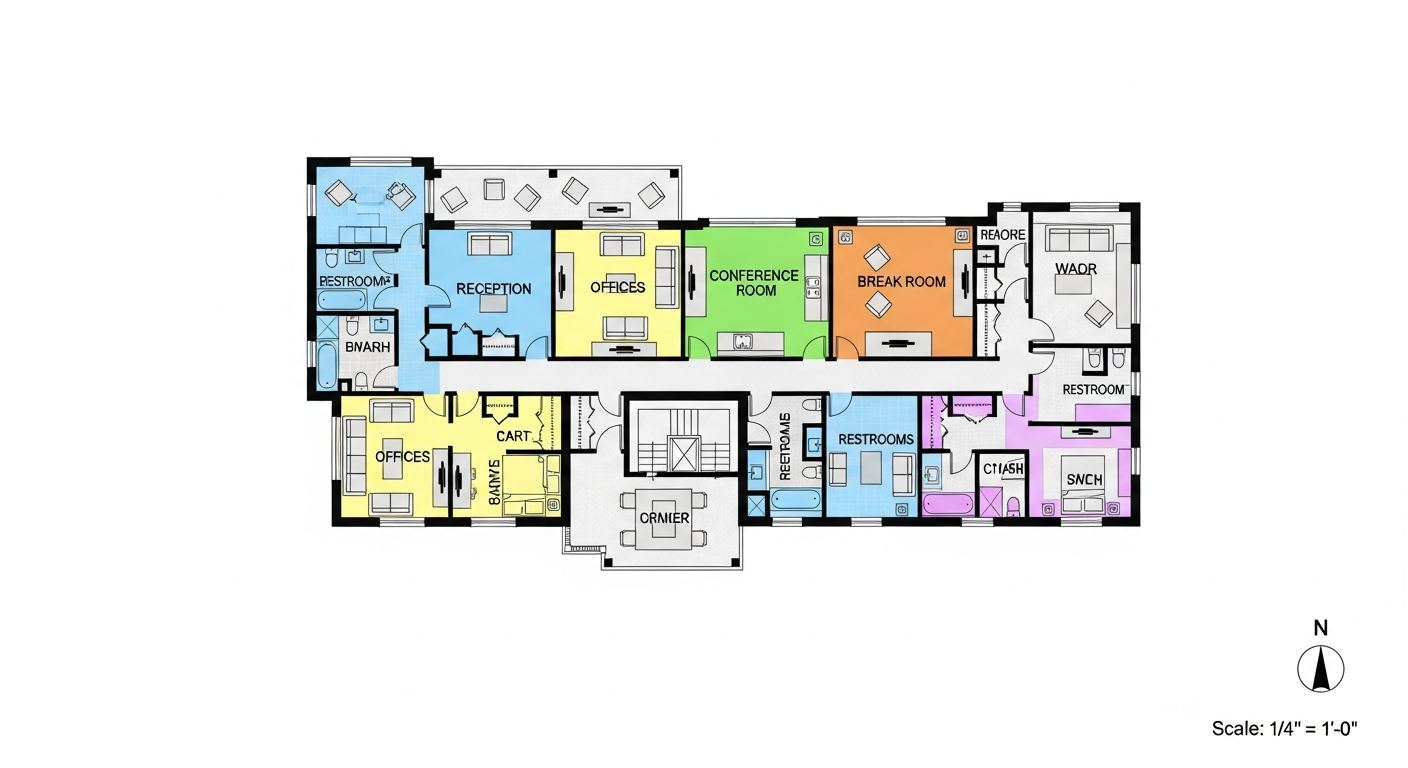
It’s crucial to distinguish between space planning and interior design, though they often work hand in hand. Space planning is fundamentally about functional organization. Determining what goes where and why, based on operational requirements and user behavior patterns. Interior design focuses on aesthetic elements: selecting finishes, furniture styles, lighting schemes, and decorative elements that create the desired visual and emotional experience.
This distinction matters enormously for CRE professionals because space planning decisions directly impact lease negotiations, building modifications, and long-term occupancy costs. Understanding whether a client’s needs require spatial reorganization versus aesthetic updates helps you guide them toward appropriate solutions and realistic budgets.
The evolution of space planning reflects broader changes in work culture and business strategy. Traditional approaches treated office layout as a static, one-time decision—create a plan, build it out, and use it for years without major changes. Today’s space planning has become a dynamic, data-driven discipline that anticipates change and builds in flexibility from the start.
Modern space planning considers growth scenarios, technology evolution, and changing work patterns. It examines space utilization data to understand how different areas actually get used versus how planners intended them to be used. This evidence-based approach enables more informed decisions and helps avoid costly mistakes that become apparent only after occupancy begins.
The connection to workplace strategy and business objectives has never been stronger. Forward-thinking organizations recognize that office space planning isn’t just a facilities management function—it’s a tool for achieving strategic goals. Want to improve cross-departmental collaboration? Space planning can facilitate connections. Need to attract top talent in a competitive market? Space planning can create environments that differentiate your company. Seeking to reduce real estate costs while maintaining productivity? Space planning can optimize utilization and identify opportunities for efficiency.
For CRE professionals, this strategic dimension of space planning creates tremendous opportunities. Clients who initially approach you with basic square footage requirements often have underlying business objectives that thoughtful space planning can address. By understanding these connections, you can elevate conversations beyond price per square foot and position yourself as a strategic advisor who understands how space impacts business performance.
Space planning also serves as both an art and a science. The science involves quantitative analysis—calculating space standards, analyzing circulation factors, measuring utilization rates, and modeling different scenarios with mathematical precision. The art involves qualitative judgment—understanding organizational culture, anticipating user behavior, balancing competing priorities, and creating environments that feel right for specific teams and companies.
This dual nature explains why effective space planning requires both technical expertise and business acumen. CRE professionals who develop skills in both areas can bridge the gap between client aspirations and practical realities, helping translate business objectives into spatial solutions that actually work in practice.
The foundation of effective space planning also encompasses understanding regulatory and code requirements that impact layout decisions. Building codes dictate egress requirements, ADA regulations ensure accessibility, fire safety standards influence space relationships, and HVAC capabilities affect density and layout options. These constraints aren’t obstacles to creativity. Rather they’re parameters that inform smart design decisions and help avoid costly mistakes during implementation.
Understanding these foundational elements positions CRE professionals to engage in meaningful space planning conversations with clients, ask the right questions during needs assessment, and collaborate effectively with design professionals when projects require specialized expertise.
Why Office Space Planning Matters for CRE Professionals
The commercial real estate industry is experiencing a fundamental shift in how space planning impacts business outcomes. For CRE professionals, understanding this evolution is more than staying current with trends. It’s about leveraging a powerful competitive advantage that directly affects deal velocity, client satisfaction, and long-term success.
Deal acceleration represents one of the most immediate business benefits of sophisticated space planning capabilities. Consider the traditional timeline: a prospective tenant expresses interest in a space, you schedule a showing, they like the location and basics, but then comes the inevitable question—“How would our team actually fit here?” Without space planning expertise, the answer becomes, “Let me connect you with an architect who can create some options. We’ll have layouts in a few weeks.”
Those few weeks can kill momentum, allow competitors to capture the client’s attention, or give decision-makers time to develop concerns about the space. In contrast, CRE professionals who can provide immediate spatial visualization and multiple layout scenarios keep deals moving forward. Clients can make informed decisions during or immediately after the initial showing, dramatically shortening the decision cycle.
The financial impact extends beyond individual deals. Research from Harvard Business Review demonstrates that thoughtful office design significantly impacts employee productivity, satisfaction, and retention—metrics that sophisticated corporate real estate teams increasingly consider when evaluating spaces. CRE professionals who can speak credibly about these strategic implications position themselves as trusted advisors rather than transaction facilitators.
Risk mitigation represents another critical advantage. Space planning expertise helps identify potential challenges before they become deal-breaking problems. Does the client’s envisioned layout meet egress requirements? Can the HVAC system support their intended density? Are there sight line issues that could impact departmental dynamics? Identifying these constraints early allows for solution development rather than last-minute surprises that derail negotiations.
The competitive differentiation aspect cannot be overstated in today’s crowded brokerage landscape. Most CRE professionals can show spaces, negotiate terms, and handle transaction logistics competently. However, those who can also help clients visualize possibilities, understand spatial implications, and explore multiple scenarios provide tangible additional value that justifies their involvement and potentially supports premium pricing.
This differentiation becomes especially important when competing for sophisticated corporate clients who work with multiple brokers across different markets. Companies that value strategic real estate decision-making gravitate toward professionals who understand the connection between space design and business outcomes, not just square footage and lease rates.
Client confidence builds substantially when CRE professionals can provide immediate, visual answers to spatial questions. There’s something powerful about being able to pull out a tablet and show multiple layout scenarios in real-time during a property tour. It demonstrates preparedness, expertise, and client focus in ways that verbal descriptions or promises to “figure it out later” cannot match.
This visual capability proves especially valuable when working with decision-making committees that include stakeholders without real estate backgrounds. HR directors, IT managers, and department heads can meaningfully participate in space evaluation when they can see and understand layout implications, rather than trying to interpret architectural drawings or imagine possibilities from empty space.
Portfolio optimization opportunities emerge when landlords and property managers develop space planning expertise. Understanding how different layout approaches affect rentable square footage utilization helps maximize revenue per square foot. Some layout strategies create more rentable area from the same physical space, while others enhance tenant satisfaction and retention despite lower density.
Property managers who can work with tenants to optimize their space utilization often find opportunities for expansion within existing buildings rather than losing tenants to larger spaces elsewhere. This consultative approach strengthens landlord-tenant relationships and provides additional revenue streams through space planning services.
The market positioning advantage extends beyond individual client relationships to broader professional reputation. CRE professionals known for space planning expertise receive referrals from architects, corporate real estate consultants, and other industry professionals who encounter clients needing spatial analysis. This expertise also opens doors to speaking opportunities, thought leadership platforms, and professional recognition that enhances overall market presence.
Modern research from RICS increasingly demonstrates the connection between office layout and organizational performance, giving CRE professionals additional evidence to support space planning recommendations. Clients who initially focus purely on cost considerations often become more receptive to strategic space planning when presented with data about productivity, retention, and culture benefits.
The expertise also proves valuable during market downturns or challenging leasing environments. When traditional incentives reach their limits, the ability to help clients maximize value from their space decisions provides additional negotiating tools and creative solution options that can close deals others cannot.
For property developers, space planning expertise informs better building design decisions that enhance marketability and tenant satisfaction. Understanding how different floor plate sizes, core configurations, and infrastructure capabilities affect space planning possibilities helps create buildings that lease faster and command premium rents.
The compound effect of these advantages creates significant long-term business value for CRE professionals who invest in developing space planning capabilities. Individual deals close faster, client relationships deepen, referral networks expand, and market differentiation strengthens—all contributing to sustainable competitive advantage in an increasingly sophisticated commercial real estate landscape.
The Office Space Planning Process: Key Stages and Stakeholders
Understanding the office space planning process from a CRE professional’s perspective requires recognizing both the systematic methodology that drives successful projects and the complex web of stakeholders who influence decisions at every stage. This knowledge enables you to anticipate client needs, facilitate productive collaboration, and position yourself as a valuable coordinator throughout the process.
The programming phase establishes the foundation for all subsequent decisions and represents a critical opportunity for CRE professionals to demonstrate strategic thinking. This stage goes far beyond simple headcount calculations to examine organizational structure, work patterns, growth projections, and cultural aspirations. Effective programming asks questions like: How do different departments need to interact? What percentage of staff work remotely versus in-office? Are there seasonal fluctuations in space needs? What technology requirements will impact layout decisions?
During programming, smart CRE professionals help clients think through scenarios they might not have considered. A rapidly growing startup might focus on immediate needs without considering how their space requirements could change as they scale from 50 to 200 employees. An established company might assume their current departmental structure will remain static without examining how new business initiatives could affect space relationships.
The programming phase also uncovers constraints and preferences that dramatically impact space selection and layout possibilities. Does the CEO value corner offices with views, or prefer an open, egalitarian environment? Are there regulatory requirements for secure areas or specialized equipment? Will the company need expansion space within the building or the flexibility to sublease if they downsize?
Schematic design translates programming insights into spatial concepts through bubble diagrams, space allocation studies, and preliminary circulation patterns. This stage focuses on big-picture organization rather than detailed layouts—determining which departments should be adjacent, how major traffic flows will work, and where specialized functions should be located.
For CRE professionals, the schematic design phase often reveals whether a particular space will truly work for a client’s needs. A narrow floor plate might not accommodate the open collaboration zones a tech company requires. A building with limited parking might not support the suburban workforce distribution a manufacturing company prefers. Identifying these mismatches early prevents wasted time on spaces that fundamentally don’t fit.
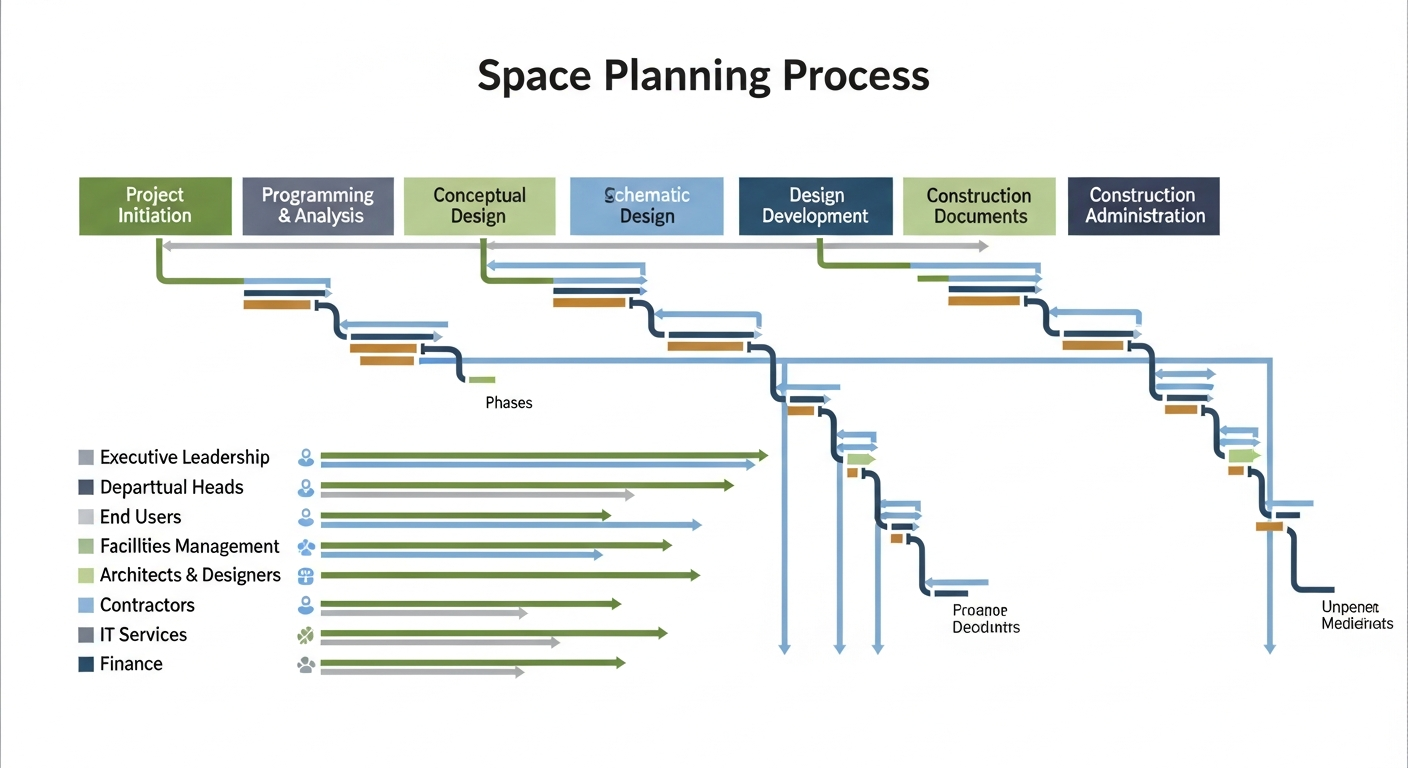
Design development dives into detailed layout decisions, furniture specification, and technology integration planning. This stage determines actual workstation locations, meeting room configurations, storage solutions, and support area layouts. The level of detail increases significantly, with decisions about power and data locations, lighting layouts, and acoustic treatments that affect both construction costs and long-term user satisfaction.
The systematic methodology used by professional space planners provides valuable insights for CRE professionals who want to ask informed questions and guide client thinking. Understanding how professionals balance competing priorities—open collaboration versus focus areas, natural light access versus efficient circulation, brand expression versus cost control—helps you facilitate productive conversations about tradeoffs.
Construction documentation creates implementation-ready drawings and specifications that contractors can bid and build from. This phase requires coordination with building systems, compliance verification, and detailed specification of every element that affects construction costs and timelines. For CRE professionals, understanding this phase helps set appropriate expectations about timeline and budget implications for different design decisions.
The stakeholder ecosystem in office space planning projects reflects the complexity of modern organizational decision-making. Corporate real estate teams typically drive the overall process and make final decisions about space selection and budget allocation. However, their decisions are heavily influenced by input from other stakeholders who bring different perspectives and priorities.
Human resources departments focus on employee experience, culture reinforcement, and talent attraction considerations. They often advocate for amenities, wellness features, and spaces that support the company’s employer brand. HR stakeholders may prioritize elements like natural light access, variety in work settings, and social interaction spaces that don’t show immediate ROI but support long-term retention and recruitment goals.
Information technology teams evaluate infrastructure requirements, technology integration possibilities, and future-proofing considerations. IT stakeholders often drive decisions about conference room equipment, wireless coverage, cable management, and power distribution that significantly impact layout possibilities and construction budgets.
Facilities management professionals bring operational perspectives about maintenance, cleaning, security, and long-term space management requirements. They often identify practical considerations that other stakeholders overlook—like how furniture selections affect cleaning routines or how layout decisions impact HVAC efficiency.
Department heads and team leaders provide insights about work processes, collaboration patterns, and functional requirements specific to their areas. The engineering team might need different acoustic conditions than the sales team. The finance department might require different security considerations than the marketing department.
Architects and design consultants bring technical expertise about space planning principles, building code requirements, and design solutions. However, their involvement varies significantly depending on project complexity and client preferences. Some clients prefer architect-led processes for major build-outs, while others seek more streamlined approaches for simpler projects.
Critical decision points throughout the process create opportunities for CRE professionals to provide valuable guidance and maintain project momentum. Budget approval decisions often require balancing spatial aspirations with financial realities. Understanding typical cost ranges for different space planning approaches helps you guide client expectations and identify potential budget challenges early.
Timeline coordination becomes complex when space planning intersects with lease negotiations, existing lease expirations, and business operational requirements. Clients who need to move by a specific date may need to accept layout compromises to meet their timeline, while those with flexibility can pursue more optimal solutions that require longer implementation periods.
Change management throughout the process tests the flexibility of both space plans and stakeholder relationships. As clients better understand space planning implications, they often want to modify their initial requirements. Building change management expectations into the process prevents scope creep from derailing budgets and timelines.
The most successful CRE professionals learn to facilitate productive stakeholder coordination rather than simply responding to individual requests. This might involve scheduling joint meetings where facilities, IT, and HR can discuss competing priorities together, or helping clients establish decision-making hierarchies that prevent endless revision cycles.
Understanding this complex process positions CRE professionals to add value throughout project lifecycles, not just during initial space selection. Clients often need ongoing guidance about space planning decisions as their projects evolve, creating opportunities for continued engagement and potential additional services.
Critical Considerations in Office Space Planning
Successful office space planning for CRE professionals requires deep understanding of the interconnected factors that drive spatial decisions and impact long-term project success. These considerations extend far beyond basic space allocation to encompass complex technical, operational, and strategic variables that can make or break major real estate investments.
Space efficiency metrics form the quantitative foundation of effective space planning and directly impact the financial success of real estate decisions. The relationship between usable and rentable square footage creates immediate cost implications that CRE professionals must help clients navigate. Usable square footage represents the space actually available for the tenant’s operations, while rentable square footage includes proportional shares of common areas like lobbies, corridors, and mechanical rooms.
Understanding circulation factors helps predict how much of a client’s leased space will actually accommodate productive work. Efficient space plans typically achieve circulation factors between 20-25% of total space, meaning that a well-designed 10,000 square foot office will provide approximately 7,500-8,000 square feet of actual work areas. Poor space planning can push circulation factors above 30%, significantly reducing the value clients receive from their real estate investment.
Space per employee ratios vary dramatically based on work style, industry norms, and company culture. Traditional corporate environments often allocated 200-300 square feet per person, including individual offices and support areas. Modern open office designs frequently target 125-175 square feet per person, while activity-based working environments might optimize around 100-150 square feet per person by assuming not everyone will be in the office simultaneously.
However, these ratios only tell part of the story. The quality of space allocation often matters more than pure efficiency metrics. A 150 square foot allocation that provides access to natural light, variety in work settings, and appropriate acoustic conditions will typically outperform a 200 square foot allocation in a poorly designed environment.
Workflow optimization requires understanding how different organizational functions interact and how space relationships can enhance or hinder productivity. Departmental adjacencies aren’t just about convenience—they’re about enabling the informal interactions that drive innovation, problem-solving, and organizational learning.
Consider a technology company where the product development team needs frequent interaction with both engineering and marketing departments. Placing product development between these groups can facilitate natural collaboration, while isolating them on a different floor could impede the cross-functional communication essential to successful product launches.
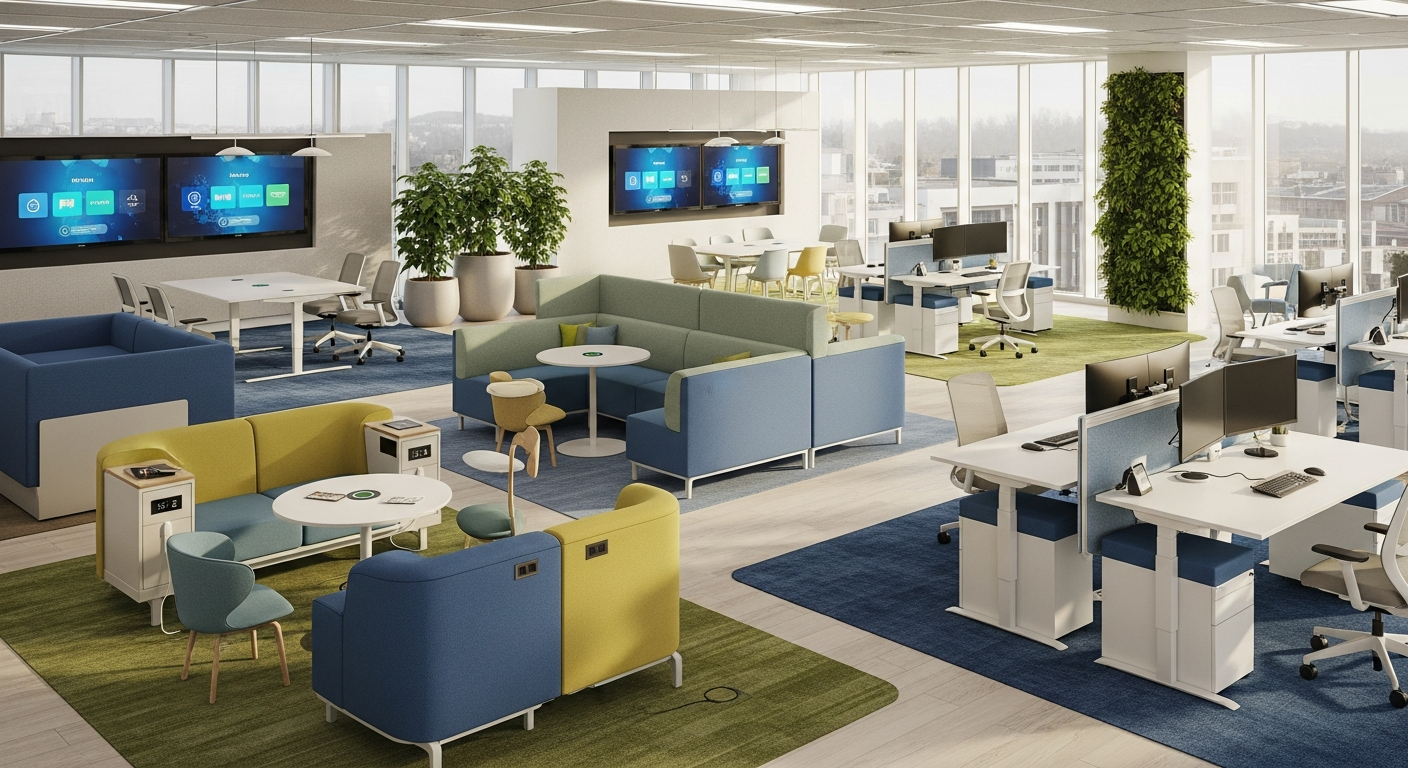
Collaboration zones require careful balance between accessibility and acoustic control. Open collaboration areas encourage spontaneous interaction but can create noise issues for nearby focus work. Enclosed meeting rooms provide acoustic privacy but may feel isolated from the broader team energy. Successful space planning creates a variety of collaboration options that accommodate different types of interactions and team preferences.
Privacy requirements vary significantly across different functions and organizational cultures. Financial services companies often need enclosed offices for confidential client conversations, while creative agencies might thrive in completely open environments. Understanding these cultural and functional differences helps CRE professionals guide clients toward spaces and buildings that support their specific workflow needs.
Technology infrastructure planning has become increasingly critical as workplace technology evolves rapidly. Power distribution affects both layout flexibility and long-term operational costs. Older buildings with limited electrical capacity might require significant infrastructure upgrades to support modern technology densities, while newer buildings designed for technology tenants offer more flexibility.
Data connectivity requirements extend beyond basic internet access to encompass wireless coverage, conference room AV systems, and emerging technologies like IoT sensors that monitor space utilization. The World Economic Forum’s research on future workplace requirements highlights how technology integration increasingly drives space planning decisions rather than simply accommodating them.
Future-proofing considerations help clients avoid costly retrofits as their technology needs evolve. This might involve specifying modular power and data systems that can be reconfigured without major construction, or ensuring that conference rooms can accommodate emerging video collaboration technologies without requiring extensive rewiring.
Building code compliance creates non-negotiable constraints that significantly impact space planning possibilities. Egress requirements determine maximum travel distances to exits, minimum corridor widths, and door swing directions that can limit layout options in buildings with challenging configurations.
ADA accessibility standards affect everything from workstation design to restroom locations to conference room layouts. These requirements aren’t just legal obligations—they’re opportunities to create more inclusive environments that accommodate diverse employee needs and support talent attraction efforts.
Fire safety regulations influence space relationships, particularly around storage areas, server rooms, and kitchens. Understanding these requirements helps prevent layout decisions that require costly modifications during the permitting process.
Ventilation and HVAC considerations often constrain space planning in ways that aren’t immediately obvious. Buildings designed for private office layouts might not provide adequate air circulation for open office densities. Similarly, buildings with perimeter HVAC systems might not effectively cool interior zones when space planning creates high-density collaboration areas away from windows.
Flexibility and growth planning separates short-term space solutions from strategic real estate decisions that accommodate changing business needs. Modular furniture systems enable reconfiguration as teams expand or contract, while fixed architectural elements create long-term constraints that can become costly to modify.
Swing space allocation provides buffer capacity for temporary projects, visiting teams, or short-term growth before major space modifications become necessary. Many successful companies allocate 10-15% of their space as flexible swing space that can accommodate various temporary needs.
Expansion scenarios require coordination with building availability and lease terms. Understanding how a client’s space could grow within a building helps identify properties that offer long-term flexibility versus those that might require relocation as the business scales.
Employee experience considerations increasingly drive space planning decisions as companies compete for talent in challenging labor markets. Natural light access affects both productivity and well-being, making window allocation a critical space planning consideration that goes beyond traditional hierarchy-based office assignment.
Acoustic design impacts both individual productivity and overall workplace satisfaction. Open office environments require careful attention to sound masking, material selection, and space zoning to prevent noise issues that can undermine the collaborative benefits of open layouts.
Wellness features like fitness facilities, meditation rooms, and outdoor access increasingly influence space planning decisions and tenant attraction. Companies view these amenities as investments in employee health and productivity rather than optional perks.
Brand expression through space design helps companies reinforce their culture and values while attracting talent that aligns with their organizational identity. This might involve incorporating company colors and logos, but more often involves creating environments that reflect company values like innovation, collaboration, or environmental responsibility.
Understanding these multifaceted considerations enables CRE professionals to guide sophisticated conversations about space planning tradeoffs and help clients make informed decisions that align with their operational needs, financial constraints, and strategic objectives.
Challenges of Traditional Space Planning Methods
The limitations of conventional space planning approaches create significant friction in commercial real estate transactions and tenant satisfaction, presenting both challenges and opportunities for CRE professionals who understand these pain points and can offer alternative solutions.
Time constraints represent the most immediate and visible challenge in traditional space planning workflows. The conventional process requires specialized architects or space planners to manually create layouts using CAD software, a process that typically takes weeks even for relatively straightforward projects. This timeline begins with initial client meetings to understand requirements, progresses through multiple design iterations based on feedback, and concludes with final documentation that clients can actually understand and approve.
For CRE professionals, these extended timelines create multiple problems. Enthusiastic clients can lose momentum during weeks-long waiting periods, especially when competing opportunities capture their attention. Decision-making committees may change composition or priorities during extended design processes, requiring substantial rework when new stakeholders introduce different requirements. Market conditions can shift during lengthy space planning phases, affecting lease negotiations or availability of preferred properties.
The time challenge becomes especially acute in competitive leasing situations where multiple tenants are evaluating the same space. The client who can visualize their layout possibilities immediately has a significant advantage over those waiting weeks for architectural drawings. This speed difference often determines which tenant secures preferred spaces in tight markets.
Limited scenario evaluation emerges from the manual effort required to create each layout option. Traditional space planning typically produces only one or two layout alternatives due to the time and cost involved in creating additional options. This constraint forces clients to make major spatial decisions based on limited information, potentially missing creative solutions that could better serve their needs.
The limitation becomes particularly problematic when clients want to explore fundamentally different approaches to space organization. Should they prioritize private offices or open collaboration areas? Would a centralized conference room cluster work better than distributed meeting spaces? How would different growth scenarios affect their layout decisions? Traditional methods make it prohibitively expensive to explore these alternatives comprehensively.
The lack of scenario comparison also prevents evidence-based decision making. Clients often settle for the first reasonable layout they see rather than evaluating multiple options to understand tradeoffs between different spatial strategies. This can lead to suboptimal long-term outcomes that become apparent only after occupancy begins.
Static visualization problems stem from the traditional reliance on 2D floor plans and section drawings that require significant spatial reasoning skills to understand. Many business decision-makers lack the architectural training needed to translate technical drawings into mental models of actual spatial experiences. A conference room might look adequately sized on a floor plan but feel cramped when furnished and occupied by its intended number of people.
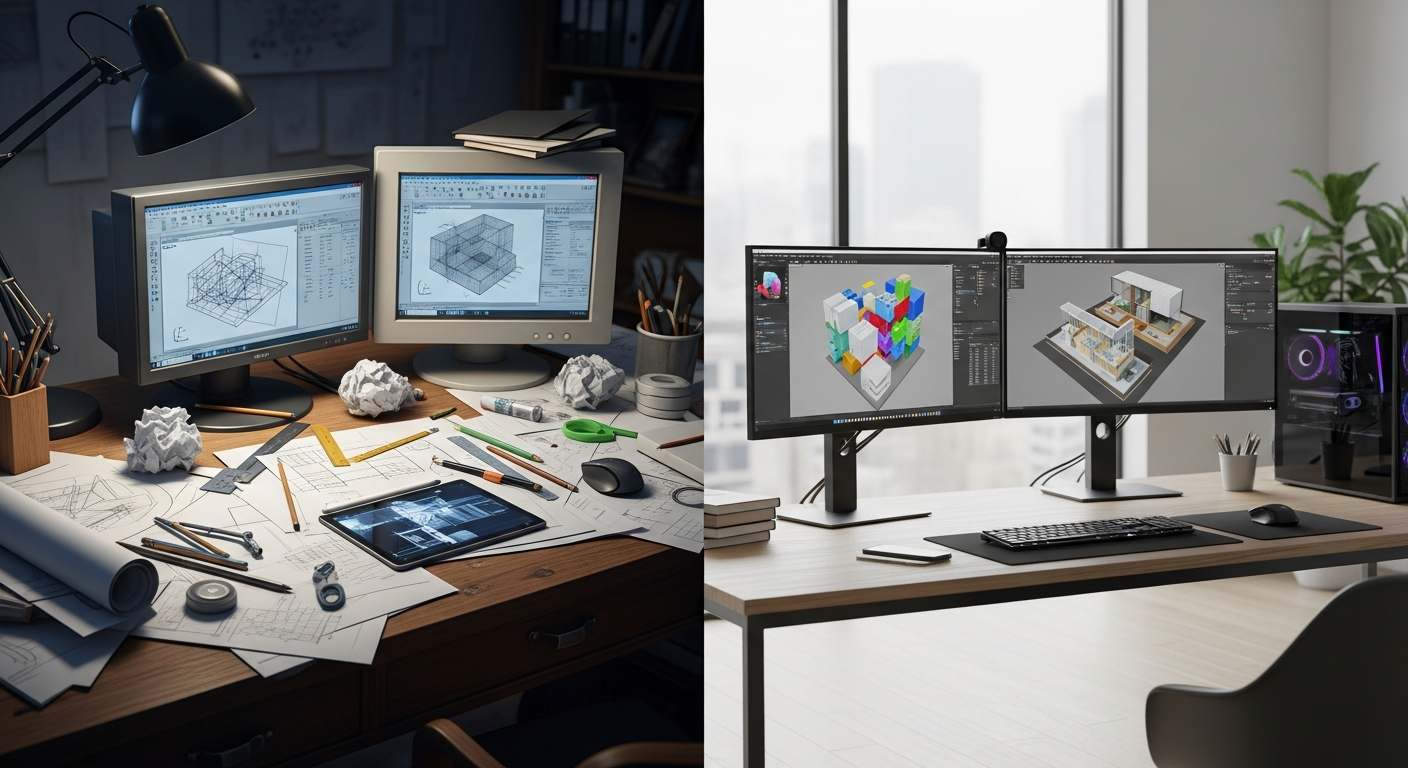
The visualization challenge becomes especially problematic when communicating with diverse stakeholder groups that include HR directors, department heads, and senior executives without design backgrounds. These stakeholders often struggle to provide meaningful feedback on layouts they can’t fully visualize, leading to approval of plans that don’t meet actual user needs.
Static visualizations also fail to communicate important spatial qualities like natural light penetration, sight lines between departments, or the feeling of openness versus enclosure that significantly impacts user experience. Clients may approve layouts that look good on paper but create unexpected problems in practice.
Revision complexity creates cascading delays and cost increases when clients want to modify layouts after initial design work is complete. Traditional CAD-based workflows require manual rework of drawings, coordination of related building systems, and verification of code compliance for each change. Simple modifications like moving a conference room or adjusting the open office area can trigger hours or days of additional design work.
The revision challenge discourages iterative design processes that typically lead to better outcomes. Clients may accept suboptimal layouts to avoid the time and cost associated with changes, or they may request multiple simultaneous modifications that create coordination challenges for design professionals.
Revision complexity also makes it difficult to respond to changing circumstances during extended project timelines. If a client’s headcount projections change or they decide to reorganize their departmental structure, incorporating these updates into traditional space planning workflows often requires starting over with significant portions of the design work.
Expertise bottlenecks occur when space planning projects depend on specialized architects or designers whose availability limits project scheduling and increases costs. Most CRE professionals don’t have in-house space planning capabilities, requiring them to coordinate with external consultants whose schedules may not align with client timelines or budget constraints.
The expertise bottleneck becomes particularly challenging for smaller projects that don’t justify full architectural services but still require professional space planning analysis. A 5,000 square foot office renovation might not warrant a comprehensive architectural engagement, but it still needs thoughtful layout development that considers workflow, building codes, and user experience.
Limited access to space planning expertise also prevents CRE professionals from exploring spatial possibilities during initial property tours. Without the ability to quickly visualize layout options, brokers must rely on verbal descriptions or promises to “figure it out later” that may not address client concerns about whether their team will actually fit comfortably in a given space.
Communication barriers between design professionals and business stakeholders often result in layouts that meet technical requirements but miss important user needs or organizational preferences. Architects may focus on spatial efficiency and code compliance while overlooking workflow patterns or cultural factors that affect how spaces actually get used.
The communication challenge extends to translating business requirements into design parameters. When a client says they need “collaborative space,” do they mean large open areas for department-wide meetings, small team rooms for project work, or informal social spaces for casual interaction? Traditional space planning processes often don’t include sufficient dialogue to clarify these distinctions, leading to spaces that don’t support intended activities.
Technical drawings and architectural terminology create additional communication barriers that prevent meaningful stakeholder participation in design decisions. Business leaders may defer to design professionals rather than advocating for their actual needs, resulting in spaces that look professionally designed but don’t function optimally for their intended users.
These cumulative challenges create opportunities for CRE professionals who can offer alternative approaches that address traditional space planning limitations while maintaining the quality and professionalism that clients expect. Understanding these pain points positions you to recognize when clients might benefit from modern space planning solutions and articulate the value proposition of technology-enabled alternatives.
The Modern Approach: Technology-Driven Office Space Planning
The emergence of automated architectural services and AI-driven space planning technologies has fundamentally transformed what’s possible in commercial real estate, creating new opportunities for CRE professionals to deliver superior client experiences while accelerating deal closure and enhancing competitive positioning.
Automated layout generation represents the most dramatic advancement in space planning technology, enabling the creation of multiple, professionally designed layout scenarios in minutes rather than weeks. Advanced algorithms analyze space requirements, workflow patterns, building constraints, and design principles to generate layouts that would traditionally require hours of manual effort from experienced architects.
This automation doesn’t replace professional design expertise—it amplifies it by handling routine calculations and spatial arrangements while freeing professionals to focus on strategic considerations and client collaboration. A CRE professional can now explore dozens of layout scenarios during initial client meetings, testing different departmental arrangements, density levels, and space allocation strategies in real-time.
The speed advantage transforms client interactions from theoretical discussions about possibilities to concrete evaluation of actual spatial solutions. Instead of asking clients to imagine how their team might fit in a space, you can show them multiple viable options immediately, complete with accurate square footage calculations and circulation analysis.
3D visualization capabilities eliminate the communication barriers inherent in traditional 2D drawings by providing immersive, photorealistic representations of proposed layouts. Clients can virtually walk through their future office, understanding sight lines, spatial relationships, and the actual feel of different areas before making major real estate commitments.
The visualization advantage proves especially valuable when working with diverse stakeholder groups that include both design-savvy professionals and business leaders without architectural backgrounds. A virtual tour eliminates uncertainty about how spaces will actually function and enables meaningful feedback from all stakeholders regardless of their spatial reasoning abilities.
Modern 3D visualization also incorporates lighting analysis, showing how natural light will penetrate different areas throughout the day and across seasons. This capability helps clients understand which spaces will feel bright and energizing versus those that might require additional artificial lighting or careful design attention.
Real-time iteration enables collaborative design sessions where clients can request modifications and see results immediately rather than waiting days or weeks for revised drawings. Want to see how the layout would work with a larger conference room? The change can be implemented and visualized instantly. Curious about the impact of moving the kitchen to a different location? Multiple options can be generated and compared within minutes.
This iterative capability fundamentally changes the client experience from passive review of predetermined options to active participation in design development. Clients can explore their preferences, test different scenarios, and understand tradeoffs between competing priorities without the time and cost penalties traditionally associated with design changes.
Real-time iteration also enables rapid response to changing circumstances. If a client’s headcount projections change during lease negotiations, or if building constraints emerge during due diligence, layouts can be updated immediately to reflect new requirements.
Data-driven optimization leverages space utilization analytics and evidence-based design principles to recommend layouts that maximize both efficiency and user satisfaction. Advanced systems analyze workspace utilization patterns from similar organizations to predict how different layout strategies will perform in practice.
This analytical capability helps clients make informed decisions about space allocation ratios, meeting room quantities, and collaboration area sizing based on actual usage data rather than assumptions or industry rules of thumb. The result is spaces that better match real user behavior and deliver superior return on real estate investment.
Data-driven optimization also identifies opportunities for space efficiency improvements that might not be obvious from visual inspection alone. Subtle adjustments to circulation patterns or workspace clustering can often yield additional usable space without compromising functionality or user experience.

Enhanced accessibility for non-design professionals democratizes space planning participation by providing intuitive interfaces that enable meaningful contribution without requiring architectural expertise. Business stakeholders can evaluate layouts, request modifications, and provide feedback using familiar tools rather than struggling to interpret technical drawings.
This accessibility advantage enables more inclusive decision-making processes where HR directors, department heads, and senior executives can participate meaningfully in space planning discussions. The result is layouts that better reflect actual user needs and organizational priorities rather than designer assumptions.
Accessibility also extends to ongoing space management after initial occupancy. Organizations can use the same tools to evaluate space modifications, plan for growth, or optimize utilization as their needs evolve over time.
Scalability benefits enable CRE professionals to evaluate more properties and scenarios without proportional increases in time or cost. Instead of limiting analysis to the most promising options due to traditional space planning constraints, you can now provide comprehensive spatial analysis for multiple properties, enabling better informed location decisions.
This scalability proves especially valuable for clients evaluating multiple markets or building types. A company considering both urban high-rise and suburban campus options can see detailed layout scenarios for each alternative, understanding how their space requirements would translate to different building configurations.
Scalability also supports portfolio-level analysis for organizations with multiple locations. Space planning scenarios can be developed for consistent workplace standards across different buildings while accommodating local constraints and opportunities.
qbiq’s approach to automated architectural services exemplifies how modern technology transforms space planning from a time-intensive, expert-dependent process into an accessible, rapid, collaborative activity that enhances rather than replaces professional expertise. The platform enables CRE professionals to provide immediate spatial analysis during property tours, explore multiple scenarios collaboratively with clients, and deliver comprehensive space planning services without requiring extensive design training or external consultant coordination.
The technology advancement enables new service delivery models where CRE professionals can offer space planning as an integrated part of their standard service offering rather than an additional cost requiring external coordination. This integration creates competitive advantages while providing additional revenue opportunities and stronger client relationships.
Quality consistency improves when automated systems apply professional design principles systematically rather than depending on individual designer expertise and experience levels. Every layout benefits from comprehensive analysis of circulation requirements, code compliance, and spatial efficiency regardless of project size or budget constraints.
This consistency particularly benefits smaller projects that traditionally received less design attention due to economic constraints. A 3,000 square foot office renovation can now receive the same level of analytical rigor as a major corporate headquarters project.
The technology evolution represents a fundamental shift in space planning accessibility and capability that creates new opportunities for CRE professionals who embrace these tools while maintaining the human expertise and client relationship skills that remain essential to successful real estate practice.
Bringing It All Together: The Future of Space Planning in CRE
As we’ve explored throughout this comprehensive guide, office space planning has transformed from a peripheral design consideration into a central business function that directly impacts commercial real estate success. The evolution from weeks-long manual processes to real-time, technology-enabled collaboration represents more than just operational efficiency—it’s a fundamental shift in how CRE professionals can serve clients, differentiate their services, and drive superior business outcomes.
The convergence of automated design technology, 3D visualization, and data-driven optimization has created unprecedented opportunities for CRE professionals to add value throughout the client engagement process. Instead of outsourcing space planning to external consultants and waiting weeks for results, forward-thinking professionals can now provide immediate spatial analysis during property tours, facilitate collaborative design sessions that engage diverse stakeholder groups, and iterate through multiple scenarios to identify optimal solutions.

This technological advancement democratizes space planning expertise without diminishing the importance of professional judgment, market knowledge, and client relationship skills that distinguish successful CRE professionals. Technology amplifies human capabilities rather than replacing them, enabling professionals to focus on strategic consultation while automating routine spatial analysis and layout generation.
The business impact extends across multiple dimensions of CRE practice. Deal velocity accelerates when clients can visualize space possibilities immediately rather than waiting for external design services. Client satisfaction improves when stakeholders can participate meaningfully in spatial decisions regardless of their design background. Competitive positioning strengthens when you can provide comprehensive space planning services that competitors treat as separate, time-intensive engagements.
Perhaps most importantly, space planning expertise positions CRE professionals as strategic advisors who understand the connection between real estate decisions and business outcomes. Clients increasingly recognize that office space planning affects productivity, culture, talent attraction, and operational efficiency—factors that extend far beyond simple cost per square foot calculations.
The integration of space planning capabilities into standard CRE service delivery creates new revenue opportunities while strengthening client relationships through enhanced value delivery. Instead of focusing purely on transaction facilitation, professionals can guide comprehensive workplace strategy development that positions them as essential partners in their clients’ business success.
Looking ahead, the space planning landscape will continue evolving as hybrid work patterns stabilize, sustainability requirements intensify, and new technologies emerge. CRE professionals who develop space planning expertise now will be positioned to adapt to these changes while maintaining competitive advantages built on superior client service and strategic consultation capabilities.
The transformation from traditional, expert-dependent space planning to accessible, technology-enabled collaboration represents a rare opportunity to fundamentally enhance service delivery while reducing operational complexity. The question for CRE professionals isn’t whether space planning technology will reshape the industry—it’s whether you’ll lead this transformation or struggle to catch up as competitors gain advantages through early adoption.
Ready to transform your office space planning approach? Discover how qbiq’s automated architectural services can help you evaluate more scenarios, accelerate client decision-making, and win more deals. Experience the difference that AI-driven space planning makes for CRE professionals and their clients. Because in today’s competitive landscape, the ability to show instead of just tell can make all the difference in converting prospects into satisfied, long-term clients.
The future of commercial real estate belongs to professionals who can bridge the gap between spatial possibilities and business realities. With modern space planning technology, that future is available today for those ready to embrace it.





.png)


